Why Is My Electricity Bill So High? What Actually Goes Into the Price of Power

You opened your electricity bill, saw the total, and felt that familiar frustration. Whether it's a winter spike you didn't see coming or a slow creep that's been building for months, electricity costs have a way of feeling opaque — a number that arrives every month with very little explanation attached.
This guide breaks down what you're actually paying for, line by line, and explains why electricity in New England costs significantly more than in most of the country.
Your Bill Is Not One Charge — It's Several
The most important thing to understand about your electricity bill is that it isn't simply a charge for the electricity you consumed. It's a stack of separate costs bundled into a single statement, and each one reflects a different part of the system that gets electricity from a power plant to your outlet.
Most residential and commercial bills include some version of the following: an energy or supply charge, a delivery or distribution charge, a transmission charge, and a collection of taxes and fees. Many commercial accounts also carry a demand charge. Each of these is determined differently, moves independently, and responds to different factors. When your bill goes up, it matters which of these actually changed — because the levers available to you depend entirely on which component is driving the increase.
The Energy Charge: What You Actually Consumed
The energy charge — sometimes called the supply charge or generation charge — is the most intuitive part of your bill. It's the cost of the electricity itself: the kilowatt-hours (kWh) you consumed during the billing period, multiplied by the rate you pay per kWh.
A kilowatt-hour is a straightforward unit. One kilowatt-hour is the amount of energy used by a 1,000-watt device running for one hour. Your air conditioner, electric water heater, and dryer are the biggest movers of this number. Lighting and phone chargers barely register.
This is the part of your bill most directly within your control. Use less electricity, and this charge goes down. It's also the component that varies most with the seasons — summer air conditioning and winter electric heating both drive consumption up, which is why bills tend to peak in the hottest and coldest months.
In deregulated energy markets — which includes Rhode Island — you have the option to shop for a competitive electricity supplier for this portion of your bill. Your utility still delivers the power; you're choosing who generates it. Whether that saves you money depends on timing and contract terms, but the option exists.
Some rate plans also use time-of-use pricing, which charges different rates depending on when you consume electricity. Power used during peak demand hours — typically weekday afternoons and early evenings — costs more than power used overnight or on weekends. If you're on a time-of-use plan, shifting when you run high-draw appliances can meaningfully reduce your supply charge.
Delivery and Distribution: The Cost of Getting It to You
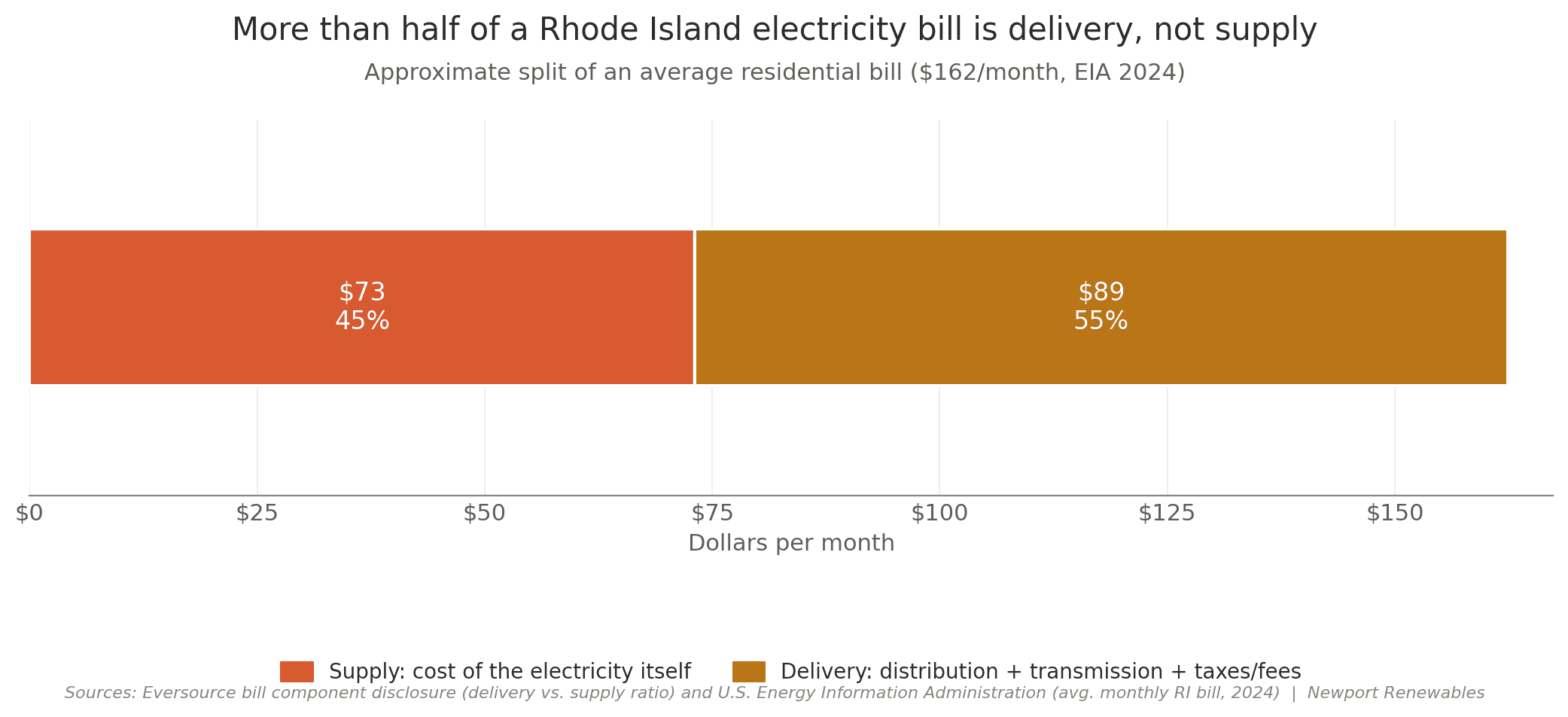
This is the section of your bill that surprises people most when they look closely. On average, the delivery charge makes up about 55% of a residential electricity bill, with supply costs making up the remaining 45%. More than half of what you pay has nothing to do with how much electricity you used — it's the cost of the infrastructure that brought it to you.
Eversource, one of New England's largest utilities, describes it plainly: delivery is the entire system that brings electricity to your home, not just the act of transporting it. It includes maintenance of and investment in power lines, substations, and all the infrastructure needed to keep service reliable. Every pole, every transformer, every underground cable, every crew that responds to an outage — that's what the delivery charge funds.
This portion of your bill is largely fixed. You pay it whether you use a lot of electricity or a little, because the infrastructure exists and has to be maintained regardless of your consumption level. There's a fixed monthly customer charge — a flat fee just for being connected to the grid — and then per-kWh delivery charges on top of that.
You cannot choose a different delivery provider. Your utility is your utility, assigned by your location, and regulated by the state public utilities commission. Rates are set through formal proceedings, not by market competition.
Transmission Charges, Taxes, and Fees
Transmission is a subset of delivery that covers the high-voltage infrastructure moving electricity from power plants to the local distribution network — the large towers and long-distance lines that cross state lines and connect the regional grid. These charges are federally regulated by the Federal Energy Regulatory Commission (FERC) and can increase when new transmission lines are built or existing ones are upgraded.
Taxes and fees round out the remaining line items. These typically include state and local taxes, public purpose program charges — which fund things like low-income assistance programs, energy efficiency incentives, and renewable energy development — and various regulatory fees. None of these are negotiable. They're set by state and federal policy and applied uniformly.
Together, transmission charges, taxes, and fees are the least visible and least controllable part of your bill. They're worth understanding not because you can reduce them, but because they're often mistaken for utility profits. In most cases they're not — they're pass-through costs that the utility collects and remits to governments, grid operators, and third-party program administrators.
Demand Charges: The One That Catches People Off Guard
Most residential customers don't see demand charges on their bills. But many commercial customers, and some larger residential accounts, do — and it's frequently the most misunderstood line item on the statement.
A demand charge is not based on how much electricity you consumed over the month. It's based on your peak rate of consumption during the billing period — typically measured as your highest 15- or 30-minute average draw, in kilowatts. Think of it as the grid asking: at your most power-hungry moment this month, how much capacity did you require?
Utilities use demand charges because the grid has to be built to handle peak loads. If your facility briefly draws 200 kilowatts at 2pm on a Tuesday, the infrastructure serving you has to be capable of delivering 200 kilowatts — regardless of whether you draw that much for one minute or one hour. Building and maintaining that capacity costs money, and demand charges are how utilities recover it.
The practical implication: a single spike — a moment when heavy equipment, HVAC systems, and lighting all run simultaneously — can set your demand charge for the entire month. Reducing your demand charge means managing when high-draw equipment runs, not just how much total electricity you use.
Why New England Pays More Than Almost Anywhere Else in the Country
If your bill feels high, you're not imagining it. New England residents and businesses pay some of the highest electricity rates in the continental United States — and Rhode Island sits near the top of that list.
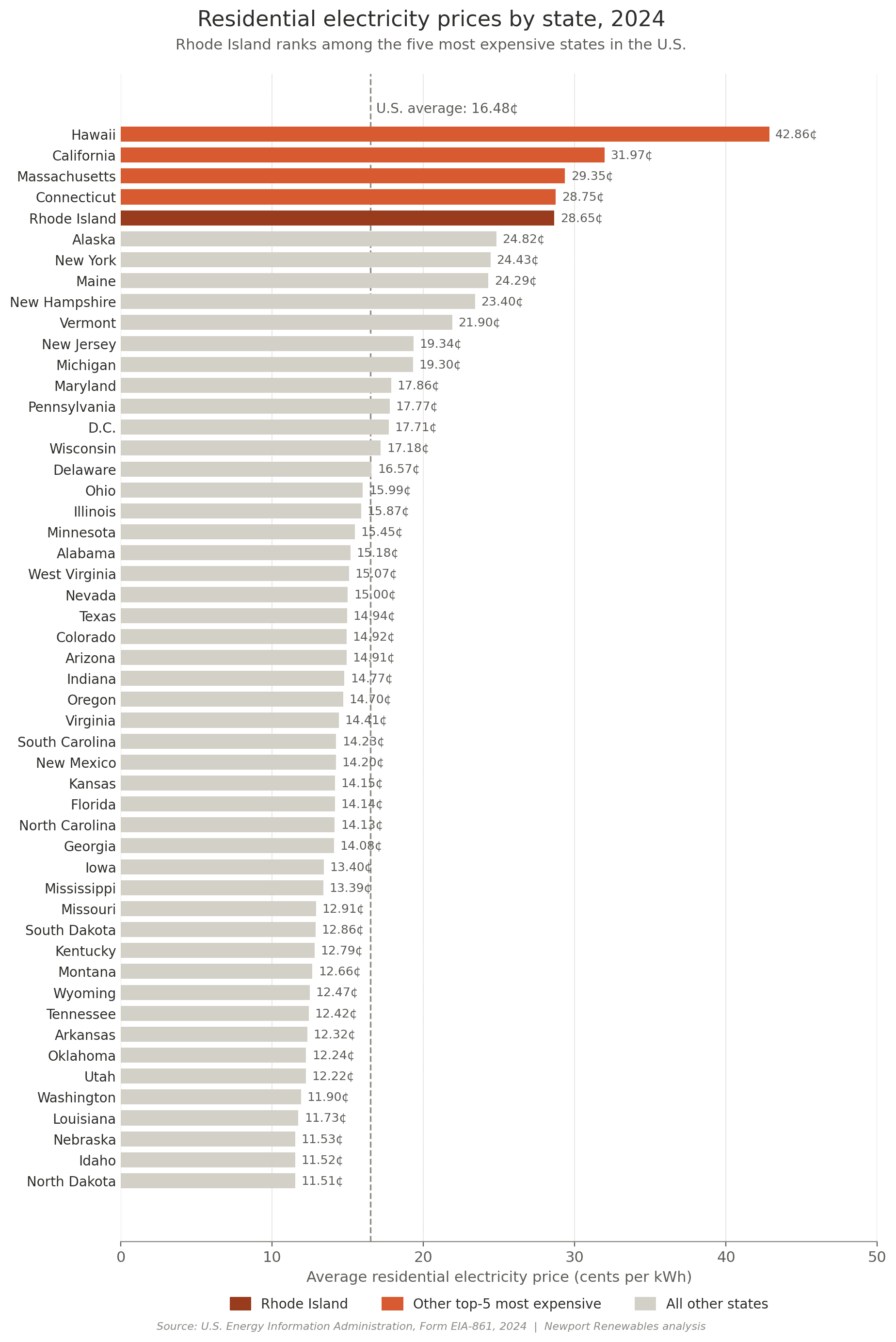
According to the most recent EIA-sourced pricing data, Rhode Island residential customers paid an average of 28.65 cents per kWh in 2024, with average monthly bills of $162.40. Massachusetts and Connecticut are in the same range. As a region, the Northeast pays about 42% more than the national average, with Rhode Island and Massachusetts ranking among the five most expensive states in the country.
The primary reason is natural gas.
Natural gas accounts for about 38% of electricity generation nationally. In New England, it's closer to 53%. In Rhode Island specifically, the number is even more stark: in 2023, natural gas fueled 87% of Rhode Island's total in-state electricity generation — the second-highest share of any state in the country after Delaware. When natural gas prices rise, Rhode Island electricity prices follow almost immediately.
The problem is compounded by geography. New England sits at the end of the national pipeline system and has no fossil fuel reserves of its own. As the Acadia Center's Ben Butterworth has put it, there is a hard physical constraint on how much gas can be delivered to the region through the pipeline system — and when demand rises, prices rise with it. Rhode Island's situation is particularly acute: the state is served by a single pipeline, the Algonquin Gas Pipeline, and sits at the end of it. There is no underground natural gas storage in the state. When cold weather spikes demand and pipeline capacity tightens, Rhode Island has very limited buffer.
Rhode Island Energy, which supplies electricity to most of the state, does not profit on supply rates. The costs are passed through directly to customers at whatever price the utility paid in the wholesale market. That means global events — the war in Ukraine, surging international demand for liquefied natural gas, cold snaps that strain pipeline capacity — translate directly and quickly into higher bills for Rhode Island customers. Winter rates are structurally higher than summer rates for this reason: natural gas transportation costs rise with demand during the coldest months, and the pipeline constraints that shape that market are a persistent feature, not an anomaly.
Conclusion
Your electricity bill is the sum of a lot of moving parts: what electricity costs to generate, what it costs to deliver, what regulators require utilities to fund, and what the regional fuel market is doing at any given moment. Most of those parts are outside your control. The energy charge — how much you consume and when — is the one area where your behavior has a direct effect.
Understanding the breakdown doesn't make the bill smaller, but it does change what you can do about it. If your energy charge is the problem, the answer is conservation, efficiency, or changing when you use power. If your delivery charge is climbing, that's a regulatory and infrastructure story, and the lever there is policy. If you're in Rhode Island and your bill spikes every January, you now know exactly why.
For commercial property owners in Rhode Island looking to reduce the energy charge portion of their bill: Newport Renewables installs commercial solar. Contact us here to get started exploring energy saving systems for your business: https://nptre.com/contact
Let's Chat
Start your next project with Newport Renewables.
OUR SERVICES
Work with Newport Renewables
We do two things, and we do them at full scale: commercial solar across Rhode Island and ground-up custom homes built to perform. Here's where you fit.
Commercial solar for your property or business?
We design and install solar for commercial buildings, warehouses, and income properties across Rhode Island — sized to your actual load, your roof or land, and the incentives available right now. The goal isn't just panels on a roof; it's a system that pays for itself and keeps producing for decades.
→ See how commercial solar works
Building a new custom home?
We design and build custom homes with integrated zero-energy systems from the ground up. When every component — orientation, envelope, electrical capacity, HVAC, solar, storage — is planned together instead of bolted on later, you get a home that's built for long-term performance and value.
→ Learn about our zero-energy home builds
316 Columbia St • Wakefield, RI 02879 | 401.619.5906




Copyright © 2024 Newport Renewables. All Rights Reserved.
316 Columbia St • Wakefield, RI 02879 | 401.619.5906
Copyright © 2024 Newport Renewables. All Rights Reserved.
Why Is My Electricity Bill So High? What Actually Goes Into the Price of Power
You opened your electricity bill, saw the total, and felt that familiar frustration. Whether it's a winter spike you didn't see coming or a slow creep that's been building for months, electricity costs have a way of feeling opaque — a number that arrives every month with very little explanation attached.
This guide breaks down what you're actually paying for, line by line, and explains why electricity in New England costs significantly more than in most of the country.
Your Bill Is Not One Charge — It's Several
The most important thing to understand about your electricity bill is that it isn't simply a charge for the electricity you consumed. It's a stack of separate costs bundled into a single statement, and each one reflects a different part of the system that gets electricity from a power plant to your outlet.
Most residential and commercial bills include some version of the following: an energy or supply charge, a delivery or distribution charge, a transmission charge, and a collection of taxes and fees. Many commercial accounts also carry a demand charge. Each of these is determined differently, moves independently, and responds to different factors. When your bill goes up, it matters which of these actually changed — because the levers available to you depend entirely on which component is driving the increase.
The Energy Charge: What You Actually Consumed
The energy charge — sometimes called the supply charge or generation charge — is the most intuitive part of your bill. It's the cost of the electricity itself: the kilowatt-hours (kWh) you consumed during the billing period, multiplied by the rate you pay per kWh.
A kilowatt-hour is a straightforward unit. One kilowatt-hour is the amount of energy used by a 1,000-watt device running for one hour. Your air conditioner, electric water heater, and dryer are the biggest movers of this number. Lighting and phone chargers barely register.
This is the part of your bill most directly within your control. Use less electricity, and this charge goes down. It's also the component that varies most with the seasons — summer air conditioning and winter electric heating both drive consumption up, which is why bills tend to peak in the hottest and coldest months.
In deregulated energy markets — which includes Rhode Island — you have the option to shop for a competitive electricity supplier for this portion of your bill. Your utility still delivers the power; you're choosing who generates it. Whether that saves you money depends on timing and contract terms, but the option exists.
Some rate plans also use time-of-use pricing, which charges different rates depending on when you consume electricity. Power used during peak demand hours — typically weekday afternoons and early evenings — costs more than power used overnight or on weekends. If you're on a time-of-use plan, shifting when you run high-draw appliances can meaningfully reduce your supply charge.
Delivery and Distribution: The Cost of Getting It to You
This is the section of your bill that surprises people most when they look closely. On average, the delivery charge makes up about 55% of a residential electricity bill, with supply costs making up the remaining 45%. More than half of what you pay has nothing to do with how much electricity you used — it's the cost of the infrastructure that brought it to you.
Eversource, one of New England's largest utilities, describes it plainly: delivery is the entire system that brings electricity to your home, not just the act of transporting it. It includes maintenance of and investment in power lines, substations, and all the infrastructure needed to keep service reliable. Every pole, every transformer, every underground cable, every crew that responds to an outage — that's what the delivery charge funds.
This portion of your bill is largely fixed. You pay it whether you use a lot of electricity or a little, because the infrastructure exists and has to be maintained regardless of your consumption level. There's a fixed monthly customer charge — a flat fee just for being connected to the grid — and then per-kWh delivery charges on top of that.
You cannot choose a different delivery provider. Your utility is your utility, assigned by your location, and regulated by the state public utilities commission. Rates are set through formal proceedings, not by market competition.
Transmission Charges, Taxes, and Fees
Transmission is a subset of delivery that covers the high-voltage infrastructure moving electricity from power plants to the local distribution network — the large towers and long-distance lines that cross state lines and connect the regional grid. These charges are federally regulated by the Federal Energy Regulatory Commission (FERC) and can increase when new transmission lines are built or existing ones are upgraded.
Taxes and fees round out the remaining line items. These typically include state and local taxes, public purpose program charges — which fund things like low-income assistance programs, energy efficiency incentives, and renewable energy development — and various regulatory fees. None of these are negotiable. They're set by state and federal policy and applied uniformly.
Together, transmission charges, taxes, and fees are the least visible and least controllable part of your bill. They're worth understanding not because you can reduce them, but because they're often mistaken for utility profits. In most cases they're not — they're pass-through costs that the utility collects and remits to governments, grid operators, and third-party program administrators.
Demand Charges: The One That Catches People Off Guard
Most residential customers don't see demand charges on their bills. But many commercial customers, and some larger residential accounts, do — and it's frequently the most misunderstood line item on the statement.
A demand charge is not based on how much electricity you consumed over the month. It's based on your peak rate of consumption during the billing period — typically measured as your highest 15- or 30-minute average draw, in kilowatts. Think of it as the grid asking: at your most power-hungry moment this month, how much capacity did you require?
Utilities use demand charges because the grid has to be built to handle peak loads. If your facility briefly draws 200 kilowatts at 2pm on a Tuesday, the infrastructure serving you has to be capable of delivering 200 kilowatts — regardless of whether you draw that much for one minute or one hour. Building and maintaining that capacity costs money, and demand charges are how utilities recover it.
The practical implication: a single spike — a moment when heavy equipment, HVAC systems, and lighting all run simultaneously — can set your demand charge for the entire month. Reducing your demand charge means managing when high-draw equipment runs, not just how much total electricity you use.
Why New England Pays More Than Almost Anywhere Else in the Country
If your bill feels high, you're not imagining it. New England residents and businesses pay some of the highest electricity rates in the continental United States — and Rhode Island sits near the top of that list.
According to the most recent EIA-sourced pricing data, Rhode Island residential customers paid an average of 28.65 cents per kWh in 2024, with average monthly bills of $162.40. Massachusetts and Connecticut are in the same range. As a region, the Northeast pays about 42% more than the national average, with Rhode Island and Massachusetts ranking among the five most expensive states in the country.
The primary reason is natural gas.
Natural gas accounts for about 38% of electricity generation nationally. In New England, it's closer to 53%. In Rhode Island specifically, the number is even more stark: in 2023, natural gas fueled 87% of Rhode Island's total in-state electricity generation — the second-highest share of any state in the country after Delaware. When natural gas prices rise, Rhode Island electricity prices follow almost immediately.
The problem is compounded by geography. New England sits at the end of the national pipeline system and has no fossil fuel reserves of its own. As the Acadia Center's Ben Butterworth has put it, there is a hard physical constraint on how much gas can be delivered to the region through the pipeline system — and when demand rises, prices rise with it. Rhode Island's situation is particularly acute: the state is served by a single pipeline, the Algonquin Gas Pipeline, and sits at the end of it. There is no underground natural gas storage in the state. When cold weather spikes demand and pipeline capacity tightens, Rhode Island has very limited buffer.
Rhode Island Energy, which supplies electricity to most of the state, does not profit on supply rates. The costs are passed through directly to customers at whatever price the utility paid in the wholesale market. That means global events — the war in Ukraine, surging international demand for liquefied natural gas, cold snaps that strain pipeline capacity — translate directly and quickly into higher bills for Rhode Island customers. Winter rates are structurally higher than summer rates for this reason: natural gas transportation costs rise with demand during the coldest months, and the pipeline constraints that shape that market are a persistent feature, not an anomaly.
Conclusion
Your electricity bill is the sum of a lot of moving parts: what electricity costs to generate, what it costs to deliver, what regulators require utilities to fund, and what the regional fuel market is doing at any given moment. Most of those parts are outside your control. The energy charge — how much you consume and when — is the one area where your behavior has a direct effect.
Understanding the breakdown doesn't make the bill smaller, but it does change what you can do about it. If your energy charge is the problem, the answer is conservation, efficiency, or changing when you use power. If your delivery charge is climbing, that's a regulatory and infrastructure story, and the lever there is policy. If you're in Rhode Island and your bill spikes every January, you now know exactly why.
For commercial property owners in Rhode Island looking to reduce the energy charge portion of their bill: Newport Renewables installs commercial solar. Contact us here to get started exploring energy saving systems for your business: https://nptre.com/contact
OUR SERVICES
Work with Newport Renewables
We do two things, and we do them at full scale: commercial solar across Rhode Island and ground-up custom homes built to perform. Here's where you fit.
Commercial solar for your property or business?
We design and install solar for commercial buildings, warehouses, and income properties across Rhode Island — sized to your actual load, your roof or land, and the incentives available right now. The goal isn't just panels on a roof; it's a system that pays for itself and keeps producing for decades.
→ See how commercial solar works
Building a new custom home?
We design and build custom homes with integrated zero-energy systems from the ground up. When every component — orientation, envelope, electrical capacity, HVAC, solar, storage — is planned together instead of bolted on later, you get a home that's built for long-term performance and value.
→ Learn about our zero-energy home builds
316 Columbia St • Wakefield, RI 02879 | 401.619.5906
Copyright © 2024 Newport Renewables. All Rights Reserved.

Why Is My Electricity Bill So High? What Actually Goes Into the Price of Power
You opened your electricity bill, saw the total, and felt that familiar frustration. Whether it's a winter spike you didn't see coming or a slow creep that's been building for months, electricity costs have a way of feeling opaque — a number that arrives every month with very little explanation attached.
This guide breaks down what you're actually paying for, line by line, and explains why electricity in New England costs significantly more than in most of the country.
Your Bill Is Not One Charge — It's Several
The most important thing to understand about your electricity bill is that it isn't simply a charge for the electricity you consumed. It's a stack of separate costs bundled into a single statement, and each one reflects a different part of the system that gets electricity from a power plant to your outlet.
Most residential and commercial bills include some version of the following: an energy or supply charge, a delivery or distribution charge, a transmission charge, and a collection of taxes and fees. Many commercial accounts also carry a demand charge. Each of these is determined differently, moves independently, and responds to different factors. When your bill goes up, it matters which of these actually changed — because the levers available to you depend entirely on which component is driving the increase.
The Energy Charge: What You Actually Consumed
The energy charge — sometimes called the supply charge or generation charge — is the most intuitive part of your bill. It's the cost of the electricity itself: the kilowatt-hours (kWh) you consumed during the billing period, multiplied by the rate you pay per kWh.
A kilowatt-hour is a straightforward unit. One kilowatt-hour is the amount of energy used by a 1,000-watt device running for one hour. Your air conditioner, electric water heater, and dryer are the biggest movers of this number. Lighting and phone chargers barely register.
This is the part of your bill most directly within your control. Use less electricity, and this charge goes down. It's also the component that varies most with the seasons — summer air conditioning and winter electric heating both drive consumption up, which is why bills tend to peak in the hottest and coldest months.
In deregulated energy markets — which includes Rhode Island — you have the option to shop for a competitive electricity supplier for this portion of your bill. Your utility still delivers the power; you're choosing who generates it. Whether that saves you money depends on timing and contract terms, but the option exists.
Some rate plans also use time-of-use pricing, which charges different rates depending on when you consume electricity. Power used during peak demand hours — typically weekday afternoons and early evenings — costs more than power used overnight or on weekends. If you're on a time-of-use plan, shifting when you run high-draw appliances can meaningfully reduce your supply charge.
Delivery and Distribution: The Cost of Getting It to You
This is the section of your bill that surprises people most when they look closely. On average, the delivery charge makes up about 55% of a residential electricity bill, with supply costs making up the remaining 45%. More than half of what you pay has nothing to do with how much electricity you used — it's the cost of the infrastructure that brought it to you.
Eversource, one of New England's largest utilities, describes it plainly: delivery is the entire system that brings electricity to your home, not just the act of transporting it. It includes maintenance of and investment in power lines, substations, and all the infrastructure needed to keep service reliable. Every pole, every transformer, every underground cable, every crew that responds to an outage — that's what the delivery charge funds.
This portion of your bill is largely fixed. You pay it whether you use a lot of electricity or a little, because the infrastructure exists and has to be maintained regardless of your consumption level. There's a fixed monthly customer charge — a flat fee just for being connected to the grid — and then per-kWh delivery charges on top of that.
You cannot choose a different delivery provider. Your utility is your utility, assigned by your location, and regulated by the state public utilities commission. Rates are set through formal proceedings, not by market competition.
Transmission Charges, Taxes, and Fees
Transmission is a subset of delivery that covers the high-voltage infrastructure moving electricity from power plants to the local distribution network — the large towers and long-distance lines that cross state lines and connect the regional grid. These charges are federally regulated by the Federal Energy Regulatory Commission (FERC) and can increase when new transmission lines are built or existing ones are upgraded.
Taxes and fees round out the remaining line items. These typically include state and local taxes, public purpose program charges — which fund things like low-income assistance programs, energy efficiency incentives, and renewable energy development — and various regulatory fees. None of these are negotiable. They're set by state and federal policy and applied uniformly.
Together, transmission charges, taxes, and fees are the least visible and least controllable part of your bill. They're worth understanding not because you can reduce them, but because they're often mistaken for utility profits. In most cases they're not — they're pass-through costs that the utility collects and remits to governments, grid operators, and third-party program administrators.
Demand Charges: The One That Catches People Off Guard
Most residential customers don't see demand charges on their bills. But many commercial customers, and some larger residential accounts, do — and it's frequently the most misunderstood line item on the statement.
A demand charge is not based on how much electricity you consumed over the month. It's based on your peak rate of consumption during the billing period — typically measured as your highest 15- or 30-minute average draw, in kilowatts. Think of it as the grid asking: at your most power-hungry moment this month, how much capacity did you require?
Utilities use demand charges because the grid has to be built to handle peak loads. If your facility briefly draws 200 kilowatts at 2pm on a Tuesday, the infrastructure serving you has to be capable of delivering 200 kilowatts — regardless of whether you draw that much for one minute or one hour. Building and maintaining that capacity costs money, and demand charges are how utilities recover it.
The practical implication: a single spike — a moment when heavy equipment, HVAC systems, and lighting all run simultaneously — can set your demand charge for the entire month. Reducing your demand charge means managing when high-draw equipment runs, not just how much total electricity you use.
Why New England Pays More Than Almost Anywhere Else in the Country
If your bill feels high, you're not imagining it. New England residents and businesses pay some of the highest electricity rates in the continental United States — and Rhode Island sits near the top of that list.
According to the most recent EIA-sourced pricing data, Rhode Island residential customers paid an average of 28.65 cents per kWh in 2024, with average monthly bills of $162.40. Massachusetts and Connecticut are in the same range. As a region, the Northeast pays about 42% more than the national average, with Rhode Island and Massachusetts ranking among the five most expensive states in the country.
The primary reason is natural gas.
Natural gas accounts for about 38% of electricity generation nationally. In New England, it's closer to 53%. In Rhode Island specifically, the number is even more stark: in 2023, natural gas fueled 87% of Rhode Island's total in-state electricity generation — the second-highest share of any state in the country after Delaware. When natural gas prices rise, Rhode Island electricity prices follow almost immediately.
The problem is compounded by geography. New England sits at the end of the national pipeline system and has no fossil fuel reserves of its own. As the Acadia Center's Ben Butterworth has put it, there is a hard physical constraint on how much gas can be delivered to the region through the pipeline system — and when demand rises, prices rise with it. Rhode Island's situation is particularly acute: the state is served by a single pipeline, the Algonquin Gas Pipeline, and sits at the end of it. There is no underground natural gas storage in the state. When cold weather spikes demand and pipeline capacity tightens, Rhode Island has very limited buffer.
Rhode Island Energy, which supplies electricity to most of the state, does not profit on supply rates. The costs are passed through directly to customers at whatever price the utility paid in the wholesale market. That means global events — the war in Ukraine, surging international demand for liquefied natural gas, cold snaps that strain pipeline capacity — translate directly and quickly into higher bills for Rhode Island customers. Winter rates are structurally higher than summer rates for this reason: natural gas transportation costs rise with demand during the coldest months, and the pipeline constraints that shape that market are a persistent feature, not an anomaly.
Conclusion
Your electricity bill is the sum of a lot of moving parts: what electricity costs to generate, what it costs to deliver, what regulators require utilities to fund, and what the regional fuel market is doing at any given moment. Most of those parts are outside your control. The energy charge — how much you consume and when — is the one area where your behavior has a direct effect.
Understanding the breakdown doesn't make the bill smaller, but it does change what you can do about it. If your energy charge is the problem, the answer is conservation, efficiency, or changing when you use power. If your delivery charge is climbing, that's a regulatory and infrastructure story, and the lever there is policy. If you're in Rhode Island and your bill spikes every January, you now know exactly why.
For commercial property owners in Rhode Island looking to reduce the energy charge portion of their bill: Newport Renewables installs commercial solar. Contact us here to get started exploring energy saving systems for your business: https://nptre.com/contact
OUR SERVICES
Work with Newport Renewables
We do two things, and we do them at full scale: commercial solar across Rhode Island and ground-up custom homes built to perform. Here's where you fit.
Commercial solar for your property or business?
We design and install solar for commercial buildings, warehouses, and income properties across Rhode Island — sized to your actual load, your roof or land, and the incentives available right now. The goal isn't just panels on a roof; it's a system that pays for itself and keeps producing for decades.
→ See how commercial solar works
Building a new custom home?
We design and build custom homes with integrated zero-energy systems from the ground up. When every component — orientation, envelope, electrical capacity, HVAC, solar, storage — is planned together instead of bolted on later, you get a home that's built for long-term performance and value.
→ Learn about our zero-energy home builds
Let's Chat
Start your next project with Newport Renewables.
316 Columbia St • Wakefield, RI 02879 | 401.619.5906
Copyright © 2024 Newport Renewables. All Rights Reserved.
316 Columbia St • Wakefield, RI 02879 | 401.619.5906
Copyright © 2024 Newport Renewables. All Rights Reserved.