Electricity Rates by State: What Americans Pay for Power in 2026
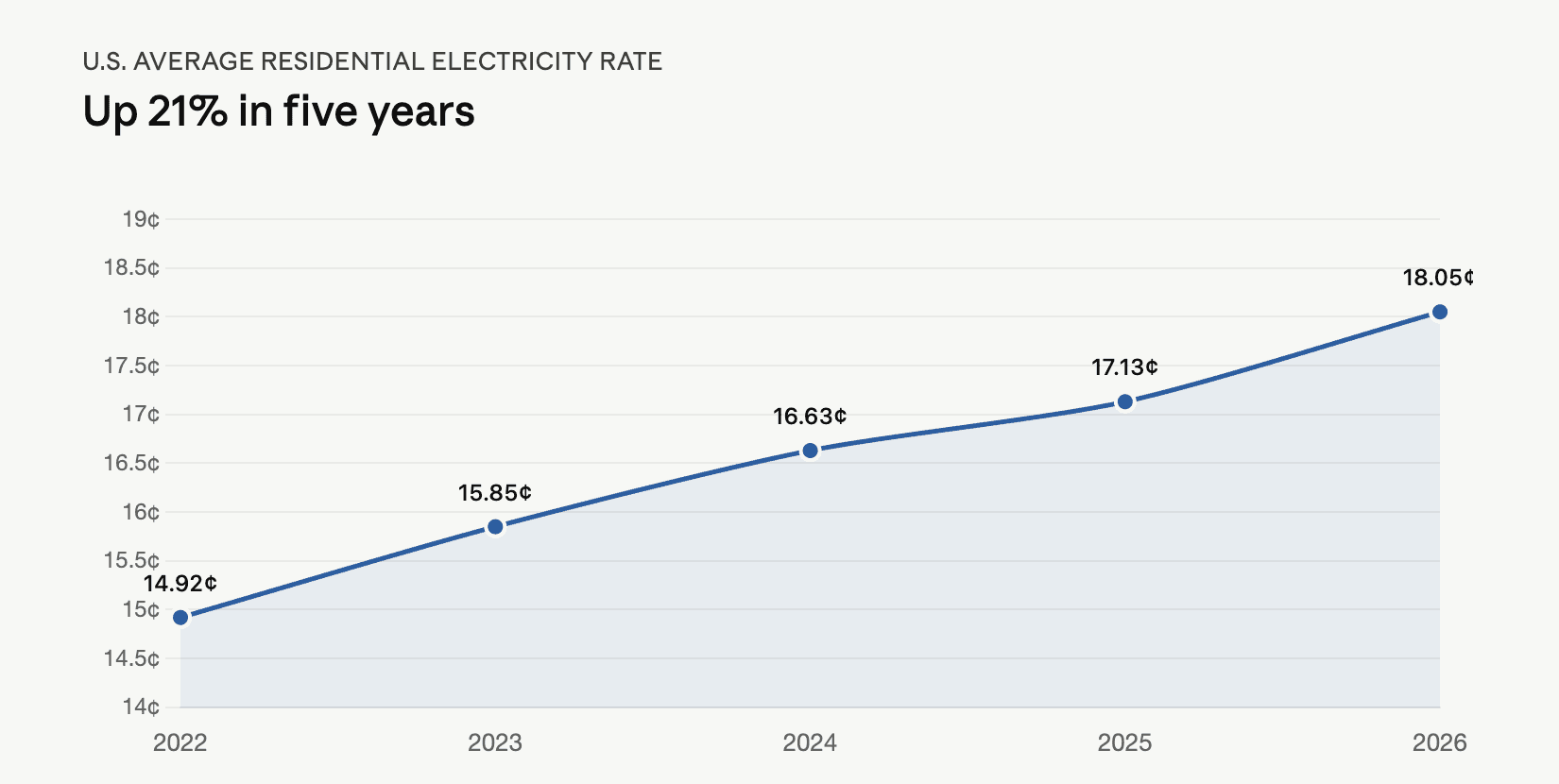
Electricity costs more than most people realize — and far more in some states than others. The national average residential rate hit 18.05 cents per kilowatt-hour in March 2026, up 5.4% from a year earlier and 21% higher than it was just five years ago. But that national average conceals a range that runs from 12.44 cents in Louisiana to 39.89 cents in Hawaii — a spread of more than 3 to 1.
Where you live determines what you pay. And what you pay determines how quickly energy-saving investments — insulation, efficient appliances, solar — pay for themselves.
This page compiles residential and commercial electricity rates for all 50 states plus D.C., updated March 2026, sourced from the U.S. Energy Information Administration (EIA) via ElectricChoice. It also covers regional patterns, five-year trends, and the factors that drive prices up or down in different parts of the country*.*
The Short Version
Before getting into the full data, a few numbers worth knowing:
The national residential average is 18.05¢/kWh, up from 17.13¢ last year. The national commercial average is 14.12¢/kWh — about 22% lower than residential, because businesses consume power in larger, more predictable quantities that reduce per-customer infrastructure overhead.
The cheapest state for residential electricity is Louisiana at 12.44¢/kWh. The most expensive is Hawaii at 39.89¢/kWh — more than twice the national average. Remove Hawaii, California, and Alaska from the West's regional average, and the remaining ten western states average just 14.59¢ — well below the national figure.
The fastest-rising states in the past year: California (+8.9%), Rhode Island (+8.4%), Maine (+8.1%), New Jersey (+8.3% commercial), and Connecticut (+8.0% commercial). Every state saw rates increase. The lowest YoY increase was Louisiana at +1.8%.
Residential Electricity Rates by State
All figures in cents per kilowatt-hour. National average: 18.05¢/kWh
State | Rate (¢/kWh) | YoY Change |
|---|---|---|
Alabama | 16.79 | +4.0% |
Alaska | 26.57 | +4.4% |
Arizona | 15.62 | +3.1% |
Arkansas | 13.32 | +2.3% |
California | 33.75 | +8.9% |
Colorado | 16.33 | +4.7% |
Connecticut | 27.84 | +7.0% |
Delaware | 18.39 | +5.3% |
District of Columbia | 24.03 | +4.8% |
Florida | 15.77 | +3.4% |
Georgia | 14.60 | +3.0% |
Hawaii | 39.89 | +7.5% |
Idaho | 12.51 | +2.1% |
Illinois | 18.82 | +6.0% |
Indiana | 17.42 | +5.1% |
Iowa | 13.54 | +2.6% |
Kansas | 15.23 | +3.7% |
Kentucky | 13.68 | +2.9% |
Louisiana | 12.44 | +1.8% |
Maine | 29.55 | +8.1% |
Maryland | 22.40 | +6.4% |
Massachusetts | 31.51 | +7.7% |
Michigan | 20.55 | +6.1% |
Minnesota | 16.44 | +4.0% |
Mississippi | 14.53 | +2.7% |
Missouri | 13.01 | +2.5% |
Montana | 14.33 | +3.3% |
Nebraska | 13.19 | +2.4% |
Nevada | 13.83 | +3.1% |
New Hampshire | 27.39 | +7.3% |
New Jersey | 22.65 | +6.6% |
New Mexico | 15.00 | +3.5% |
New York | 27.07 | +7.1% |
North Carolina | 15.12 | +3.2% |
North Dakota | 12.87 | +2.0% |
Ohio | 17.93 | +5.6% |
Oklahoma | 14.48 | +3.4% |
Oregon | 16.23 | +3.9% |
Pennsylvania | 20.58 | +6.3% |
Rhode Island | 31.30 | +8.4% |
South Carolina | 15.71 | +3.6% |
South Dakota | 14.15 | +2.8% |
Tennessee | 13.12 | +2.3% |
Texas | 16.18 | +4.3% |
Utah | 13.75 | +2.7% |
Vermont | 24.89 | +6.7% |
Virginia | 16.43 | +4.1% |
Washington | 14.12 | +3.0% |
West Virginia | 16.26 | +4.5% |
Wisconsin | 18.45 | +5.8% |
Wyoming | 15.18 | +3.6% |
U.S. Average | 18.05 | +5.4% |
Commercial Electricity Rates by State
All figures in cents per kilowatt-hour. National average: 14.12¢/kWh
State | Rate (¢/kWh) | YoY Change |
|---|---|---|
Alabama | 14.46 | +3.1% |
Alaska | 23.12 | +4.4% |
Arizona | 13.09 | +2.3% |
Arkansas | 10.77 | +2.9% |
California | 29.46 | +6.3% |
Colorado | 13.32 | +3.2% |
Connecticut | 23.89 | +8.0% |
Delaware | 12.69 | +4.1% |
District of Columbia | 20.86 | +4.7% |
Florida | 11.55 | +3.3% |
Georgia | 11.44 | +3.5% |
Hawaii | 38.79 | +8.9% |
Idaho | 8.19 | +1.6% |
Illinois | 14.01 | +6.0% |
Indiana | 14.16 | +4.4% |
Iowa | 13.31 | +3.1% |
Kansas | 12.05 | +3.7% |
Kentucky | 12.15 | +2.7% |
Louisiana | 10.93 | +3.0% |
Maine | 21.40 | +7.3% |
Maryland | 15.18 | +6.4% |
Massachusetts | 23.40 | +7.7% |
Michigan | 14.92 | +6.6% |
Minnesota | 13.22 | +3.7% |
Mississippi | 12.67 | +3.1% |
Missouri | 12.51 | +4.2% |
Montana | 12.61 | +3.5% |
Nebraska | 9.58 | +2.3% |
Nevada | 9.91 | +3.2% |
New Hampshire | 20.54 | +8.3% |
New Jersey | 18.78 | +9.1% |
New Mexico | 12.24 | +4.0% |
New York | 22.54 | +7.0% |
North Carolina | 10.09 | +3.3% |
North Dakota | 7.44 | +1.3% |
Ohio | 11.55 | +5.5% |
Oklahoma | 10.04 | +3.7% |
Oregon | 11.36 | +3.4% |
Pennsylvania | 12.79 | +6.2% |
Rhode Island | 22.44 | +8.6% |
South Carolina | 10.88 | +3.8% |
South Dakota | 10.99 | +3.2% |
Tennessee | 13.02 | +2.9% |
Texas | 9.12 | +4.2% |
Utah | 10.87 | +3.0% |
Vermont | 19.33 | +6.7% |
Virginia | 9.73 | +4.1% |
Washington | 11.90 | +3.3% |
West Virginia | 11.65 | +4.4% |
Wisconsin | 13.70 | +5.7% |
Wyoming | 9.79 | +3.5% |
U.S. Average | 14.12 | +5.0% |
The Most and Least Expensive States
Top 10 Most Expensive (Residential)
Hawaii leads by a wide margin, driven by geography and fuel dependency. The rest of the top 10 are concentrated in the Northeast and Pacific Coast — regions where aging grid infrastructure, limited domestic fuel production, and aggressive renewable mandates all push costs higher.
Rank | State | Rate (¢/kWh) | vs. National Avg |
|---|---|---|---|
1 | Hawaii | 39.89 | +121% |
2 | California | 33.75 | +87% |
3 | Massachusetts | 31.51 | +75% |
4 | Rhode Island | 31.30 | +73% |
5 | Maine | 29.55 | +64% |
6 | Connecticut | 27.84 | +54% |
7 | New Hampshire | 27.39 | +52% |
8 | Alaska | 26.57 | +47% |
9 | Vermont | 24.89 | +38% |
10 | District of Columbia | 24.03 | +33% |
Top 10 Least Expensive (Residential)
The cheapest states share a common thread: access to abundant low-cost generation, whether that's natural gas in the South Central region, hydroelectric power in the Northwest, or legacy nuclear and coal infrastructure in the Plains. None of these states have deregulated electricity markets, which tends to keep rates more stable but removes the consumer option to shop for lower prices.
Rank | State | Rate (¢/kWh) | vs. National Avg |
|---|---|---|---|
1 | Louisiana | 12.44 | -31% |
2 | Idaho | 12.51 | -31% |
3 | North Dakota | 12.87 | -29% |
4 | Missouri | 13.01 | -28% |
5 | Tennessee | 13.12 | -27% |
6 | Nebraska | 13.19 | -27% |
7 | Arkansas | 13.32 | -26% |
8 | Utah | 13.75 | -24% |
9 | Iowa | 13.54 | -25% |
10 | Nevada | 13.83 | -23% |
Electricity Rates by Region
Rates follow clear geographic patterns. The fuel sources a region relies on, the age of its grid infrastructure, and the structure of its electricity market all shape what customers pay.
Northeast — 25.63¢/kWh (42% above national average)
CT, DE, DC, ME, MD, MA, NH, NJ, NY, PA, RI, VT
The Northeast pays more for electricity than any other region in the country, and has for decades. The reasons are structural: the region has limited domestic fuel production, relies heavily on natural gas delivered through a constrained pipeline network, and maintains aging transmission infrastructure that requires continuous investment. Renewable energy mandates across nearly every northeastern state add procurement costs as the region transitions away from fossil fuels.
On the upside, most northeastern states have deregulated electricity markets, giving consumers the ability to compare and switch providers — with typical savings of 15–30% for those who shop actively.
West — 19.01¢/kWh (5% above national average)
AK, AZ, CA, CO, HI, ID, MT, NV, NM, OR, UT, WA, WY
The western average is heavily skewed by three outliers: Hawaii (39.89¢), California (33.75¢), and Alaska (26.57¢). Strip those three out and the remaining ten states average just 14.59¢ — well below the national figure — thanks to abundant hydroelectric capacity in the Pacific Northwest and rapidly expanding solar in the desert Southwest. Idaho at 12.51¢ and Nevada at 13.83¢ are among the most affordable electricity markets in the country despite their geography.
California's rate, at 33.75¢ and rising fastest of any state (+8.9% YoY), warrants its own explanation. The state has the most ambitious renewable energy mandates in the country, a grid that has required extensive wildfire-hardening investment, and a utility rate structure that layers in programs ranging from low-income subsidies to electric vehicle incentives — all recovered through volumetric charges on every kilowatt-hour sold.
Midwest — 15.97¢/kWh (12% below national average)
IL, IN, IA, KS, MI, MN, MO, NE, ND, OH, SD, WI
The Midwest sits just below the national average with significant internal variation. Michigan (20.55¢) and Illinois (18.82¢) sit above the national average, while wind-rich Great Plains states — North Dakota (12.87¢), Iowa (13.54¢), Nebraska (13.19¢) — anchor the low end. Ohio and Illinois have deregulated electricity markets, giving consumers in those states the ability to shop providers.
Southeast — 15.20¢/kWh (16% below national average)
AL, FL, GA, KY, MS, NC, SC, TN, VA, WV
Low fuel costs and stable regulatory environments keep southeastern rates comfortably below the national average. Tennessee (13.12¢) and Georgia (14.60¢) benefit from TVA hydroelectric capacity and nuclear baseload generation. None of the ten southeastern states have deregulated electricity markets — rates are set by regulated utilities — but the trade-off is generally lower and more predictable pricing. Virginia (16.43¢) is the regional outlier, driven upward by grid modernization costs and the concentration of data center load in Northern Virginia, the densest data center market in the world.
South Central — 14.11¢/kWh (22% below national average)
AR, LA, OK, TX
The four South Central states post the lowest regional average in the country. Louisiana (12.44¢) leads nationally, benefiting from abundant natural gas production and low infrastructure costs. Texas (16.18¢) is the regional outlier — its deregulated ERCOT market creates more price variability than the other three states, but also gives consumers more provider choice than anywhere else in the country.
How Electricity Rates Have Changed: 2022–2026
The national residential average has risen 21% in five years. That's not a blip — it's a sustained trend driven by multiple overlapping pressures.
Year | Avg Rate (¢/kWh) | YoY Change |
|---|---|---|
2022 | 14.92 | — |
2023 | 15.85 | +6.2% |
2024 | 16.63 | +4.9% |
2025 | 17.13 | +3.0% |
2026 | 18.05 | +5.4% |
The 2025–2026 jump of 5.4% reversed a two-year slowdown and landed at the highest single-year increase since 2023. Several factors converged: natural gas prices rose through the second half of 2025; electricity demand hit records driven by data center construction and accelerating EV adoption; and grid hardening costs from wildfire mitigation in the West and storm hardening along the Gulf Coast and Eastern Seaboard worked their way through utility rate cases.
The long-run trajectory is unlikely to reverse. Demand is growing — data centers, EVs, and electrification of industrial processes are adding load to a grid that was largely built for flat or declining consumption. Transmission investment backlogs and interconnection queues are stretching timelines for new generation. And in states with aggressive decarbonization mandates, the cost of the energy transition is being recovered through the same per-kWh charges that have been rising for years.
What Drives Electricity Prices
Electricity rates are not arbitrary. Six underlying factors account for most of the variation between states and most of the change over time.
Fuel costs. Natural gas now sets the marginal price of electricity across most of the United States. When gas prices rise, electricity rates follow — quickly in deregulated markets, with a lag in regulated ones. States that rely heavily on gas for generation, like those in New England, are more exposed to fuel price swings than states with large nuclear or hydroelectric bases that generate at fixed long-run costs.
Power plant infrastructure. Older coal and nuclear plants, once depreciated, generate cheap electricity. As these plants retire and are replaced by newer gas, wind, and solar facilities — which carry their own capital and financing costs — the underlying cost of generation changes. This transition is happening across the country at different speeds.
Transmission and distribution. Moving electricity from where it's generated to where it's used is expensive, and the cost is rising. Grid modernization, storm hardening, wildfire mitigation, and the interconnection of new renewable generation all require significant capital investment. Utilities recover these costs through distribution charges that appear on every customer's bill regardless of how much power they use.
Seasonal and demand-driven factors. Heat waves, cold snaps, and other demand spikes strain generating capacity and push up spot prices — especially in deregulated markets where customers are on variable-rate contracts. Data center growth in Northern Virginia, the Phoenix metro, and other major markets has added baseline load that utilities now must plan for.
State regulation and market structure. In regulated states, a utility commission sets rates through a formal approval process. In deregulated states, generation is priced through competitive markets. Neither structure is inherently cheaper — it depends on the fuel mix, infrastructure, and policy environment — but deregulation gives consumers the option to shop, which can produce savings for those who do.
Renewable energy mandates. State renewable portfolio standards require utilities to source a percentage of their power from qualifying renewables, which creates procurement costs that are passed through to customers. Over time, as solar and wind become the cheapest form of new generation, this dynamic is shifting — but in the near term, states with aggressive mandates tend to see faster rate increases during the transition period.
Residential vs. Commercial Rates
Commercial customers consistently pay less per kilowatt-hour than residential customers — 14.12¢ nationally versus 18.05¢, a gap of about 22%.
The reasons are economic rather than preferential. Businesses tend to consume electricity in larger volumes, which spreads fixed costs across more kilowatt-hours. They often have more predictable load profiles, which reduces the utility's need to maintain costly standby capacity. And commercial meters and billing are more efficient on a per-customer basis than residential service.
The gap between residential and commercial rates is widest in states with high residential rates. In California, commercial customers (29.46¢) pay 13% less than residential (33.75¢). In Massachusetts, the gap is 26% (23.40¢ vs. 31.51¢). In Texas, where commercial customers pay just 9.12¢, the commercial rate is 44% below the residential rate of 16.18¢ — partly because large commercial customers in ERCOT can negotiate direct supply agreements and take advantage of competitive market structures unavailable to most residential accounts.
For businesses evaluating energy costs, the commercial rate is the relevant benchmark for modeling potential savings from efficiency investments, solar, or fuel switching.
Deregulated Markets: Where You Can Shop for Lower Rates
In 14 states plus D.C., electricity generation has been deregulated — meaning customers can choose their electricity supplier rather than accepting the default utility rate. Transmission and distribution remain regulated monopolies in all states, so the poles and wires portion of your bill doesn't change. But the generation supply charge — typically 40–60% of a total bill — can be shopped.
The deregulated states are: Connecticut, Delaware, Illinois, Maine, Maryland, Massachusetts, Michigan, New Hampshire, New Jersey, New York, Ohio, Pennsylvania, Rhode Island, and Texas.
Customers in these states who actively compare providers typically save 15–30% on the supply portion of their bill. The catch is that variable-rate contracts can expose customers to price swings — notably, Texas ERCOT customers on variable rates experienced extreme price spikes during Winter Storm Uri in 2021. Fixed-rate contracts provide predictability; variable rates can go either direction.
In regulated states, there is no supplier choice. Rates are set by the state utility commission through a rate case process, and customers pay whatever the approved tariff specifies. The upside is stability; the downside is no competitive pressure to reduce costs.
Frequently Asked Questions
Which state has the cheapest electricity? Louisiana has the cheapest residential electricity at 12.44¢/kWh — 31% below the national average. For commercial customers, North Dakota leads at 7.44¢/kWh. Louisiana benefits from abundant natural gas production and refining capacity; North Dakota from low infrastructure costs and hydroelectric access.
Which state has the most expensive electricity? Hawaii at 39.89¢/kWh — more than twice the national average. Hawaii imports petroleum to fuel most of its power generation, and island geography means no connection to the mainland grid or access to cheaper pipeline natural gas. Among the contiguous 48 states, California (33.75¢) is the most expensive.
Why is electricity so expensive in New England? The Northeast pays 42% more than the national average because of a combination of factors: heavy dependence on natural gas delivered through a constrained pipeline system, aging transmission infrastructure, aggressive state renewable mandates, and limited domestic fuel production. The region has essentially no coal, minimal hydro, and until recently limited utility-scale solar and wind. It gets its natural gas at the end of a long pipeline from producing regions — and during cold snaps, that pipeline competes with home heating demand, driving up prices.
Why did electricity rates increase so much in 2026? The 5.4% national increase in 2025–2026 reflected rising natural gas prices, record electricity demand driven by data center construction and EV adoption, and infrastructure investment costs flowing through utility rate cases. California saw the steepest residential increase (+8.9%), followed by Rhode Island (+8.4%) and Maine (+8.1%).
Can switching providers save money? Yes, if you're in a deregulated state. Customers who actively compare providers typically save 15–30% on the supply portion of their bill. Fixed-rate contracts offer price certainty; variable contracts can produce savings or expose you to spikes depending on market conditions. In the 36 regulated states, there is no supplier choice.
Why do commercial customers pay less than residential? Businesses use more electricity in more predictable patterns, which lowers the per-unit cost of serving them. Fixed infrastructure costs get spread across larger volumes. Billing and metering overhead is lower per kilowatt-hour. The national commercial average (14.12¢) is about 22% below the residential average (18.05¢).
Will electricity rates keep rising? The structural pressures — growing demand from electrification and data centers, aging infrastructure requiring replacement, renewable energy transition costs — are all pointing in the direction of continued increases. The pace will vary by state and by how quickly new generation capacity comes online to meet rising demand. No major forecaster is projecting a sustained national decline in electricity rates over the next five years.
Sources
https://www.eia.gov/electricity/monthly/epm_table_grapher.php?t=epmt_5_6_a#:~:text=Table_title:
Regional averages and national trend data (2022–2026): ElectricChoice — electricchoice.com/electricity-prices-by-state/
Deregulated state list and market structure: ElectricChoice — electricchoice.com/map-deregulated-energy-markets/
https://www.eia.gov/electricity/monthly/epm_table_grapher.php?t=epmt_5_6_a#:~:text=Table_title:
Let's Chat
Start your next project with Newport Renewables.
OUR SERVICES
Work with Newport Renewables
We do two things, and we do them at full scale: commercial solar across Rhode Island and ground-up custom homes built to perform. Here's where you fit.
Commercial solar for your property or business?
We design and install solar for commercial buildings, warehouses, and income properties across Rhode Island — sized to your actual load, your roof or land, and the incentives available right now. The goal isn't just panels on a roof; it's a system that pays for itself and keeps producing for decades.
→ See how commercial solar works
Building a new custom home?
We design and build custom homes with integrated zero-energy systems from the ground up. When every component — orientation, envelope, electrical capacity, HVAC, solar, storage — is planned together instead of bolted on later, you get a home that's built for long-term performance and value.
→ Learn about our zero-energy home builds
316 Columbia St • Wakefield, RI 02879 | 401.619.5906




Copyright © 2024 Newport Renewables. All Rights Reserved.
316 Columbia St • Wakefield, RI 02879 | 401.619.5906
Copyright © 2024 Newport Renewables. All Rights Reserved.
Electricity Rates by State: What Americans Pay for Power in 2026
Electricity costs more than most people realize — and far more in some states than others. The national average residential rate hit 18.05 cents per kilowatt-hour in March 2026, up 5.4% from a year earlier and 21% higher than it was just five years ago. But that national average conceals a range that runs from 12.44 cents in Louisiana to 39.89 cents in Hawaii — a spread of more than 3 to 1.
Where you live determines what you pay. And what you pay determines how quickly energy-saving investments — insulation, efficient appliances, solar — pay for themselves.
This page compiles residential and commercial electricity rates for all 50 states plus D.C., updated March 2026, sourced from the U.S. Energy Information Administration (EIA) via ElectricChoice. It also covers regional patterns, five-year trends, and the factors that drive prices up or down in different parts of the country*.*
The Short Version
Before getting into the full data, a few numbers worth knowing:
The national residential average is 18.05¢/kWh, up from 17.13¢ last year. The national commercial average is 14.12¢/kWh — about 22% lower than residential, because businesses consume power in larger, more predictable quantities that reduce per-customer infrastructure overhead.
The cheapest state for residential electricity is Louisiana at 12.44¢/kWh. The most expensive is Hawaii at 39.89¢/kWh — more than twice the national average. Remove Hawaii, California, and Alaska from the West's regional average, and the remaining ten western states average just 14.59¢ — well below the national figure.
The fastest-rising states in the past year: California (+8.9%), Rhode Island (+8.4%), Maine (+8.1%), New Jersey (+8.3% commercial), and Connecticut (+8.0% commercial). Every state saw rates increase. The lowest YoY increase was Louisiana at +1.8%.
Residential Electricity Rates by State
All figures in cents per kilowatt-hour. National average: 18.05¢/kWh
State | Rate (¢/kWh) | YoY Change |
|---|---|---|
Alabama | 16.79 | +4.0% |
Alaska | 26.57 | +4.4% |
Arizona | 15.62 | +3.1% |
Arkansas | 13.32 | +2.3% |
California | 33.75 | +8.9% |
Colorado | 16.33 | +4.7% |
Connecticut | 27.84 | +7.0% |
Delaware | 18.39 | +5.3% |
District of Columbia | 24.03 | +4.8% |
Florida | 15.77 | +3.4% |
Georgia | 14.60 | +3.0% |
Hawaii | 39.89 | +7.5% |
Idaho | 12.51 | +2.1% |
Illinois | 18.82 | +6.0% |
Indiana | 17.42 | +5.1% |
Iowa | 13.54 | +2.6% |
Kansas | 15.23 | +3.7% |
Kentucky | 13.68 | +2.9% |
Louisiana | 12.44 | +1.8% |
Maine | 29.55 | +8.1% |
Maryland | 22.40 | +6.4% |
Massachusetts | 31.51 | +7.7% |
Michigan | 20.55 | +6.1% |
Minnesota | 16.44 | +4.0% |
Mississippi | 14.53 | +2.7% |
Missouri | 13.01 | +2.5% |
Montana | 14.33 | +3.3% |
Nebraska | 13.19 | +2.4% |
Nevada | 13.83 | +3.1% |
New Hampshire | 27.39 | +7.3% |
New Jersey | 22.65 | +6.6% |
New Mexico | 15.00 | +3.5% |
New York | 27.07 | +7.1% |
North Carolina | 15.12 | +3.2% |
North Dakota | 12.87 | +2.0% |
Ohio | 17.93 | +5.6% |
Oklahoma | 14.48 | +3.4% |
Oregon | 16.23 | +3.9% |
Pennsylvania | 20.58 | +6.3% |
Rhode Island | 31.30 | +8.4% |
South Carolina | 15.71 | +3.6% |
South Dakota | 14.15 | +2.8% |
Tennessee | 13.12 | +2.3% |
Texas | 16.18 | +4.3% |
Utah | 13.75 | +2.7% |
Vermont | 24.89 | +6.7% |
Virginia | 16.43 | +4.1% |
Washington | 14.12 | +3.0% |
West Virginia | 16.26 | +4.5% |
Wisconsin | 18.45 | +5.8% |
Wyoming | 15.18 | +3.6% |
U.S. Average | 18.05 | +5.4% |
Commercial Electricity Rates by State
All figures in cents per kilowatt-hour. National average: 14.12¢/kWh
State | Rate (¢/kWh) | YoY Change |
|---|---|---|
Alabama | 14.46 | +3.1% |
Alaska | 23.12 | +4.4% |
Arizona | 13.09 | +2.3% |
Arkansas | 10.77 | +2.9% |
California | 29.46 | +6.3% |
Colorado | 13.32 | +3.2% |
Connecticut | 23.89 | +8.0% |
Delaware | 12.69 | +4.1% |
District of Columbia | 20.86 | +4.7% |
Florida | 11.55 | +3.3% |
Georgia | 11.44 | +3.5% |
Hawaii | 38.79 | +8.9% |
Idaho | 8.19 | +1.6% |
Illinois | 14.01 | +6.0% |
Indiana | 14.16 | +4.4% |
Iowa | 13.31 | +3.1% |
Kansas | 12.05 | +3.7% |
Kentucky | 12.15 | +2.7% |
Louisiana | 10.93 | +3.0% |
Maine | 21.40 | +7.3% |
Maryland | 15.18 | +6.4% |
Massachusetts | 23.40 | +7.7% |
Michigan | 14.92 | +6.6% |
Minnesota | 13.22 | +3.7% |
Mississippi | 12.67 | +3.1% |
Missouri | 12.51 | +4.2% |
Montana | 12.61 | +3.5% |
Nebraska | 9.58 | +2.3% |
Nevada | 9.91 | +3.2% |
New Hampshire | 20.54 | +8.3% |
New Jersey | 18.78 | +9.1% |
New Mexico | 12.24 | +4.0% |
New York | 22.54 | +7.0% |
North Carolina | 10.09 | +3.3% |
North Dakota | 7.44 | +1.3% |
Ohio | 11.55 | +5.5% |
Oklahoma | 10.04 | +3.7% |
Oregon | 11.36 | +3.4% |
Pennsylvania | 12.79 | +6.2% |
Rhode Island | 22.44 | +8.6% |
South Carolina | 10.88 | +3.8% |
South Dakota | 10.99 | +3.2% |
Tennessee | 13.02 | +2.9% |
Texas | 9.12 | +4.2% |
Utah | 10.87 | +3.0% |
Vermont | 19.33 | +6.7% |
Virginia | 9.73 | +4.1% |
Washington | 11.90 | +3.3% |
West Virginia | 11.65 | +4.4% |
Wisconsin | 13.70 | +5.7% |
Wyoming | 9.79 | +3.5% |
U.S. Average | 14.12 | +5.0% |
The Most and Least Expensive States
Top 10 Most Expensive (Residential)
Hawaii leads by a wide margin, driven by geography and fuel dependency. The rest of the top 10 are concentrated in the Northeast and Pacific Coast — regions where aging grid infrastructure, limited domestic fuel production, and aggressive renewable mandates all push costs higher.
Rank | State | Rate (¢/kWh) | vs. National Avg |
|---|---|---|---|
1 | Hawaii | 39.89 | +121% |
2 | California | 33.75 | +87% |
3 | Massachusetts | 31.51 | +75% |
4 | Rhode Island | 31.30 | +73% |
5 | Maine | 29.55 | +64% |
6 | Connecticut | 27.84 | +54% |
7 | New Hampshire | 27.39 | +52% |
8 | Alaska | 26.57 | +47% |
9 | Vermont | 24.89 | +38% |
10 | District of Columbia | 24.03 | +33% |
Top 10 Least Expensive (Residential)
The cheapest states share a common thread: access to abundant low-cost generation, whether that's natural gas in the South Central region, hydroelectric power in the Northwest, or legacy nuclear and coal infrastructure in the Plains. None of these states have deregulated electricity markets, which tends to keep rates more stable but removes the consumer option to shop for lower prices.
Rank | State | Rate (¢/kWh) | vs. National Avg |
|---|---|---|---|
1 | Louisiana | 12.44 | -31% |
2 | Idaho | 12.51 | -31% |
3 | North Dakota | 12.87 | -29% |
4 | Missouri | 13.01 | -28% |
5 | Tennessee | 13.12 | -27% |
6 | Nebraska | 13.19 | -27% |
7 | Arkansas | 13.32 | -26% |
8 | Utah | 13.75 | -24% |
9 | Iowa | 13.54 | -25% |
10 | Nevada | 13.83 | -23% |
Electricity Rates by Region
Rates follow clear geographic patterns. The fuel sources a region relies on, the age of its grid infrastructure, and the structure of its electricity market all shape what customers pay.
Northeast — 25.63¢/kWh (42% above national average)
CT, DE, DC, ME, MD, MA, NH, NJ, NY, PA, RI, VT
The Northeast pays more for electricity than any other region in the country, and has for decades. The reasons are structural: the region has limited domestic fuel production, relies heavily on natural gas delivered through a constrained pipeline network, and maintains aging transmission infrastructure that requires continuous investment. Renewable energy mandates across nearly every northeastern state add procurement costs as the region transitions away from fossil fuels.
On the upside, most northeastern states have deregulated electricity markets, giving consumers the ability to compare and switch providers — with typical savings of 15–30% for those who shop actively.
West — 19.01¢/kWh (5% above national average)
AK, AZ, CA, CO, HI, ID, MT, NV, NM, OR, UT, WA, WY
The western average is heavily skewed by three outliers: Hawaii (39.89¢), California (33.75¢), and Alaska (26.57¢). Strip those three out and the remaining ten states average just 14.59¢ — well below the national figure — thanks to abundant hydroelectric capacity in the Pacific Northwest and rapidly expanding solar in the desert Southwest. Idaho at 12.51¢ and Nevada at 13.83¢ are among the most affordable electricity markets in the country despite their geography.
California's rate, at 33.75¢ and rising fastest of any state (+8.9% YoY), warrants its own explanation. The state has the most ambitious renewable energy mandates in the country, a grid that has required extensive wildfire-hardening investment, and a utility rate structure that layers in programs ranging from low-income subsidies to electric vehicle incentives — all recovered through volumetric charges on every kilowatt-hour sold.
Midwest — 15.97¢/kWh (12% below national average)
IL, IN, IA, KS, MI, MN, MO, NE, ND, OH, SD, WI
The Midwest sits just below the national average with significant internal variation. Michigan (20.55¢) and Illinois (18.82¢) sit above the national average, while wind-rich Great Plains states — North Dakota (12.87¢), Iowa (13.54¢), Nebraska (13.19¢) — anchor the low end. Ohio and Illinois have deregulated electricity markets, giving consumers in those states the ability to shop providers.
Southeast — 15.20¢/kWh (16% below national average)
AL, FL, GA, KY, MS, NC, SC, TN, VA, WV
Low fuel costs and stable regulatory environments keep southeastern rates comfortably below the national average. Tennessee (13.12¢) and Georgia (14.60¢) benefit from TVA hydroelectric capacity and nuclear baseload generation. None of the ten southeastern states have deregulated electricity markets — rates are set by regulated utilities — but the trade-off is generally lower and more predictable pricing. Virginia (16.43¢) is the regional outlier, driven upward by grid modernization costs and the concentration of data center load in Northern Virginia, the densest data center market in the world.
South Central — 14.11¢/kWh (22% below national average)
AR, LA, OK, TX
The four South Central states post the lowest regional average in the country. Louisiana (12.44¢) leads nationally, benefiting from abundant natural gas production and low infrastructure costs. Texas (16.18¢) is the regional outlier — its deregulated ERCOT market creates more price variability than the other three states, but also gives consumers more provider choice than anywhere else in the country.
How Electricity Rates Have Changed: 2022–2026
The national residential average has risen 21% in five years. That's not a blip — it's a sustained trend driven by multiple overlapping pressures.
Year | Avg Rate (¢/kWh) | YoY Change |
|---|---|---|
2022 | 14.92 | — |
2023 | 15.85 | +6.2% |
2024 | 16.63 | +4.9% |
2025 | 17.13 | +3.0% |
2026 | 18.05 | +5.4% |
The 2025–2026 jump of 5.4% reversed a two-year slowdown and landed at the highest single-year increase since 2023. Several factors converged: natural gas prices rose through the second half of 2025; electricity demand hit records driven by data center construction and accelerating EV adoption; and grid hardening costs from wildfire mitigation in the West and storm hardening along the Gulf Coast and Eastern Seaboard worked their way through utility rate cases.
The long-run trajectory is unlikely to reverse. Demand is growing — data centers, EVs, and electrification of industrial processes are adding load to a grid that was largely built for flat or declining consumption. Transmission investment backlogs and interconnection queues are stretching timelines for new generation. And in states with aggressive decarbonization mandates, the cost of the energy transition is being recovered through the same per-kWh charges that have been rising for years.
What Drives Electricity Prices
Electricity rates are not arbitrary. Six underlying factors account for most of the variation between states and most of the change over time.
Fuel costs. Natural gas now sets the marginal price of electricity across most of the United States. When gas prices rise, electricity rates follow — quickly in deregulated markets, with a lag in regulated ones. States that rely heavily on gas for generation, like those in New England, are more exposed to fuel price swings than states with large nuclear or hydroelectric bases that generate at fixed long-run costs.
Power plant infrastructure. Older coal and nuclear plants, once depreciated, generate cheap electricity. As these plants retire and are replaced by newer gas, wind, and solar facilities — which carry their own capital and financing costs — the underlying cost of generation changes. This transition is happening across the country at different speeds.
Transmission and distribution. Moving electricity from where it's generated to where it's used is expensive, and the cost is rising. Grid modernization, storm hardening, wildfire mitigation, and the interconnection of new renewable generation all require significant capital investment. Utilities recover these costs through distribution charges that appear on every customer's bill regardless of how much power they use.
Seasonal and demand-driven factors. Heat waves, cold snaps, and other demand spikes strain generating capacity and push up spot prices — especially in deregulated markets where customers are on variable-rate contracts. Data center growth in Northern Virginia, the Phoenix metro, and other major markets has added baseline load that utilities now must plan for.
State regulation and market structure. In regulated states, a utility commission sets rates through a formal approval process. In deregulated states, generation is priced through competitive markets. Neither structure is inherently cheaper — it depends on the fuel mix, infrastructure, and policy environment — but deregulation gives consumers the option to shop, which can produce savings for those who do.
Renewable energy mandates. State renewable portfolio standards require utilities to source a percentage of their power from qualifying renewables, which creates procurement costs that are passed through to customers. Over time, as solar and wind become the cheapest form of new generation, this dynamic is shifting — but in the near term, states with aggressive mandates tend to see faster rate increases during the transition period.
Residential vs. Commercial Rates
Commercial customers consistently pay less per kilowatt-hour than residential customers — 14.12¢ nationally versus 18.05¢, a gap of about 22%.
The reasons are economic rather than preferential. Businesses tend to consume electricity in larger volumes, which spreads fixed costs across more kilowatt-hours. They often have more predictable load profiles, which reduces the utility's need to maintain costly standby capacity. And commercial meters and billing are more efficient on a per-customer basis than residential service.
The gap between residential and commercial rates is widest in states with high residential rates. In California, commercial customers (29.46¢) pay 13% less than residential (33.75¢). In Massachusetts, the gap is 26% (23.40¢ vs. 31.51¢). In Texas, where commercial customers pay just 9.12¢, the commercial rate is 44% below the residential rate of 16.18¢ — partly because large commercial customers in ERCOT can negotiate direct supply agreements and take advantage of competitive market structures unavailable to most residential accounts.
For businesses evaluating energy costs, the commercial rate is the relevant benchmark for modeling potential savings from efficiency investments, solar, or fuel switching.
Deregulated Markets: Where You Can Shop for Lower Rates
In 14 states plus D.C., electricity generation has been deregulated — meaning customers can choose their electricity supplier rather than accepting the default utility rate. Transmission and distribution remain regulated monopolies in all states, so the poles and wires portion of your bill doesn't change. But the generation supply charge — typically 40–60% of a total bill — can be shopped.
The deregulated states are: Connecticut, Delaware, Illinois, Maine, Maryland, Massachusetts, Michigan, New Hampshire, New Jersey, New York, Ohio, Pennsylvania, Rhode Island, and Texas.
Customers in these states who actively compare providers typically save 15–30% on the supply portion of their bill. The catch is that variable-rate contracts can expose customers to price swings — notably, Texas ERCOT customers on variable rates experienced extreme price spikes during Winter Storm Uri in 2021. Fixed-rate contracts provide predictability; variable rates can go either direction.
In regulated states, there is no supplier choice. Rates are set by the state utility commission through a rate case process, and customers pay whatever the approved tariff specifies. The upside is stability; the downside is no competitive pressure to reduce costs.
Frequently Asked Questions
Which state has the cheapest electricity? Louisiana has the cheapest residential electricity at 12.44¢/kWh — 31% below the national average. For commercial customers, North Dakota leads at 7.44¢/kWh. Louisiana benefits from abundant natural gas production and refining capacity; North Dakota from low infrastructure costs and hydroelectric access.
Which state has the most expensive electricity? Hawaii at 39.89¢/kWh — more than twice the national average. Hawaii imports petroleum to fuel most of its power generation, and island geography means no connection to the mainland grid or access to cheaper pipeline natural gas. Among the contiguous 48 states, California (33.75¢) is the most expensive.
Why is electricity so expensive in New England? The Northeast pays 42% more than the national average because of a combination of factors: heavy dependence on natural gas delivered through a constrained pipeline system, aging transmission infrastructure, aggressive state renewable mandates, and limited domestic fuel production. The region has essentially no coal, minimal hydro, and until recently limited utility-scale solar and wind. It gets its natural gas at the end of a long pipeline from producing regions — and during cold snaps, that pipeline competes with home heating demand, driving up prices.
Why did electricity rates increase so much in 2026? The 5.4% national increase in 2025–2026 reflected rising natural gas prices, record electricity demand driven by data center construction and EV adoption, and infrastructure investment costs flowing through utility rate cases. California saw the steepest residential increase (+8.9%), followed by Rhode Island (+8.4%) and Maine (+8.1%).
Can switching providers save money? Yes, if you're in a deregulated state. Customers who actively compare providers typically save 15–30% on the supply portion of their bill. Fixed-rate contracts offer price certainty; variable contracts can produce savings or expose you to spikes depending on market conditions. In the 36 regulated states, there is no supplier choice.
Why do commercial customers pay less than residential? Businesses use more electricity in more predictable patterns, which lowers the per-unit cost of serving them. Fixed infrastructure costs get spread across larger volumes. Billing and metering overhead is lower per kilowatt-hour. The national commercial average (14.12¢) is about 22% below the residential average (18.05¢).
Will electricity rates keep rising? The structural pressures — growing demand from electrification and data centers, aging infrastructure requiring replacement, renewable energy transition costs — are all pointing in the direction of continued increases. The pace will vary by state and by how quickly new generation capacity comes online to meet rising demand. No major forecaster is projecting a sustained national decline in electricity rates over the next five years.
Sources
https://www.eia.gov/electricity/monthly/epm_table_grapher.php?t=epmt_5_6_a#:~:text=Table_title:
Regional averages and national trend data (2022–2026): ElectricChoice — electricchoice.com/electricity-prices-by-state/
Deregulated state list and market structure: ElectricChoice — electricchoice.com/map-deregulated-energy-markets/
https://www.eia.gov/electricity/monthly/epm_table_grapher.php?t=epmt_5_6_a#:~:text=Table_title:
OUR SERVICES
Work with Newport Renewables
We do two things, and we do them at full scale: commercial solar across Rhode Island and ground-up custom homes built to perform. Here's where you fit.
Commercial solar for your property or business?
We design and install solar for commercial buildings, warehouses, and income properties across Rhode Island — sized to your actual load, your roof or land, and the incentives available right now. The goal isn't just panels on a roof; it's a system that pays for itself and keeps producing for decades.
→ See how commercial solar works
Building a new custom home?
We design and build custom homes with integrated zero-energy systems from the ground up. When every component — orientation, envelope, electrical capacity, HVAC, solar, storage — is planned together instead of bolted on later, you get a home that's built for long-term performance and value.
→ Learn about our zero-energy home builds
316 Columbia St • Wakefield, RI 02879 | 401.619.5906
Copyright © 2024 Newport Renewables. All Rights Reserved.

Electricity Rates by State: What Americans Pay for Power in 2026
Electricity costs more than most people realize — and far more in some states than others. The national average residential rate hit 18.05 cents per kilowatt-hour in March 2026, up 5.4% from a year earlier and 21% higher than it was just five years ago. But that national average conceals a range that runs from 12.44 cents in Louisiana to 39.89 cents in Hawaii — a spread of more than 3 to 1.
Where you live determines what you pay. And what you pay determines how quickly energy-saving investments — insulation, efficient appliances, solar — pay for themselves.
This page compiles residential and commercial electricity rates for all 50 states plus D.C., updated March 2026, sourced from the U.S. Energy Information Administration (EIA) via ElectricChoice. It also covers regional patterns, five-year trends, and the factors that drive prices up or down in different parts of the country*.*
The Short Version
Before getting into the full data, a few numbers worth knowing:
The national residential average is 18.05¢/kWh, up from 17.13¢ last year. The national commercial average is 14.12¢/kWh — about 22% lower than residential, because businesses consume power in larger, more predictable quantities that reduce per-customer infrastructure overhead.
The cheapest state for residential electricity is Louisiana at 12.44¢/kWh. The most expensive is Hawaii at 39.89¢/kWh — more than twice the national average. Remove Hawaii, California, and Alaska from the West's regional average, and the remaining ten western states average just 14.59¢ — well below the national figure.
The fastest-rising states in the past year: California (+8.9%), Rhode Island (+8.4%), Maine (+8.1%), New Jersey (+8.3% commercial), and Connecticut (+8.0% commercial). Every state saw rates increase. The lowest YoY increase was Louisiana at +1.8%.
Residential Electricity Rates by State
All figures in cents per kilowatt-hour. National average: 18.05¢/kWh
State | Rate (¢/kWh) | YoY Change |
|---|---|---|
Alabama | 16.79 | +4.0% |
Alaska | 26.57 | +4.4% |
Arizona | 15.62 | +3.1% |
Arkansas | 13.32 | +2.3% |
California | 33.75 | +8.9% |
Colorado | 16.33 | +4.7% |
Connecticut | 27.84 | +7.0% |
Delaware | 18.39 | +5.3% |
District of Columbia | 24.03 | +4.8% |
Florida | 15.77 | +3.4% |
Georgia | 14.60 | +3.0% |
Hawaii | 39.89 | +7.5% |
Idaho | 12.51 | +2.1% |
Illinois | 18.82 | +6.0% |
Indiana | 17.42 | +5.1% |
Iowa | 13.54 | +2.6% |
Kansas | 15.23 | +3.7% |
Kentucky | 13.68 | +2.9% |
Louisiana | 12.44 | +1.8% |
Maine | 29.55 | +8.1% |
Maryland | 22.40 | +6.4% |
Massachusetts | 31.51 | +7.7% |
Michigan | 20.55 | +6.1% |
Minnesota | 16.44 | +4.0% |
Mississippi | 14.53 | +2.7% |
Missouri | 13.01 | +2.5% |
Montana | 14.33 | +3.3% |
Nebraska | 13.19 | +2.4% |
Nevada | 13.83 | +3.1% |
New Hampshire | 27.39 | +7.3% |
New Jersey | 22.65 | +6.6% |
New Mexico | 15.00 | +3.5% |
New York | 27.07 | +7.1% |
North Carolina | 15.12 | +3.2% |
North Dakota | 12.87 | +2.0% |
Ohio | 17.93 | +5.6% |
Oklahoma | 14.48 | +3.4% |
Oregon | 16.23 | +3.9% |
Pennsylvania | 20.58 | +6.3% |
Rhode Island | 31.30 | +8.4% |
South Carolina | 15.71 | +3.6% |
South Dakota | 14.15 | +2.8% |
Tennessee | 13.12 | +2.3% |
Texas | 16.18 | +4.3% |
Utah | 13.75 | +2.7% |
Vermont | 24.89 | +6.7% |
Virginia | 16.43 | +4.1% |
Washington | 14.12 | +3.0% |
West Virginia | 16.26 | +4.5% |
Wisconsin | 18.45 | +5.8% |
Wyoming | 15.18 | +3.6% |
U.S. Average | 18.05 | +5.4% |
Commercial Electricity Rates by State
All figures in cents per kilowatt-hour. National average: 14.12¢/kWh
State | Rate (¢/kWh) | YoY Change |
|---|---|---|
Alabama | 14.46 | +3.1% |
Alaska | 23.12 | +4.4% |
Arizona | 13.09 | +2.3% |
Arkansas | 10.77 | +2.9% |
California | 29.46 | +6.3% |
Colorado | 13.32 | +3.2% |
Connecticut | 23.89 | +8.0% |
Delaware | 12.69 | +4.1% |
District of Columbia | 20.86 | +4.7% |
Florida | 11.55 | +3.3% |
Georgia | 11.44 | +3.5% |
Hawaii | 38.79 | +8.9% |
Idaho | 8.19 | +1.6% |
Illinois | 14.01 | +6.0% |
Indiana | 14.16 | +4.4% |
Iowa | 13.31 | +3.1% |
Kansas | 12.05 | +3.7% |
Kentucky | 12.15 | +2.7% |
Louisiana | 10.93 | +3.0% |
Maine | 21.40 | +7.3% |
Maryland | 15.18 | +6.4% |
Massachusetts | 23.40 | +7.7% |
Michigan | 14.92 | +6.6% |
Minnesota | 13.22 | +3.7% |
Mississippi | 12.67 | +3.1% |
Missouri | 12.51 | +4.2% |
Montana | 12.61 | +3.5% |
Nebraska | 9.58 | +2.3% |
Nevada | 9.91 | +3.2% |
New Hampshire | 20.54 | +8.3% |
New Jersey | 18.78 | +9.1% |
New Mexico | 12.24 | +4.0% |
New York | 22.54 | +7.0% |
North Carolina | 10.09 | +3.3% |
North Dakota | 7.44 | +1.3% |
Ohio | 11.55 | +5.5% |
Oklahoma | 10.04 | +3.7% |
Oregon | 11.36 | +3.4% |
Pennsylvania | 12.79 | +6.2% |
Rhode Island | 22.44 | +8.6% |
South Carolina | 10.88 | +3.8% |
South Dakota | 10.99 | +3.2% |
Tennessee | 13.02 | +2.9% |
Texas | 9.12 | +4.2% |
Utah | 10.87 | +3.0% |
Vermont | 19.33 | +6.7% |
Virginia | 9.73 | +4.1% |
Washington | 11.90 | +3.3% |
West Virginia | 11.65 | +4.4% |
Wisconsin | 13.70 | +5.7% |
Wyoming | 9.79 | +3.5% |
U.S. Average | 14.12 | +5.0% |
The Most and Least Expensive States
Top 10 Most Expensive (Residential)
Hawaii leads by a wide margin, driven by geography and fuel dependency. The rest of the top 10 are concentrated in the Northeast and Pacific Coast — regions where aging grid infrastructure, limited domestic fuel production, and aggressive renewable mandates all push costs higher.
Rank | State | Rate (¢/kWh) | vs. National Avg |
|---|---|---|---|
1 | Hawaii | 39.89 | +121% |
2 | California | 33.75 | +87% |
3 | Massachusetts | 31.51 | +75% |
4 | Rhode Island | 31.30 | +73% |
5 | Maine | 29.55 | +64% |
6 | Connecticut | 27.84 | +54% |
7 | New Hampshire | 27.39 | +52% |
8 | Alaska | 26.57 | +47% |
9 | Vermont | 24.89 | +38% |
10 | District of Columbia | 24.03 | +33% |
Top 10 Least Expensive (Residential)
The cheapest states share a common thread: access to abundant low-cost generation, whether that's natural gas in the South Central region, hydroelectric power in the Northwest, or legacy nuclear and coal infrastructure in the Plains. None of these states have deregulated electricity markets, which tends to keep rates more stable but removes the consumer option to shop for lower prices.
Rank | State | Rate (¢/kWh) | vs. National Avg |
|---|---|---|---|
1 | Louisiana | 12.44 | -31% |
2 | Idaho | 12.51 | -31% |
3 | North Dakota | 12.87 | -29% |
4 | Missouri | 13.01 | -28% |
5 | Tennessee | 13.12 | -27% |
6 | Nebraska | 13.19 | -27% |
7 | Arkansas | 13.32 | -26% |
8 | Utah | 13.75 | -24% |
9 | Iowa | 13.54 | -25% |
10 | Nevada | 13.83 | -23% |
Electricity Rates by Region
Rates follow clear geographic patterns. The fuel sources a region relies on, the age of its grid infrastructure, and the structure of its electricity market all shape what customers pay.
Northeast — 25.63¢/kWh (42% above national average)
CT, DE, DC, ME, MD, MA, NH, NJ, NY, PA, RI, VT
The Northeast pays more for electricity than any other region in the country, and has for decades. The reasons are structural: the region has limited domestic fuel production, relies heavily on natural gas delivered through a constrained pipeline network, and maintains aging transmission infrastructure that requires continuous investment. Renewable energy mandates across nearly every northeastern state add procurement costs as the region transitions away from fossil fuels.
On the upside, most northeastern states have deregulated electricity markets, giving consumers the ability to compare and switch providers — with typical savings of 15–30% for those who shop actively.
West — 19.01¢/kWh (5% above national average)
AK, AZ, CA, CO, HI, ID, MT, NV, NM, OR, UT, WA, WY
The western average is heavily skewed by three outliers: Hawaii (39.89¢), California (33.75¢), and Alaska (26.57¢). Strip those three out and the remaining ten states average just 14.59¢ — well below the national figure — thanks to abundant hydroelectric capacity in the Pacific Northwest and rapidly expanding solar in the desert Southwest. Idaho at 12.51¢ and Nevada at 13.83¢ are among the most affordable electricity markets in the country despite their geography.
California's rate, at 33.75¢ and rising fastest of any state (+8.9% YoY), warrants its own explanation. The state has the most ambitious renewable energy mandates in the country, a grid that has required extensive wildfire-hardening investment, and a utility rate structure that layers in programs ranging from low-income subsidies to electric vehicle incentives — all recovered through volumetric charges on every kilowatt-hour sold.
Midwest — 15.97¢/kWh (12% below national average)
IL, IN, IA, KS, MI, MN, MO, NE, ND, OH, SD, WI
The Midwest sits just below the national average with significant internal variation. Michigan (20.55¢) and Illinois (18.82¢) sit above the national average, while wind-rich Great Plains states — North Dakota (12.87¢), Iowa (13.54¢), Nebraska (13.19¢) — anchor the low end. Ohio and Illinois have deregulated electricity markets, giving consumers in those states the ability to shop providers.
Southeast — 15.20¢/kWh (16% below national average)
AL, FL, GA, KY, MS, NC, SC, TN, VA, WV
Low fuel costs and stable regulatory environments keep southeastern rates comfortably below the national average. Tennessee (13.12¢) and Georgia (14.60¢) benefit from TVA hydroelectric capacity and nuclear baseload generation. None of the ten southeastern states have deregulated electricity markets — rates are set by regulated utilities — but the trade-off is generally lower and more predictable pricing. Virginia (16.43¢) is the regional outlier, driven upward by grid modernization costs and the concentration of data center load in Northern Virginia, the densest data center market in the world.
South Central — 14.11¢/kWh (22% below national average)
AR, LA, OK, TX
The four South Central states post the lowest regional average in the country. Louisiana (12.44¢) leads nationally, benefiting from abundant natural gas production and low infrastructure costs. Texas (16.18¢) is the regional outlier — its deregulated ERCOT market creates more price variability than the other three states, but also gives consumers more provider choice than anywhere else in the country.
How Electricity Rates Have Changed: 2022–2026
The national residential average has risen 21% in five years. That's not a blip — it's a sustained trend driven by multiple overlapping pressures.
Year | Avg Rate (¢/kWh) | YoY Change |
|---|---|---|
2022 | 14.92 | — |
2023 | 15.85 | +6.2% |
2024 | 16.63 | +4.9% |
2025 | 17.13 | +3.0% |
2026 | 18.05 | +5.4% |
The 2025–2026 jump of 5.4% reversed a two-year slowdown and landed at the highest single-year increase since 2023. Several factors converged: natural gas prices rose through the second half of 2025; electricity demand hit records driven by data center construction and accelerating EV adoption; and grid hardening costs from wildfire mitigation in the West and storm hardening along the Gulf Coast and Eastern Seaboard worked their way through utility rate cases.
The long-run trajectory is unlikely to reverse. Demand is growing — data centers, EVs, and electrification of industrial processes are adding load to a grid that was largely built for flat or declining consumption. Transmission investment backlogs and interconnection queues are stretching timelines for new generation. And in states with aggressive decarbonization mandates, the cost of the energy transition is being recovered through the same per-kWh charges that have been rising for years.
What Drives Electricity Prices
Electricity rates are not arbitrary. Six underlying factors account for most of the variation between states and most of the change over time.
Fuel costs. Natural gas now sets the marginal price of electricity across most of the United States. When gas prices rise, electricity rates follow — quickly in deregulated markets, with a lag in regulated ones. States that rely heavily on gas for generation, like those in New England, are more exposed to fuel price swings than states with large nuclear or hydroelectric bases that generate at fixed long-run costs.
Power plant infrastructure. Older coal and nuclear plants, once depreciated, generate cheap electricity. As these plants retire and are replaced by newer gas, wind, and solar facilities — which carry their own capital and financing costs — the underlying cost of generation changes. This transition is happening across the country at different speeds.
Transmission and distribution. Moving electricity from where it's generated to where it's used is expensive, and the cost is rising. Grid modernization, storm hardening, wildfire mitigation, and the interconnection of new renewable generation all require significant capital investment. Utilities recover these costs through distribution charges that appear on every customer's bill regardless of how much power they use.
Seasonal and demand-driven factors. Heat waves, cold snaps, and other demand spikes strain generating capacity and push up spot prices — especially in deregulated markets where customers are on variable-rate contracts. Data center growth in Northern Virginia, the Phoenix metro, and other major markets has added baseline load that utilities now must plan for.
State regulation and market structure. In regulated states, a utility commission sets rates through a formal approval process. In deregulated states, generation is priced through competitive markets. Neither structure is inherently cheaper — it depends on the fuel mix, infrastructure, and policy environment — but deregulation gives consumers the option to shop, which can produce savings for those who do.
Renewable energy mandates. State renewable portfolio standards require utilities to source a percentage of their power from qualifying renewables, which creates procurement costs that are passed through to customers. Over time, as solar and wind become the cheapest form of new generation, this dynamic is shifting — but in the near term, states with aggressive mandates tend to see faster rate increases during the transition period.
Residential vs. Commercial Rates
Commercial customers consistently pay less per kilowatt-hour than residential customers — 14.12¢ nationally versus 18.05¢, a gap of about 22%.
The reasons are economic rather than preferential. Businesses tend to consume electricity in larger volumes, which spreads fixed costs across more kilowatt-hours. They often have more predictable load profiles, which reduces the utility's need to maintain costly standby capacity. And commercial meters and billing are more efficient on a per-customer basis than residential service.
The gap between residential and commercial rates is widest in states with high residential rates. In California, commercial customers (29.46¢) pay 13% less than residential (33.75¢). In Massachusetts, the gap is 26% (23.40¢ vs. 31.51¢). In Texas, where commercial customers pay just 9.12¢, the commercial rate is 44% below the residential rate of 16.18¢ — partly because large commercial customers in ERCOT can negotiate direct supply agreements and take advantage of competitive market structures unavailable to most residential accounts.
For businesses evaluating energy costs, the commercial rate is the relevant benchmark for modeling potential savings from efficiency investments, solar, or fuel switching.
Deregulated Markets: Where You Can Shop for Lower Rates
In 14 states plus D.C., electricity generation has been deregulated — meaning customers can choose their electricity supplier rather than accepting the default utility rate. Transmission and distribution remain regulated monopolies in all states, so the poles and wires portion of your bill doesn't change. But the generation supply charge — typically 40–60% of a total bill — can be shopped.
The deregulated states are: Connecticut, Delaware, Illinois, Maine, Maryland, Massachusetts, Michigan, New Hampshire, New Jersey, New York, Ohio, Pennsylvania, Rhode Island, and Texas.
Customers in these states who actively compare providers typically save 15–30% on the supply portion of their bill. The catch is that variable-rate contracts can expose customers to price swings — notably, Texas ERCOT customers on variable rates experienced extreme price spikes during Winter Storm Uri in 2021. Fixed-rate contracts provide predictability; variable rates can go either direction.
In regulated states, there is no supplier choice. Rates are set by the state utility commission through a rate case process, and customers pay whatever the approved tariff specifies. The upside is stability; the downside is no competitive pressure to reduce costs.
Frequently Asked Questions
Which state has the cheapest electricity? Louisiana has the cheapest residential electricity at 12.44¢/kWh — 31% below the national average. For commercial customers, North Dakota leads at 7.44¢/kWh. Louisiana benefits from abundant natural gas production and refining capacity; North Dakota from low infrastructure costs and hydroelectric access.
Which state has the most expensive electricity? Hawaii at 39.89¢/kWh — more than twice the national average. Hawaii imports petroleum to fuel most of its power generation, and island geography means no connection to the mainland grid or access to cheaper pipeline natural gas. Among the contiguous 48 states, California (33.75¢) is the most expensive.
Why is electricity so expensive in New England? The Northeast pays 42% more than the national average because of a combination of factors: heavy dependence on natural gas delivered through a constrained pipeline system, aging transmission infrastructure, aggressive state renewable mandates, and limited domestic fuel production. The region has essentially no coal, minimal hydro, and until recently limited utility-scale solar and wind. It gets its natural gas at the end of a long pipeline from producing regions — and during cold snaps, that pipeline competes with home heating demand, driving up prices.
Why did electricity rates increase so much in 2026? The 5.4% national increase in 2025–2026 reflected rising natural gas prices, record electricity demand driven by data center construction and EV adoption, and infrastructure investment costs flowing through utility rate cases. California saw the steepest residential increase (+8.9%), followed by Rhode Island (+8.4%) and Maine (+8.1%).
Can switching providers save money? Yes, if you're in a deregulated state. Customers who actively compare providers typically save 15–30% on the supply portion of their bill. Fixed-rate contracts offer price certainty; variable contracts can produce savings or expose you to spikes depending on market conditions. In the 36 regulated states, there is no supplier choice.
Why do commercial customers pay less than residential? Businesses use more electricity in more predictable patterns, which lowers the per-unit cost of serving them. Fixed infrastructure costs get spread across larger volumes. Billing and metering overhead is lower per kilowatt-hour. The national commercial average (14.12¢) is about 22% below the residential average (18.05¢).
Will electricity rates keep rising? The structural pressures — growing demand from electrification and data centers, aging infrastructure requiring replacement, renewable energy transition costs — are all pointing in the direction of continued increases. The pace will vary by state and by how quickly new generation capacity comes online to meet rising demand. No major forecaster is projecting a sustained national decline in electricity rates over the next five years.
Sources
https://www.eia.gov/electricity/monthly/epm_table_grapher.php?t=epmt_5_6_a#:~:text=Table_title:
Regional averages and national trend data (2022–2026): ElectricChoice — electricchoice.com/electricity-prices-by-state/
Deregulated state list and market structure: ElectricChoice — electricchoice.com/map-deregulated-energy-markets/
https://www.eia.gov/electricity/monthly/epm_table_grapher.php?t=epmt_5_6_a#:~:text=Table_title:
OUR SERVICES
Work with Newport Renewables
We do two things, and we do them at full scale: commercial solar across Rhode Island and ground-up custom homes built to perform. Here's where you fit.
Commercial solar for your property or business?
We design and install solar for commercial buildings, warehouses, and income properties across Rhode Island — sized to your actual load, your roof or land, and the incentives available right now. The goal isn't just panels on a roof; it's a system that pays for itself and keeps producing for decades.
→ See how commercial solar works
Building a new custom home?
We design and build custom homes with integrated zero-energy systems from the ground up. When every component — orientation, envelope, electrical capacity, HVAC, solar, storage — is planned together instead of bolted on later, you get a home that's built for long-term performance and value.
→ Learn about our zero-energy home builds
Let's Chat
Start your next project with Newport Renewables.
316 Columbia St • Wakefield, RI 02879 | 401.619.5906
Copyright © 2024 Newport Renewables. All Rights Reserved.
316 Columbia St • Wakefield, RI 02879 | 401.619.5906
Copyright © 2024 Newport Renewables. All Rights Reserved.