Which Household Appliances Use the Most Electricity?
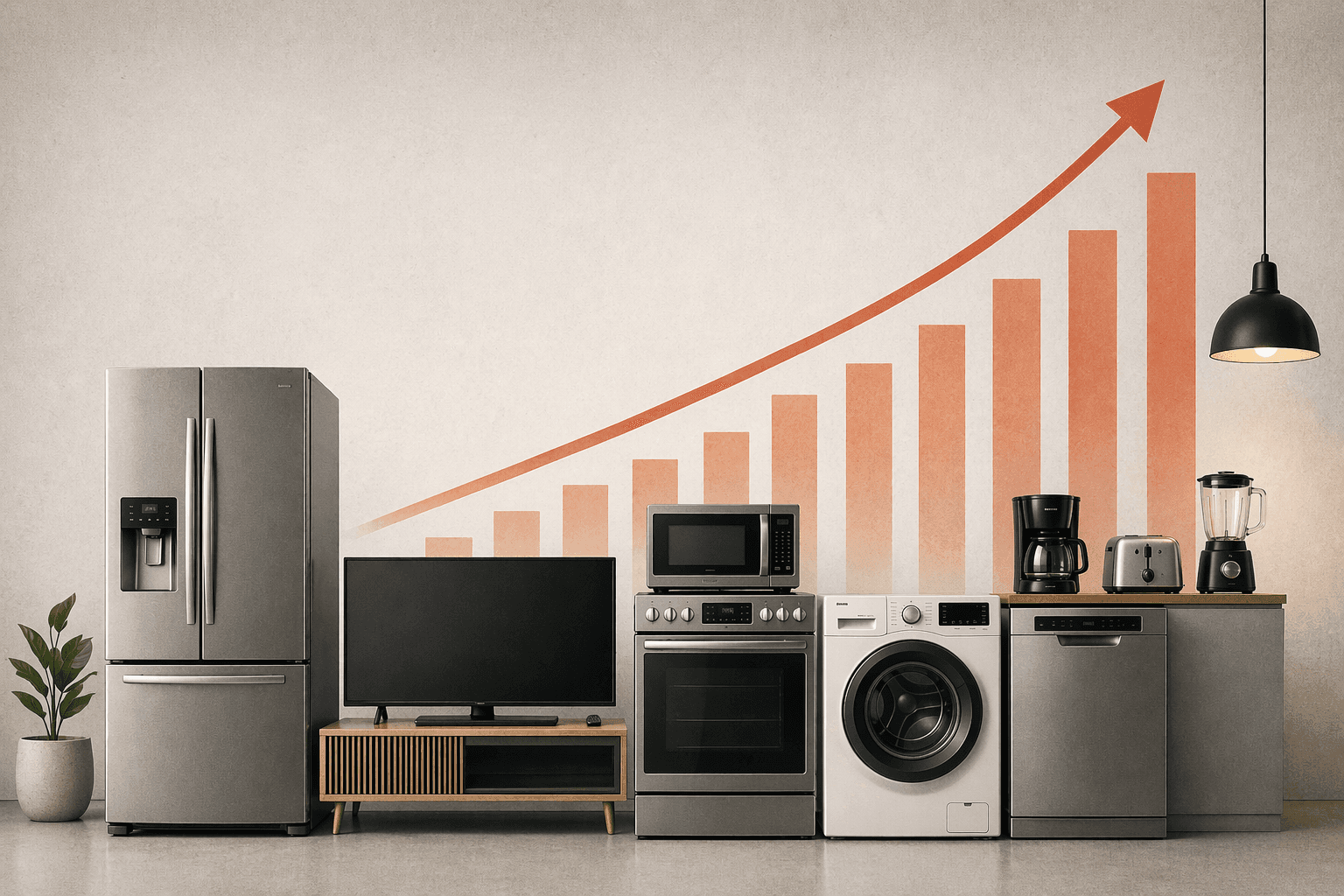
Most people blame the wrong things for their high electricity bill.
The phone charger you leave plugged in. The TV running in the background. The lights you forgot to turn off in the bathroom. These feel like the culprits because they're visible, easy to think about, and easy to fix. But the math doesn't support it. A phone charger draws so little power it barely registers on your monthly bill. A modern flat-screen TV costs less than $20 a year to run.
The real drainers are the systems and appliances that produce heat, move air, or run continuously — often in rooms you're not even in. Understanding which ones actually matter, and why, is the first step to doing something about your bill.
Here's the short version before we get into the detail: in a typical home, heating and cooling, water heating, and the clothes dryer together account for roughly 60% or more of your electricity use. Everything else — every gadget, light, and screen in your house combined — fights over what's left. If you only remember one thing from this page, remember that.
How Electricity Consumption Actually Works
Before getting into the list, it's worth understanding the unit your utility bills you for: the kilowatt-hour, or kWh.
One kWh is the amount of energy used by a 1,000-watt appliance running for one hour. Your bill is the total of all those kilowatt-hours accumulated over a month.
The formula is simple:
(Wattage × hours used per day) ÷ 1,000 = daily kWh
Multiply that by 30 and you have your monthly contribution from that appliance.
This formula explains everything. High wattage multiplied by many hours equals a big number. Low wattage, even run constantly, produces almost nothing. A 5-watt phone charger running 24 hours a day for a full month uses 3.6 kWh — a few cents. A 3,000-watt electric water heater running two hours a day uses 180 kWh — a much more meaningful line on your bill.
Two variables drive everything: how many watts the appliance pulls, and how many hours it runs. A device can be huge on one and tiny on the other. An oven pulls enormous wattage but runs for an hour at a time. A refrigerator pulls modest wattage but never switches off. Both end up mattering — for opposite reasons.
The Average American Home: Setting the Baseline
Based on 2022 EIA data, the typical U.S. home uses about 10,791 kWh of electricity per year — roughly 899 kWh per month. That's the number every percentage below is drawn from.
Knowing where your consumption goes tells you where to focus your attention. The percentages throughout this article are drawn from the U.S. Energy Information Administration's Residential Energy Consumption Survey (RECS) and end-use estimates. Your own split will shift based on your climate, the age of your equipment, whether you heat with electricity or gas, and how many people live in your home — but the ranking of the big consumers stays remarkably consistent from house to house.
The Big Picture, at a Glance
Before the detailed breakdown, here's how the major appliances stack up. Wattages are typical operating ranges; annual costs assume the appliance's real-world runtime and a national-average residential rate of about $0.17/kWh. If you live somewhere with higher rates — the Northeast and California especially — scale these numbers up accordingly (more on that below).
Appliance / System | Typical wattage when running | Est. annual use | Est. annual cost @ $0.17/kWh | Share of home electricity |
|---|---|---|---|---|
Central AC / heat pump (cooling) | 2,000–5,000 W | 1,000–3,000 kWh | $170–$510 | part of ~50% HVAC |
Electric heating (resistance/furnace) | 10,000–15,000 W | highly variable | $300–$1,200+ | part of ~50% HVAC |
Electric water heater (tank) | 3,500–4,500 W | 3,000–3,500 kWh | $510–$595 | ~9–14% |
EV charging (Level 2, if you own one) | 7,000–11,500 W | 2,000–4,000 kWh | $340–$680 | varies (often top 2) |
Pool pump (if you have one) | 1,000–2,500 W | 1,500–3,000 kWh | $255–$510 | varies |
Electric clothes dryer | 1,800–5,000 W | ~900 kWh | ~$153 | ~4% |
Refrigerator | 100–400 W | 500–800 kWh | $85–$136 | ~4–7% |
Lighting (whole home) | varies | 500–1,000 kWh | $85–$170 | ~4–9% |
Electric oven / range | 2,000–5,000 W | 300–600 kWh | $50–$100 | ~3–4% |
Dishwasher | 1,200–2,400 W | 200–300 kWh | $35–$50 | ~2% |
Television | 50–100 W | 85–130 kWh | $15–$22 | ~3–4% |
Laptop | 30–70 W | 180–300 kWh | $30–$50 | ~1% |
Phone charger | 5–20 W | ~4 kWh | ~$1 | negligible |
Notice the pattern: everything in the top half of that table either makes heat, makes cold, or runs constantly. Everything in the bottom half is a gadget. That divide is the whole story.
The Real Drainers
1. Heating and Cooling (HVAC) — 50% of home energy use
Heating and cooling together account for roughly half of the energy used in a typical American home. Your HVAC system is, by a wide margin, the single largest electricity consumer under your roof.
The reason is physics. Moving air to a precise temperature requires sustained, high-wattage effort. A central air conditioner draws between 2,000 and 5,000 watts depending on the unit size and outdoor temperature. A central AC running through a hot summer can consume over 1,000 kWh in a single month. Run that math against your local electricity rate and you'll find HVAC alone can represent the majority of your bill during peak seasons.
Electric resistance heating — baseboard heaters, space heaters, electric furnaces — is even more expensive to run than cooling because it converts electricity directly to heat at a 1:1 ratio, which is the least efficient way to heat a space. A single 1,500-watt space heater running eight hours a day adds about 360 kWh to your monthly bill.
Heat pumps are the more efficient alternative. They don't generate heat — they move it — and can produce two to four times more heating or cooling energy than the electricity they consume.
What actually helps: A programmable thermostat. Sealing air leaks around windows and doors. Annual HVAC maintenance. Upgrading to a heat pump if your system is older than 15 years.
2. Water Heating — 9% of home electricity
The water heater is the second-largest electricity consumer in most American homes, accounting for roughly 8.8% of total household electricity use according to EIA 2025 data.
A standard electric tank water heater draws between 3,500 and 4,500 watts and can consume over 3,000 kWh annually. It runs year-round, quietly, in a utility closet you walk past without thinking about it. That's what makes it such an effective budget drain — it's not seasonal, it doesn't announce itself, and most people never think to address it.
The water heater works hard because it's maintaining temperature constantly, even when no one is drawing hot water. This is called standby heat loss — the tank cools slightly, the heating element kicks on to reheat it, and the cycle repeats all day.
What actually helps: Lowering the thermostat setting to 120°F (most are set higher from the factory). Insulating the tank and pipes. Switching to a tankless water heater, which heats only on demand, eliminating standby loss entirely. Heat pump water heaters are even more efficient and can reduce water heating costs by up to 70%.
3. Clothes Dryer — 4% of home electricity
The washing machine gets equal billing when people talk about laundry energy use, but the dryer is the real offender. The washer uses relatively modest amounts of electricity — most of its energy goes toward pumping water and spinning the drum. The dryer, by contrast, uses electric heating coils to produce hot air and push it through wet fabric until it evaporates the moisture.
That's an energy-intensive process. Dryers draw anywhere from 1,800 to 5,000 watts per cycle. EIA data shows clothes dryers account for just under 4% of total household electricity consumption.
A family doing five loads a week runs a dryer roughly 260 times a year. At an average cycle length of 45 minutes and 5,000 watts, that's over 900 kWh annually — close to one month of a typical household's total electricity use just for drying clothes.
What actually helps: Line drying when weather allows. Cleaning the lint trap before every load (a clogged trap extends drying time). Running full loads only. ENERGY STAR-certified dryers use significantly less energy than older models.
4. Refrigerator — 4% of home electricity
The refrigerator is the one appliance in your house that never turns off. It runs 24 hours a day, 365 days a year, maintaining a cold interior regardless of whether it's full or empty, whether it's summer or winter.
A typical refrigerator draws 100 to 200 watts while the compressor is running, cycling on and off throughout the day. That adds up to roughly 500 kWh to 800 kWh per year for a standard unit — more for older models, larger units, or refrigerators kept in warm garages where the compressor works harder to maintain temperature.
The refrigerator's contribution to your bill is moderate compared to HVAC or the water heater, but it's also inescapable. You can't turn it off, you can't reduce its hours, and ignoring maintenance makes it run less efficiently over time.
What actually helps: Keeping the condenser coils clean. Making sure door seals are tight (a worn gasket lets cold air escape constantly). Setting the temperature to 37–40°F for the fridge and 0°F for the freezer — not colder. If you have a second refrigerator in the garage that's mostly empty, that unit may be costing more than it's worth.
5. Lighting — 4% of home electricity
Lighting used to be a major drain. It isn't anymore — at least not for homes that have switched to LEDs.
An old 60-watt incandescent bulb uses 60 watts. An equivalent LED uses about 8–10 watts for the same light output. That's roughly an 85% reduction in energy use per bulb. Across every fixture in a house, that difference compounds significantly.
Homes still running incandescent or halogen bulbs are spending far more on lighting than necessary. EIA data suggests lighting accounts for about 4% of total household electricity use — but that figure shifts considerably depending on what type of bulbs a home is using and how many hours per day lights are on.
What actually helps: Replacing remaining incandescent or CFL bulbs with LEDs. Using occupancy sensors or timers in rooms that tend to be left lit. Taking advantage of natural daylight.
6. Dishwasher and Cooking Appliances
The dishwasher gets a bad reputation for energy use, but it's less of an offender than most people expect. The motor and pump draw relatively modest wattage. The real energy hit comes from the heated drying cycle — skip that and let dishes air dry, and you cut the dishwasher's energy use significantly.
Electric ovens and ranges use substantial wattage when they're on — often 2,000 to 5,000 watts for an oven — but they run infrequently enough that their annual contribution to your bill is limited. The microwave is far more efficient for reheating. Air fryers and induction cooktops are more efficient for everyday cooking than conventional ovens.
7. EV Charging — the new heavyweight
If you own an electric vehicle, it may quietly become one of the two largest electricity consumers in your house — rivaling or beating your HVAC.
A Level 2 home charger draws 7,000 to 11,500 watts, and a typical driver adds 2,000 to 4,000 kWh per year charging at home. At $0.17/kWh that's $340 to $680 annually; in a high-rate state it can exceed $1,000. Most people never see it as a separate line because it blends into the whole-home total — but it's the equivalent of adding a second water heater that runs every night.
What actually helps: Charging overnight if your utility offers a time-of-use rate with cheaper off-peak hours. Many EVs and chargers let you schedule charging windows automatically. This is also the single load where pairing with solar makes the most financial sense, because the demand is large, predictable, and shiftable to daylight hours.
8. Pool Pumps, Well Pumps, and Hot Tubs
These don't exist in every home, but where they do, they can outweigh almost everything in the gadget category combined.
A pool pump draws 1,000 to 2,500 watts and, run several hours a day through a swimming season, can add 1,500 to 3,000 kWh a year. A hot tub holds water at temperature constantly — the same standby-loss problem as a water heater, sometimes worse. A well pump cycles on every time you run water, and an aging or oversized pump can run far longer than it should.
What actually helps: A variable-speed pool pump (these can cut pump energy by 50–70% versus single-speed). Running the pump fewer hours and during off-peak windows. Insulating hot tub covers and lowering the set temperature when it's not in use.
The Appliances People Always Blame
Let's address the usual suspects.
Television: A modern flat-screen TV uses an average of about 58 watts while running. Run it four hours a day, every day for a year, and you've consumed roughly 85 kWh — translating to about $14–$17 at average U.S. electricity rates. That's less than you probably spent on one streaming subscription. Your TV is not your electricity problem.
Phone chargers: A phone charger draws 5 to 20 watts while actively charging, and most of that time the phone isn't even drawing full power. Left plugged in with nothing connected, it draws nearly zero. The math rounds to almost nothing on a monthly basis.
Laptop: More wattage than a phone charger, but still minimal. A laptop running eight hours a day adds roughly 15–25 kWh per month — a few dollars.
Small kitchen appliances: Coffee maker, toaster, blender — these draw significant wattage, but they run for minutes, not hours. High wattage × very short run time = small number.
The reason people blame these items is visibility. You see the charger, the TV, the coffee maker. You don't see the water heater cycling on at 4 a.m. or your HVAC compressor running for six straight hours on a humid July afternoon.
What About "Vampire" Power? (Standby Loads)
There's one place the gadget-blamers are partly right: phantom load, also called standby or vampire power — the electricity devices draw while plugged in but switched off or idle.
The U.S. Department of Energy estimates standby power accounts for 5 to 10% of residential electricity use, costing the average household around $100 a year, and in gadget-heavy homes it can run higher. The biggest offenders aren't phone chargers — they're devices that stay in a "ready" state: cable and DVR boxes, gaming consoles in instant-on mode, desktop computers and monitors, soundbars, and anything with a clock or a standby light.
What actually helps: Putting clusters of electronics on a smart power strip that fully cuts power when the main device is off. Disabling "quick start" / "instant on" modes on cable boxes and consoles. Unplugging rarely used devices entirely. It won't transform your bill — but it's real money, and unlike your water heater, it costs nothing to fix.
How to Find Your Own Biggest Drains
Averages are a starting point, not your actual house. To see where your money is going:
Read your bill for your real rate and usage. Find your price per kWh and your monthly kWh total. That tells you your baseline and what each kWh actually costs you.
Run the formula on suspects. Use (wattage × hours per day) ÷ 1,000 × your rate. The nameplate or manual lists the wattage. Five minutes of this will usually surface the real offenders.
Use a plug-in watt meter (a Kill A Watt-style device, around $20–$35) for anything that plugs into a standard outlet — it shows exact draw and accumulated kWh over days. This is the fastest way to catch a failing refrigerator or a power-hungry old freezer.
Check for a usage tool from your utility. Many now offer hourly or daily usage data online or through a smart meter, which lets you spot the spikes.
The goal isn't to audit everything — it's to confirm which two or three systems dominate your bill, then concentrate your effort there.
Why Your Climate Changes the Answer
The list above holds for most homes, but where you live shifts the rankings. In hot-climate states, air conditioning can balloon to the majority of a summer bill. In cold-climate states with electric heat, winter heating dominates instead. Homes on natural gas for heat, hot water, and cooking will see their electric bill led by cooling, the dryer, and the refrigerator rather than heating.
So if your bill spikes in July, look at cooling first. If it spikes in January and you heat with electricity, heating is your lever. The season your bill peaks tells you which system to address before you spend a dollar on anything else.
A Simple Framework for Prioritizing
If you want to reduce your electricity bill, there's one question worth asking about every appliance: does it produce heat or cold, and how long does it run?
Heat-producing and temperature-maintaining appliances are almost always the answer. They draw the highest wattage and operate for the longest periods. HVAC, water heaters, dryers — these three categories alone can represent 60% or more of a home's electricity consumption, depending on climate, habits, and the age of the equipment.
Everything else — lights, electronics, kitchen gadgets — operates at a fraction of the wattage and for a fraction of the time. Addressing them is fine, but it shouldn't be the first priority. If you spend energy (and money) auditing your phone chargers while your water heater thermostat is set to 140°F and your HVAC filter hasn't been changed in a year, you're focusing on the wrong end of the problem.
Start with the biggest numbers, and the math will show you where to look.
What This Means in Rhode Island
There's a local wrinkle worth naming, because we're based in Rhode Island and see it on every bill in the state: the rate matters as much as the usage. Rhode Island has some of the highest residential electricity prices in the country — well above the national average we used in the table above. That means the exact same water heater, the same dryer, the same central AC costs a New England homeowner meaningfully more per year than it costs someone in a low-rate state.
Two takeaways follow from that. First, the payback on efficiency upgrades — heat pumps, heat pump water heaters, LED conversions, sealing the envelope — is faster here than the national numbers suggest, because every kWh you avoid is worth more. Second, the case for producing your own power is stronger here than almost anywhere, for the same reason.
The Bigger Lever: Producing Power Instead of Just Reducing It
Everything above is about using less. There's a second lever most articles skip: changing where your power comes from in the first place.
We'll be straight about this, because we build these systems and we'd rather you understand the tradeoff than be sold on it. Conservation has a floor — your refrigerator, your heat, your hot water are not optional, and there's only so far efficiency can take you. Once you've addressed the big drainers, the remaining bill is largely fixed. At that point the question stops being "how do I use less?" and becomes "do I want to keep buying every kWh from the utility at rising rates?"
This is the principle behind a zero-energy home: a tightly sealed, well-insulated building envelope paired with efficient systems and on-site solar, designed to produce roughly as much energy over a year as it consumes — which can effectively eliminate the annual electric bill. It's also why commercial and municipal building owners install solar: the biggest, most predictable loads are exactly the ones on-site generation offsets best. Whether that math works for you depends on your roof, your usage, your rate, and the incentives available — but for high-rate regions it's worth running the numbers honestly.
Frequently Asked Questions
What uses the most electricity in a home?
Heating and cooling (HVAC) is the single largest electricity user in most homes, at roughly half of total use. Water heating is usually second, followed by the clothes dryer and refrigerator. If you own an electric vehicle, home charging can rival or exceed HVAC.
Does leaving things plugged in really use electricity?
Yes, but less than most people fear. Standby ("vampire") power is real and costs the average home around $100 a year, but the culprits are cable boxes, consoles, and computers in idle mode — not idle phone chargers, which draw almost nothing.
How much does it cost to run a water heater?
A standard electric tank water heater uses over 3,000 kWh a year — roughly $500 or more at average national rates, and higher in high-rate states. Lowering the thermostat to 120°F and insulating the tank reduces that; a heat pump water heater can cut it substantially.
Is it cheaper to run the AC or electric heat?
Electric resistance heat is generally more expensive to run than air conditioning, because it converts electricity directly to heat at a 1:1 ratio. A heat pump is far more efficient than both for heating and cooling because it moves heat rather than generating it.
How do I find out which appliance is costing me the most?
Use the formula (wattage × hours per day) ÷ 1,000 × your rate per kWh, or plug suspect appliances into a $20–$35 watt meter to measure exact draw. Many utilities also provide hourly usage data through a smart meter.
Does my refrigerator use a lot of electricity?
A modern fridge draws only 100–400 watts, but because it runs 24/7 it still uses 500–800 kWh a year. Old units, oversized models, and second refrigerators in hot garages use considerably more.
Do solar panels lower the electricity my appliances use?
No — solar doesn't reduce how much your appliances use; it changes where that power comes from by generating it on-site, which can offset some or all of what you'd otherwise buy from the utility. Efficiency reduces usage; solar offsets it. The two work best together.
What's the fastest way to lower a high electric bill?
Start with the biggest loads, not the smallest. Address HVAC (thermostat, sealing leaks, maintenance, a heat pump if your system is old) and water heating first. Tackling chargers and lights while ignoring those is the most common — and least effective — mistake.
Start With the Biggest Numbers
If your electricity bill keeps climbing, the answer almost certainly isn't the gadget you can see — it's the system humming away where you can't. Find your two or three biggest loads, fix those first, and the math takes care of the rest.
At Newport Renewables, we've spent more than 15 years helping Rhode Island families and businesses cut energy costs — through high-performance, zero-energy custom homes built to produce as much power as they use, and through commercial and municipal solar across the state. If you're a homeowner thinking about building, or a business or property owner weighing solar, we're happy to give you an honest read on whether it makes sense for you.
Newport Renewables — 316 Columbia St, Wakefield, RI 02879 | 401-619-5906 | nptre.com Serving Newport, Providence, Portsmouth, Jamestown, Middletown, South Kingstown, Warwick, and communities across Rhode Island.
Let's Chat
Start your next project with Newport Renewables.
OUR SERVICES
Work with Newport Renewables
We do two things, and we do them at full scale: commercial solar across Rhode Island and ground-up custom homes built to perform. Here's where you fit.
Commercial solar for your property or business?
We design and install solar for commercial buildings, warehouses, and income properties across Rhode Island — sized to your actual load, your roof or land, and the incentives available right now. The goal isn't just panels on a roof; it's a system that pays for itself and keeps producing for decades.
→ See how commercial solar works
Building a new custom home?
We design and build custom homes with integrated zero-energy systems from the ground up. When every component — orientation, envelope, electrical capacity, HVAC, solar, storage — is planned together instead of bolted on later, you get a home that's built for long-term performance and value.
→ Learn about our zero-energy home builds
316 Columbia St • Wakefield, RI 02879 | 401.619.5906




Copyright © 2024 Newport Renewables. All Rights Reserved.
316 Columbia St • Wakefield, RI 02879 | 401.619.5906
Copyright © 2024 Newport Renewables. All Rights Reserved.
Which Household Appliances Use the Most Electricity?
Most people blame the wrong things for their high electricity bill.
The phone charger you leave plugged in. The TV running in the background. The lights you forgot to turn off in the bathroom. These feel like the culprits because they're visible, easy to think about, and easy to fix. But the math doesn't support it. A phone charger draws so little power it barely registers on your monthly bill. A modern flat-screen TV costs less than $20 a year to run.
The real drainers are the systems and appliances that produce heat, move air, or run continuously — often in rooms you're not even in. Understanding which ones actually matter, and why, is the first step to doing something about your bill.
Here's the short version before we get into the detail: in a typical home, heating and cooling, water heating, and the clothes dryer together account for roughly 60% or more of your electricity use. Everything else — every gadget, light, and screen in your house combined — fights over what's left. If you only remember one thing from this page, remember that.
How Electricity Consumption Actually Works
Before getting into the list, it's worth understanding the unit your utility bills you for: the kilowatt-hour, or kWh.
One kWh is the amount of energy used by a 1,000-watt appliance running for one hour. Your bill is the total of all those kilowatt-hours accumulated over a month.
The formula is simple:
(Wattage × hours used per day) ÷ 1,000 = daily kWh
Multiply that by 30 and you have your monthly contribution from that appliance.
This formula explains everything. High wattage multiplied by many hours equals a big number. Low wattage, even run constantly, produces almost nothing. A 5-watt phone charger running 24 hours a day for a full month uses 3.6 kWh — a few cents. A 3,000-watt electric water heater running two hours a day uses 180 kWh — a much more meaningful line on your bill.
Two variables drive everything: how many watts the appliance pulls, and how many hours it runs. A device can be huge on one and tiny on the other. An oven pulls enormous wattage but runs for an hour at a time. A refrigerator pulls modest wattage but never switches off. Both end up mattering — for opposite reasons.
The Average American Home: Setting the Baseline
Based on 2022 EIA data, the typical U.S. home uses about 10,791 kWh of electricity per year — roughly 899 kWh per month. That's the number every percentage below is drawn from.
Knowing where your consumption goes tells you where to focus your attention. The percentages throughout this article are drawn from the U.S. Energy Information Administration's Residential Energy Consumption Survey (RECS) and end-use estimates. Your own split will shift based on your climate, the age of your equipment, whether you heat with electricity or gas, and how many people live in your home — but the ranking of the big consumers stays remarkably consistent from house to house.
The Big Picture, at a Glance
Before the detailed breakdown, here's how the major appliances stack up. Wattages are typical operating ranges; annual costs assume the appliance's real-world runtime and a national-average residential rate of about $0.17/kWh. If you live somewhere with higher rates — the Northeast and California especially — scale these numbers up accordingly (more on that below).
Appliance / System | Typical wattage when running | Est. annual use | Est. annual cost @ $0.17/kWh | Share of home electricity |
|---|---|---|---|---|
Central AC / heat pump (cooling) | 2,000–5,000 W | 1,000–3,000 kWh | $170–$510 | part of ~50% HVAC |
Electric heating (resistance/furnace) | 10,000–15,000 W | highly variable | $300–$1,200+ | part of ~50% HVAC |
Electric water heater (tank) | 3,500–4,500 W | 3,000–3,500 kWh | $510–$595 | ~9–14% |
EV charging (Level 2, if you own one) | 7,000–11,500 W | 2,000–4,000 kWh | $340–$680 | varies (often top 2) |
Pool pump (if you have one) | 1,000–2,500 W | 1,500–3,000 kWh | $255–$510 | varies |
Electric clothes dryer | 1,800–5,000 W | ~900 kWh | ~$153 | ~4% |
Refrigerator | 100–400 W | 500–800 kWh | $85–$136 | ~4–7% |
Lighting (whole home) | varies | 500–1,000 kWh | $85–$170 | ~4–9% |
Electric oven / range | 2,000–5,000 W | 300–600 kWh | $50–$100 | ~3–4% |
Dishwasher | 1,200–2,400 W | 200–300 kWh | $35–$50 | ~2% |
Television | 50–100 W | 85–130 kWh | $15–$22 | ~3–4% |
Laptop | 30–70 W | 180–300 kWh | $30–$50 | ~1% |
Phone charger | 5–20 W | ~4 kWh | ~$1 | negligible |
Notice the pattern: everything in the top half of that table either makes heat, makes cold, or runs constantly. Everything in the bottom half is a gadget. That divide is the whole story.
The Real Drainers
1. Heating and Cooling (HVAC) — 50% of home energy use
Heating and cooling together account for roughly half of the energy used in a typical American home. Your HVAC system is, by a wide margin, the single largest electricity consumer under your roof.
The reason is physics. Moving air to a precise temperature requires sustained, high-wattage effort. A central air conditioner draws between 2,000 and 5,000 watts depending on the unit size and outdoor temperature. A central AC running through a hot summer can consume over 1,000 kWh in a single month. Run that math against your local electricity rate and you'll find HVAC alone can represent the majority of your bill during peak seasons.
Electric resistance heating — baseboard heaters, space heaters, electric furnaces — is even more expensive to run than cooling because it converts electricity directly to heat at a 1:1 ratio, which is the least efficient way to heat a space. A single 1,500-watt space heater running eight hours a day adds about 360 kWh to your monthly bill.
Heat pumps are the more efficient alternative. They don't generate heat — they move it — and can produce two to four times more heating or cooling energy than the electricity they consume.
What actually helps: A programmable thermostat. Sealing air leaks around windows and doors. Annual HVAC maintenance. Upgrading to a heat pump if your system is older than 15 years.
2. Water Heating — 9% of home electricity
The water heater is the second-largest electricity consumer in most American homes, accounting for roughly 8.8% of total household electricity use according to EIA 2025 data.
A standard electric tank water heater draws between 3,500 and 4,500 watts and can consume over 3,000 kWh annually. It runs year-round, quietly, in a utility closet you walk past without thinking about it. That's what makes it such an effective budget drain — it's not seasonal, it doesn't announce itself, and most people never think to address it.
The water heater works hard because it's maintaining temperature constantly, even when no one is drawing hot water. This is called standby heat loss — the tank cools slightly, the heating element kicks on to reheat it, and the cycle repeats all day.
What actually helps: Lowering the thermostat setting to 120°F (most are set higher from the factory). Insulating the tank and pipes. Switching to a tankless water heater, which heats only on demand, eliminating standby loss entirely. Heat pump water heaters are even more efficient and can reduce water heating costs by up to 70%.
3. Clothes Dryer — 4% of home electricity
The washing machine gets equal billing when people talk about laundry energy use, but the dryer is the real offender. The washer uses relatively modest amounts of electricity — most of its energy goes toward pumping water and spinning the drum. The dryer, by contrast, uses electric heating coils to produce hot air and push it through wet fabric until it evaporates the moisture.
That's an energy-intensive process. Dryers draw anywhere from 1,800 to 5,000 watts per cycle. EIA data shows clothes dryers account for just under 4% of total household electricity consumption.
A family doing five loads a week runs a dryer roughly 260 times a year. At an average cycle length of 45 minutes and 5,000 watts, that's over 900 kWh annually — close to one month of a typical household's total electricity use just for drying clothes.
What actually helps: Line drying when weather allows. Cleaning the lint trap before every load (a clogged trap extends drying time). Running full loads only. ENERGY STAR-certified dryers use significantly less energy than older models.
4. Refrigerator — 4% of home electricity
The refrigerator is the one appliance in your house that never turns off. It runs 24 hours a day, 365 days a year, maintaining a cold interior regardless of whether it's full or empty, whether it's summer or winter.
A typical refrigerator draws 100 to 200 watts while the compressor is running, cycling on and off throughout the day. That adds up to roughly 500 kWh to 800 kWh per year for a standard unit — more for older models, larger units, or refrigerators kept in warm garages where the compressor works harder to maintain temperature.
The refrigerator's contribution to your bill is moderate compared to HVAC or the water heater, but it's also inescapable. You can't turn it off, you can't reduce its hours, and ignoring maintenance makes it run less efficiently over time.
What actually helps: Keeping the condenser coils clean. Making sure door seals are tight (a worn gasket lets cold air escape constantly). Setting the temperature to 37–40°F for the fridge and 0°F for the freezer — not colder. If you have a second refrigerator in the garage that's mostly empty, that unit may be costing more than it's worth.
5. Lighting — 4% of home electricity
Lighting used to be a major drain. It isn't anymore — at least not for homes that have switched to LEDs.
An old 60-watt incandescent bulb uses 60 watts. An equivalent LED uses about 8–10 watts for the same light output. That's roughly an 85% reduction in energy use per bulb. Across every fixture in a house, that difference compounds significantly.
Homes still running incandescent or halogen bulbs are spending far more on lighting than necessary. EIA data suggests lighting accounts for about 4% of total household electricity use — but that figure shifts considerably depending on what type of bulbs a home is using and how many hours per day lights are on.
What actually helps: Replacing remaining incandescent or CFL bulbs with LEDs. Using occupancy sensors or timers in rooms that tend to be left lit. Taking advantage of natural daylight.
6. Dishwasher and Cooking Appliances
The dishwasher gets a bad reputation for energy use, but it's less of an offender than most people expect. The motor and pump draw relatively modest wattage. The real energy hit comes from the heated drying cycle — skip that and let dishes air dry, and you cut the dishwasher's energy use significantly.
Electric ovens and ranges use substantial wattage when they're on — often 2,000 to 5,000 watts for an oven — but they run infrequently enough that their annual contribution to your bill is limited. The microwave is far more efficient for reheating. Air fryers and induction cooktops are more efficient for everyday cooking than conventional ovens.
7. EV Charging — the new heavyweight
If you own an electric vehicle, it may quietly become one of the two largest electricity consumers in your house — rivaling or beating your HVAC.
A Level 2 home charger draws 7,000 to 11,500 watts, and a typical driver adds 2,000 to 4,000 kWh per year charging at home. At $0.17/kWh that's $340 to $680 annually; in a high-rate state it can exceed $1,000. Most people never see it as a separate line because it blends into the whole-home total — but it's the equivalent of adding a second water heater that runs every night.
What actually helps: Charging overnight if your utility offers a time-of-use rate with cheaper off-peak hours. Many EVs and chargers let you schedule charging windows automatically. This is also the single load where pairing with solar makes the most financial sense, because the demand is large, predictable, and shiftable to daylight hours.
8. Pool Pumps, Well Pumps, and Hot Tubs
These don't exist in every home, but where they do, they can outweigh almost everything in the gadget category combined.
A pool pump draws 1,000 to 2,500 watts and, run several hours a day through a swimming season, can add 1,500 to 3,000 kWh a year. A hot tub holds water at temperature constantly — the same standby-loss problem as a water heater, sometimes worse. A well pump cycles on every time you run water, and an aging or oversized pump can run far longer than it should.
What actually helps: A variable-speed pool pump (these can cut pump energy by 50–70% versus single-speed). Running the pump fewer hours and during off-peak windows. Insulating hot tub covers and lowering the set temperature when it's not in use.
The Appliances People Always Blame
Let's address the usual suspects.
Television: A modern flat-screen TV uses an average of about 58 watts while running. Run it four hours a day, every day for a year, and you've consumed roughly 85 kWh — translating to about $14–$17 at average U.S. electricity rates. That's less than you probably spent on one streaming subscription. Your TV is not your electricity problem.
Phone chargers: A phone charger draws 5 to 20 watts while actively charging, and most of that time the phone isn't even drawing full power. Left plugged in with nothing connected, it draws nearly zero. The math rounds to almost nothing on a monthly basis.
Laptop: More wattage than a phone charger, but still minimal. A laptop running eight hours a day adds roughly 15–25 kWh per month — a few dollars.
Small kitchen appliances: Coffee maker, toaster, blender — these draw significant wattage, but they run for minutes, not hours. High wattage × very short run time = small number.
The reason people blame these items is visibility. You see the charger, the TV, the coffee maker. You don't see the water heater cycling on at 4 a.m. or your HVAC compressor running for six straight hours on a humid July afternoon.
What About "Vampire" Power? (Standby Loads)
There's one place the gadget-blamers are partly right: phantom load, also called standby or vampire power — the electricity devices draw while plugged in but switched off or idle.
The U.S. Department of Energy estimates standby power accounts for 5 to 10% of residential electricity use, costing the average household around $100 a year, and in gadget-heavy homes it can run higher. The biggest offenders aren't phone chargers — they're devices that stay in a "ready" state: cable and DVR boxes, gaming consoles in instant-on mode, desktop computers and monitors, soundbars, and anything with a clock or a standby light.
What actually helps: Putting clusters of electronics on a smart power strip that fully cuts power when the main device is off. Disabling "quick start" / "instant on" modes on cable boxes and consoles. Unplugging rarely used devices entirely. It won't transform your bill — but it's real money, and unlike your water heater, it costs nothing to fix.
How to Find Your Own Biggest Drains
Averages are a starting point, not your actual house. To see where your money is going:
Read your bill for your real rate and usage. Find your price per kWh and your monthly kWh total. That tells you your baseline and what each kWh actually costs you.
Run the formula on suspects. Use (wattage × hours per day) ÷ 1,000 × your rate. The nameplate or manual lists the wattage. Five minutes of this will usually surface the real offenders.
Use a plug-in watt meter (a Kill A Watt-style device, around $20–$35) for anything that plugs into a standard outlet — it shows exact draw and accumulated kWh over days. This is the fastest way to catch a failing refrigerator or a power-hungry old freezer.
Check for a usage tool from your utility. Many now offer hourly or daily usage data online or through a smart meter, which lets you spot the spikes.
The goal isn't to audit everything — it's to confirm which two or three systems dominate your bill, then concentrate your effort there.
Why Your Climate Changes the Answer
The list above holds for most homes, but where you live shifts the rankings. In hot-climate states, air conditioning can balloon to the majority of a summer bill. In cold-climate states with electric heat, winter heating dominates instead. Homes on natural gas for heat, hot water, and cooking will see their electric bill led by cooling, the dryer, and the refrigerator rather than heating.
So if your bill spikes in July, look at cooling first. If it spikes in January and you heat with electricity, heating is your lever. The season your bill peaks tells you which system to address before you spend a dollar on anything else.
A Simple Framework for Prioritizing
If you want to reduce your electricity bill, there's one question worth asking about every appliance: does it produce heat or cold, and how long does it run?
Heat-producing and temperature-maintaining appliances are almost always the answer. They draw the highest wattage and operate for the longest periods. HVAC, water heaters, dryers — these three categories alone can represent 60% or more of a home's electricity consumption, depending on climate, habits, and the age of the equipment.
Everything else — lights, electronics, kitchen gadgets — operates at a fraction of the wattage and for a fraction of the time. Addressing them is fine, but it shouldn't be the first priority. If you spend energy (and money) auditing your phone chargers while your water heater thermostat is set to 140°F and your HVAC filter hasn't been changed in a year, you're focusing on the wrong end of the problem.
Start with the biggest numbers, and the math will show you where to look.
What This Means in Rhode Island
There's a local wrinkle worth naming, because we're based in Rhode Island and see it on every bill in the state: the rate matters as much as the usage. Rhode Island has some of the highest residential electricity prices in the country — well above the national average we used in the table above. That means the exact same water heater, the same dryer, the same central AC costs a New England homeowner meaningfully more per year than it costs someone in a low-rate state.
Two takeaways follow from that. First, the payback on efficiency upgrades — heat pumps, heat pump water heaters, LED conversions, sealing the envelope — is faster here than the national numbers suggest, because every kWh you avoid is worth more. Second, the case for producing your own power is stronger here than almost anywhere, for the same reason.
The Bigger Lever: Producing Power Instead of Just Reducing It
Everything above is about using less. There's a second lever most articles skip: changing where your power comes from in the first place.
We'll be straight about this, because we build these systems and we'd rather you understand the tradeoff than be sold on it. Conservation has a floor — your refrigerator, your heat, your hot water are not optional, and there's only so far efficiency can take you. Once you've addressed the big drainers, the remaining bill is largely fixed. At that point the question stops being "how do I use less?" and becomes "do I want to keep buying every kWh from the utility at rising rates?"
This is the principle behind a zero-energy home: a tightly sealed, well-insulated building envelope paired with efficient systems and on-site solar, designed to produce roughly as much energy over a year as it consumes — which can effectively eliminate the annual electric bill. It's also why commercial and municipal building owners install solar: the biggest, most predictable loads are exactly the ones on-site generation offsets best. Whether that math works for you depends on your roof, your usage, your rate, and the incentives available — but for high-rate regions it's worth running the numbers honestly.
Frequently Asked Questions
What uses the most electricity in a home?
Heating and cooling (HVAC) is the single largest electricity user in most homes, at roughly half of total use. Water heating is usually second, followed by the clothes dryer and refrigerator. If you own an electric vehicle, home charging can rival or exceed HVAC.
Does leaving things plugged in really use electricity?
Yes, but less than most people fear. Standby ("vampire") power is real and costs the average home around $100 a year, but the culprits are cable boxes, consoles, and computers in idle mode — not idle phone chargers, which draw almost nothing.
How much does it cost to run a water heater?
A standard electric tank water heater uses over 3,000 kWh a year — roughly $500 or more at average national rates, and higher in high-rate states. Lowering the thermostat to 120°F and insulating the tank reduces that; a heat pump water heater can cut it substantially.
Is it cheaper to run the AC or electric heat?
Electric resistance heat is generally more expensive to run than air conditioning, because it converts electricity directly to heat at a 1:1 ratio. A heat pump is far more efficient than both for heating and cooling because it moves heat rather than generating it.
How do I find out which appliance is costing me the most?
Use the formula (wattage × hours per day) ÷ 1,000 × your rate per kWh, or plug suspect appliances into a $20–$35 watt meter to measure exact draw. Many utilities also provide hourly usage data through a smart meter.
Does my refrigerator use a lot of electricity?
A modern fridge draws only 100–400 watts, but because it runs 24/7 it still uses 500–800 kWh a year. Old units, oversized models, and second refrigerators in hot garages use considerably more.
Do solar panels lower the electricity my appliances use?
No — solar doesn't reduce how much your appliances use; it changes where that power comes from by generating it on-site, which can offset some or all of what you'd otherwise buy from the utility. Efficiency reduces usage; solar offsets it. The two work best together.
What's the fastest way to lower a high electric bill?
Start with the biggest loads, not the smallest. Address HVAC (thermostat, sealing leaks, maintenance, a heat pump if your system is old) and water heating first. Tackling chargers and lights while ignoring those is the most common — and least effective — mistake.
Start With the Biggest Numbers
If your electricity bill keeps climbing, the answer almost certainly isn't the gadget you can see — it's the system humming away where you can't. Find your two or three biggest loads, fix those first, and the math takes care of the rest.
At Newport Renewables, we've spent more than 15 years helping Rhode Island families and businesses cut energy costs — through high-performance, zero-energy custom homes built to produce as much power as they use, and through commercial and municipal solar across the state. If you're a homeowner thinking about building, or a business or property owner weighing solar, we're happy to give you an honest read on whether it makes sense for you.
Newport Renewables — 316 Columbia St, Wakefield, RI 02879 | 401-619-5906 | nptre.com Serving Newport, Providence, Portsmouth, Jamestown, Middletown, South Kingstown, Warwick, and communities across Rhode Island.
OUR SERVICES
Work with Newport Renewables
We do two things, and we do them at full scale: commercial solar across Rhode Island and ground-up custom homes built to perform. Here's where you fit.
Commercial solar for your property or business?
We design and install solar for commercial buildings, warehouses, and income properties across Rhode Island — sized to your actual load, your roof or land, and the incentives available right now. The goal isn't just panels on a roof; it's a system that pays for itself and keeps producing for decades.
→ See how commercial solar works
Building a new custom home?
We design and build custom homes with integrated zero-energy systems from the ground up. When every component — orientation, envelope, electrical capacity, HVAC, solar, storage — is planned together instead of bolted on later, you get a home that's built for long-term performance and value.
→ Learn about our zero-energy home builds
316 Columbia St • Wakefield, RI 02879 | 401.619.5906
Copyright © 2024 Newport Renewables. All Rights Reserved.

Which Household Appliances Use the Most Electricity?
Most people blame the wrong things for their high electricity bill.
The phone charger you leave plugged in. The TV running in the background. The lights you forgot to turn off in the bathroom. These feel like the culprits because they're visible, easy to think about, and easy to fix. But the math doesn't support it. A phone charger draws so little power it barely registers on your monthly bill. A modern flat-screen TV costs less than $20 a year to run.
The real drainers are the systems and appliances that produce heat, move air, or run continuously — often in rooms you're not even in. Understanding which ones actually matter, and why, is the first step to doing something about your bill.
Here's the short version before we get into the detail: in a typical home, heating and cooling, water heating, and the clothes dryer together account for roughly 60% or more of your electricity use. Everything else — every gadget, light, and screen in your house combined — fights over what's left. If you only remember one thing from this page, remember that.
How Electricity Consumption Actually Works
Before getting into the list, it's worth understanding the unit your utility bills you for: the kilowatt-hour, or kWh.
One kWh is the amount of energy used by a 1,000-watt appliance running for one hour. Your bill is the total of all those kilowatt-hours accumulated over a month.
The formula is simple:
(Wattage × hours used per day) ÷ 1,000 = daily kWh
Multiply that by 30 and you have your monthly contribution from that appliance.
This formula explains everything. High wattage multiplied by many hours equals a big number. Low wattage, even run constantly, produces almost nothing. A 5-watt phone charger running 24 hours a day for a full month uses 3.6 kWh — a few cents. A 3,000-watt electric water heater running two hours a day uses 180 kWh — a much more meaningful line on your bill.
Two variables drive everything: how many watts the appliance pulls, and how many hours it runs. A device can be huge on one and tiny on the other. An oven pulls enormous wattage but runs for an hour at a time. A refrigerator pulls modest wattage but never switches off. Both end up mattering — for opposite reasons.
The Average American Home: Setting the Baseline
Based on 2022 EIA data, the typical U.S. home uses about 10,791 kWh of electricity per year — roughly 899 kWh per month. That's the number every percentage below is drawn from.
Knowing where your consumption goes tells you where to focus your attention. The percentages throughout this article are drawn from the U.S. Energy Information Administration's Residential Energy Consumption Survey (RECS) and end-use estimates. Your own split will shift based on your climate, the age of your equipment, whether you heat with electricity or gas, and how many people live in your home — but the ranking of the big consumers stays remarkably consistent from house to house.
The Big Picture, at a Glance
Before the detailed breakdown, here's how the major appliances stack up. Wattages are typical operating ranges; annual costs assume the appliance's real-world runtime and a national-average residential rate of about $0.17/kWh. If you live somewhere with higher rates — the Northeast and California especially — scale these numbers up accordingly (more on that below).
Appliance / System | Typical wattage when running | Est. annual use | Est. annual cost @ $0.17/kWh | Share of home electricity |
|---|---|---|---|---|
Central AC / heat pump (cooling) | 2,000–5,000 W | 1,000–3,000 kWh | $170–$510 | part of ~50% HVAC |
Electric heating (resistance/furnace) | 10,000–15,000 W | highly variable | $300–$1,200+ | part of ~50% HVAC |
Electric water heater (tank) | 3,500–4,500 W | 3,000–3,500 kWh | $510–$595 | ~9–14% |
EV charging (Level 2, if you own one) | 7,000–11,500 W | 2,000–4,000 kWh | $340–$680 | varies (often top 2) |
Pool pump (if you have one) | 1,000–2,500 W | 1,500–3,000 kWh | $255–$510 | varies |
Electric clothes dryer | 1,800–5,000 W | ~900 kWh | ~$153 | ~4% |
Refrigerator | 100–400 W | 500–800 kWh | $85–$136 | ~4–7% |
Lighting (whole home) | varies | 500–1,000 kWh | $85–$170 | ~4–9% |
Electric oven / range | 2,000–5,000 W | 300–600 kWh | $50–$100 | ~3–4% |
Dishwasher | 1,200–2,400 W | 200–300 kWh | $35–$50 | ~2% |
Television | 50–100 W | 85–130 kWh | $15–$22 | ~3–4% |
Laptop | 30–70 W | 180–300 kWh | $30–$50 | ~1% |
Phone charger | 5–20 W | ~4 kWh | ~$1 | negligible |
Notice the pattern: everything in the top half of that table either makes heat, makes cold, or runs constantly. Everything in the bottom half is a gadget. That divide is the whole story.
The Real Drainers
1. Heating and Cooling (HVAC) — 50% of home energy use
Heating and cooling together account for roughly half of the energy used in a typical American home. Your HVAC system is, by a wide margin, the single largest electricity consumer under your roof.
The reason is physics. Moving air to a precise temperature requires sustained, high-wattage effort. A central air conditioner draws between 2,000 and 5,000 watts depending on the unit size and outdoor temperature. A central AC running through a hot summer can consume over 1,000 kWh in a single month. Run that math against your local electricity rate and you'll find HVAC alone can represent the majority of your bill during peak seasons.
Electric resistance heating — baseboard heaters, space heaters, electric furnaces — is even more expensive to run than cooling because it converts electricity directly to heat at a 1:1 ratio, which is the least efficient way to heat a space. A single 1,500-watt space heater running eight hours a day adds about 360 kWh to your monthly bill.
Heat pumps are the more efficient alternative. They don't generate heat — they move it — and can produce two to four times more heating or cooling energy than the electricity they consume.
What actually helps: A programmable thermostat. Sealing air leaks around windows and doors. Annual HVAC maintenance. Upgrading to a heat pump if your system is older than 15 years.
2. Water Heating — 9% of home electricity
The water heater is the second-largest electricity consumer in most American homes, accounting for roughly 8.8% of total household electricity use according to EIA 2025 data.
A standard electric tank water heater draws between 3,500 and 4,500 watts and can consume over 3,000 kWh annually. It runs year-round, quietly, in a utility closet you walk past without thinking about it. That's what makes it such an effective budget drain — it's not seasonal, it doesn't announce itself, and most people never think to address it.
The water heater works hard because it's maintaining temperature constantly, even when no one is drawing hot water. This is called standby heat loss — the tank cools slightly, the heating element kicks on to reheat it, and the cycle repeats all day.
What actually helps: Lowering the thermostat setting to 120°F (most are set higher from the factory). Insulating the tank and pipes. Switching to a tankless water heater, which heats only on demand, eliminating standby loss entirely. Heat pump water heaters are even more efficient and can reduce water heating costs by up to 70%.
3. Clothes Dryer — 4% of home electricity
The washing machine gets equal billing when people talk about laundry energy use, but the dryer is the real offender. The washer uses relatively modest amounts of electricity — most of its energy goes toward pumping water and spinning the drum. The dryer, by contrast, uses electric heating coils to produce hot air and push it through wet fabric until it evaporates the moisture.
That's an energy-intensive process. Dryers draw anywhere from 1,800 to 5,000 watts per cycle. EIA data shows clothes dryers account for just under 4% of total household electricity consumption.
A family doing five loads a week runs a dryer roughly 260 times a year. At an average cycle length of 45 minutes and 5,000 watts, that's over 900 kWh annually — close to one month of a typical household's total electricity use just for drying clothes.
What actually helps: Line drying when weather allows. Cleaning the lint trap before every load (a clogged trap extends drying time). Running full loads only. ENERGY STAR-certified dryers use significantly less energy than older models.
4. Refrigerator — 4% of home electricity
The refrigerator is the one appliance in your house that never turns off. It runs 24 hours a day, 365 days a year, maintaining a cold interior regardless of whether it's full or empty, whether it's summer or winter.
A typical refrigerator draws 100 to 200 watts while the compressor is running, cycling on and off throughout the day. That adds up to roughly 500 kWh to 800 kWh per year for a standard unit — more for older models, larger units, or refrigerators kept in warm garages where the compressor works harder to maintain temperature.
The refrigerator's contribution to your bill is moderate compared to HVAC or the water heater, but it's also inescapable. You can't turn it off, you can't reduce its hours, and ignoring maintenance makes it run less efficiently over time.
What actually helps: Keeping the condenser coils clean. Making sure door seals are tight (a worn gasket lets cold air escape constantly). Setting the temperature to 37–40°F for the fridge and 0°F for the freezer — not colder. If you have a second refrigerator in the garage that's mostly empty, that unit may be costing more than it's worth.
5. Lighting — 4% of home electricity
Lighting used to be a major drain. It isn't anymore — at least not for homes that have switched to LEDs.
An old 60-watt incandescent bulb uses 60 watts. An equivalent LED uses about 8–10 watts for the same light output. That's roughly an 85% reduction in energy use per bulb. Across every fixture in a house, that difference compounds significantly.
Homes still running incandescent or halogen bulbs are spending far more on lighting than necessary. EIA data suggests lighting accounts for about 4% of total household electricity use — but that figure shifts considerably depending on what type of bulbs a home is using and how many hours per day lights are on.
What actually helps: Replacing remaining incandescent or CFL bulbs with LEDs. Using occupancy sensors or timers in rooms that tend to be left lit. Taking advantage of natural daylight.
6. Dishwasher and Cooking Appliances
The dishwasher gets a bad reputation for energy use, but it's less of an offender than most people expect. The motor and pump draw relatively modest wattage. The real energy hit comes from the heated drying cycle — skip that and let dishes air dry, and you cut the dishwasher's energy use significantly.
Electric ovens and ranges use substantial wattage when they're on — often 2,000 to 5,000 watts for an oven — but they run infrequently enough that their annual contribution to your bill is limited. The microwave is far more efficient for reheating. Air fryers and induction cooktops are more efficient for everyday cooking than conventional ovens.
7. EV Charging — the new heavyweight
If you own an electric vehicle, it may quietly become one of the two largest electricity consumers in your house — rivaling or beating your HVAC.
A Level 2 home charger draws 7,000 to 11,500 watts, and a typical driver adds 2,000 to 4,000 kWh per year charging at home. At $0.17/kWh that's $340 to $680 annually; in a high-rate state it can exceed $1,000. Most people never see it as a separate line because it blends into the whole-home total — but it's the equivalent of adding a second water heater that runs every night.
What actually helps: Charging overnight if your utility offers a time-of-use rate with cheaper off-peak hours. Many EVs and chargers let you schedule charging windows automatically. This is also the single load where pairing with solar makes the most financial sense, because the demand is large, predictable, and shiftable to daylight hours.
8. Pool Pumps, Well Pumps, and Hot Tubs
These don't exist in every home, but where they do, they can outweigh almost everything in the gadget category combined.
A pool pump draws 1,000 to 2,500 watts and, run several hours a day through a swimming season, can add 1,500 to 3,000 kWh a year. A hot tub holds water at temperature constantly — the same standby-loss problem as a water heater, sometimes worse. A well pump cycles on every time you run water, and an aging or oversized pump can run far longer than it should.
What actually helps: A variable-speed pool pump (these can cut pump energy by 50–70% versus single-speed). Running the pump fewer hours and during off-peak windows. Insulating hot tub covers and lowering the set temperature when it's not in use.
The Appliances People Always Blame
Let's address the usual suspects.
Television: A modern flat-screen TV uses an average of about 58 watts while running. Run it four hours a day, every day for a year, and you've consumed roughly 85 kWh — translating to about $14–$17 at average U.S. electricity rates. That's less than you probably spent on one streaming subscription. Your TV is not your electricity problem.
Phone chargers: A phone charger draws 5 to 20 watts while actively charging, and most of that time the phone isn't even drawing full power. Left plugged in with nothing connected, it draws nearly zero. The math rounds to almost nothing on a monthly basis.
Laptop: More wattage than a phone charger, but still minimal. A laptop running eight hours a day adds roughly 15–25 kWh per month — a few dollars.
Small kitchen appliances: Coffee maker, toaster, blender — these draw significant wattage, but they run for minutes, not hours. High wattage × very short run time = small number.
The reason people blame these items is visibility. You see the charger, the TV, the coffee maker. You don't see the water heater cycling on at 4 a.m. or your HVAC compressor running for six straight hours on a humid July afternoon.
What About "Vampire" Power? (Standby Loads)
There's one place the gadget-blamers are partly right: phantom load, also called standby or vampire power — the electricity devices draw while plugged in but switched off or idle.
The U.S. Department of Energy estimates standby power accounts for 5 to 10% of residential electricity use, costing the average household around $100 a year, and in gadget-heavy homes it can run higher. The biggest offenders aren't phone chargers — they're devices that stay in a "ready" state: cable and DVR boxes, gaming consoles in instant-on mode, desktop computers and monitors, soundbars, and anything with a clock or a standby light.
What actually helps: Putting clusters of electronics on a smart power strip that fully cuts power when the main device is off. Disabling "quick start" / "instant on" modes on cable boxes and consoles. Unplugging rarely used devices entirely. It won't transform your bill — but it's real money, and unlike your water heater, it costs nothing to fix.
How to Find Your Own Biggest Drains
Averages are a starting point, not your actual house. To see where your money is going:
Read your bill for your real rate and usage. Find your price per kWh and your monthly kWh total. That tells you your baseline and what each kWh actually costs you.
Run the formula on suspects. Use (wattage × hours per day) ÷ 1,000 × your rate. The nameplate or manual lists the wattage. Five minutes of this will usually surface the real offenders.
Use a plug-in watt meter (a Kill A Watt-style device, around $20–$35) for anything that plugs into a standard outlet — it shows exact draw and accumulated kWh over days. This is the fastest way to catch a failing refrigerator or a power-hungry old freezer.
Check for a usage tool from your utility. Many now offer hourly or daily usage data online or through a smart meter, which lets you spot the spikes.
The goal isn't to audit everything — it's to confirm which two or three systems dominate your bill, then concentrate your effort there.
Why Your Climate Changes the Answer
The list above holds for most homes, but where you live shifts the rankings. In hot-climate states, air conditioning can balloon to the majority of a summer bill. In cold-climate states with electric heat, winter heating dominates instead. Homes on natural gas for heat, hot water, and cooking will see their electric bill led by cooling, the dryer, and the refrigerator rather than heating.
So if your bill spikes in July, look at cooling first. If it spikes in January and you heat with electricity, heating is your lever. The season your bill peaks tells you which system to address before you spend a dollar on anything else.
A Simple Framework for Prioritizing
If you want to reduce your electricity bill, there's one question worth asking about every appliance: does it produce heat or cold, and how long does it run?
Heat-producing and temperature-maintaining appliances are almost always the answer. They draw the highest wattage and operate for the longest periods. HVAC, water heaters, dryers — these three categories alone can represent 60% or more of a home's electricity consumption, depending on climate, habits, and the age of the equipment.
Everything else — lights, electronics, kitchen gadgets — operates at a fraction of the wattage and for a fraction of the time. Addressing them is fine, but it shouldn't be the first priority. If you spend energy (and money) auditing your phone chargers while your water heater thermostat is set to 140°F and your HVAC filter hasn't been changed in a year, you're focusing on the wrong end of the problem.
Start with the biggest numbers, and the math will show you where to look.
What This Means in Rhode Island
There's a local wrinkle worth naming, because we're based in Rhode Island and see it on every bill in the state: the rate matters as much as the usage. Rhode Island has some of the highest residential electricity prices in the country — well above the national average we used in the table above. That means the exact same water heater, the same dryer, the same central AC costs a New England homeowner meaningfully more per year than it costs someone in a low-rate state.
Two takeaways follow from that. First, the payback on efficiency upgrades — heat pumps, heat pump water heaters, LED conversions, sealing the envelope — is faster here than the national numbers suggest, because every kWh you avoid is worth more. Second, the case for producing your own power is stronger here than almost anywhere, for the same reason.
The Bigger Lever: Producing Power Instead of Just Reducing It
Everything above is about using less. There's a second lever most articles skip: changing where your power comes from in the first place.
We'll be straight about this, because we build these systems and we'd rather you understand the tradeoff than be sold on it. Conservation has a floor — your refrigerator, your heat, your hot water are not optional, and there's only so far efficiency can take you. Once you've addressed the big drainers, the remaining bill is largely fixed. At that point the question stops being "how do I use less?" and becomes "do I want to keep buying every kWh from the utility at rising rates?"
This is the principle behind a zero-energy home: a tightly sealed, well-insulated building envelope paired with efficient systems and on-site solar, designed to produce roughly as much energy over a year as it consumes — which can effectively eliminate the annual electric bill. It's also why commercial and municipal building owners install solar: the biggest, most predictable loads are exactly the ones on-site generation offsets best. Whether that math works for you depends on your roof, your usage, your rate, and the incentives available — but for high-rate regions it's worth running the numbers honestly.
Frequently Asked Questions
What uses the most electricity in a home?
Heating and cooling (HVAC) is the single largest electricity user in most homes, at roughly half of total use. Water heating is usually second, followed by the clothes dryer and refrigerator. If you own an electric vehicle, home charging can rival or exceed HVAC.
Does leaving things plugged in really use electricity?
Yes, but less than most people fear. Standby ("vampire") power is real and costs the average home around $100 a year, but the culprits are cable boxes, consoles, and computers in idle mode — not idle phone chargers, which draw almost nothing.
How much does it cost to run a water heater?
A standard electric tank water heater uses over 3,000 kWh a year — roughly $500 or more at average national rates, and higher in high-rate states. Lowering the thermostat to 120°F and insulating the tank reduces that; a heat pump water heater can cut it substantially.
Is it cheaper to run the AC or electric heat?
Electric resistance heat is generally more expensive to run than air conditioning, because it converts electricity directly to heat at a 1:1 ratio. A heat pump is far more efficient than both for heating and cooling because it moves heat rather than generating it.
How do I find out which appliance is costing me the most?
Use the formula (wattage × hours per day) ÷ 1,000 × your rate per kWh, or plug suspect appliances into a $20–$35 watt meter to measure exact draw. Many utilities also provide hourly usage data through a smart meter.
Does my refrigerator use a lot of electricity?
A modern fridge draws only 100–400 watts, but because it runs 24/7 it still uses 500–800 kWh a year. Old units, oversized models, and second refrigerators in hot garages use considerably more.
Do solar panels lower the electricity my appliances use?
No — solar doesn't reduce how much your appliances use; it changes where that power comes from by generating it on-site, which can offset some or all of what you'd otherwise buy from the utility. Efficiency reduces usage; solar offsets it. The two work best together.
What's the fastest way to lower a high electric bill?
Start with the biggest loads, not the smallest. Address HVAC (thermostat, sealing leaks, maintenance, a heat pump if your system is old) and water heating first. Tackling chargers and lights while ignoring those is the most common — and least effective — mistake.
Start With the Biggest Numbers
If your electricity bill keeps climbing, the answer almost certainly isn't the gadget you can see — it's the system humming away where you can't. Find your two or three biggest loads, fix those first, and the math takes care of the rest.
At Newport Renewables, we've spent more than 15 years helping Rhode Island families and businesses cut energy costs — through high-performance, zero-energy custom homes built to produce as much power as they use, and through commercial and municipal solar across the state. If you're a homeowner thinking about building, or a business or property owner weighing solar, we're happy to give you an honest read on whether it makes sense for you.
Newport Renewables — 316 Columbia St, Wakefield, RI 02879 | 401-619-5906 | nptre.com Serving Newport, Providence, Portsmouth, Jamestown, Middletown, South Kingstown, Warwick, and communities across Rhode Island.
OUR SERVICES
Work with Newport Renewables
We do two things, and we do them at full scale: commercial solar across Rhode Island and ground-up custom homes built to perform. Here's where you fit.
Commercial solar for your property or business?
We design and install solar for commercial buildings, warehouses, and income properties across Rhode Island — sized to your actual load, your roof or land, and the incentives available right now. The goal isn't just panels on a roof; it's a system that pays for itself and keeps producing for decades.
→ See how commercial solar works
Building a new custom home?
We design and build custom homes with integrated zero-energy systems from the ground up. When every component — orientation, envelope, electrical capacity, HVAC, solar, storage — is planned together instead of bolted on later, you get a home that's built for long-term performance and value.
→ Learn about our zero-energy home builds
Let's Chat
Start your next project with Newport Renewables.
316 Columbia St • Wakefield, RI 02879 | 401.619.5906
Copyright © 2024 Newport Renewables. All Rights Reserved.
316 Columbia St • Wakefield, RI 02879 | 401.619.5906
Copyright © 2024 Newport Renewables. All Rights Reserved.