Solar Operations & Maintenance: What to Expect After Your System Is Installed
Most of the conversation around commercial solar focuses on the installation decision — the upfront cost, the ROI projections, the incentives. What happens after the system is running gets far less attention, even though the operational phase is where a 25-year investment actually plays out.
The short version: commercial solar systems require very little ongoing attention. No fuel, no moving parts, no regular service intervals the way mechanical equipment demands. But "very little" is not the same as "nothing," and understanding what's actually involved helps you plan for it correctly and catch problems before they become expensive.
Here's what operations and maintenance actually looks like for a commercial solar system.
Solar Systems Are Built to Run with Minimal Intervention
Solar panels have no moving parts. They sit on your roof or ground array, convert sunlight to electricity, and degrade at roughly 0.5% per year — a rate slow enough that most panels still produce above 80% of their original output after 25 years. There's nothing to lubricate, nothing to tune, no consumables to replenish.
This is by design. The photovoltaic effect — the process by which light creates an electrical current in a semiconductor material — is passive. The National Renewable Energy Laboratory's Best Practices for Operation and Maintenance of Photovoltaic and Energy Storage Systems notes that selecting low- or no-maintenance alternatives at the design stage is a foundational principle of good system engineering. A well-designed commercial system should require no more than a few hours of professional attention per year under normal conditions.
That said, "largely self-maintaining" doesn't mean "set it and forget it." The few things that do require attention matter precisely because ignoring them can mask performance problems for months before anyone notices.
What Routine Maintenance Actually Involves
For most commercial systems in New England, routine maintenance covers four areas:
Panel cleaning. In climates with regular rainfall, panels are typically self-cleaning — rain washes off accumulated dust and debris. That said, a periodic visual inspection is worth doing to catch anything rainfall won't handle on its own, like bird droppings, leaf buildup, or shading from nearby growth. If something looks off, it makes sense to bring someone in for a professional cleaning.
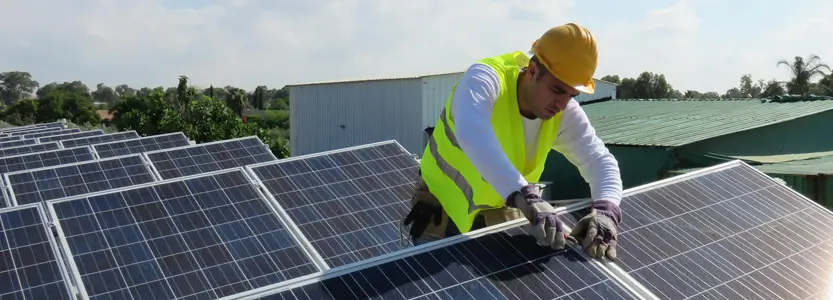
Physical inspection. Panels, mounting hardware, wiring conduits, and junction boxes should be inspected periodically for physical damage — cracked glass, loose connections, signs of water intrusion, corrosion on electrical connections. The Pacific Northwest National Laboratory's O&M guidelines recommend a routine that includes verifying all mounting hardware is secure and checking for any wiring that shows movement or wear from wind and thermal expansion.
Inverter checks. Inverters are wall-mounted or cabinet-mounted and accessible at ground level, making them straightforward to inspect visually. Checking for error codes, verifying ventilation is clear, and confirming the unit is operating within expected parameters takes minutes. Most modern inverters report status data remotely, so many of these checks happen automatically through the monitoring system.
Monitoring review. This is the highest-value maintenance activity, and it's discussed in detail in the next section.
NREL's multi-organization working group on PV O&M recommends budgeting approximately 1% of initial system cost annually for small commercial systems — that figure covers routine inspections, cleaning when needed, and a reserve for any corrective maintenance that arises.
Monitoring: The Most Important Ongoing Task
Modern commercial solar systems come with monitoring platforms that report production data in real time — typically accessible through a web portal or mobile app. Your system's inverter or a dedicated monitoring device measures output continuously and flags deviations from expected performance.
This matters because performance problems are not always obvious. A string of panels with a failed connection, a shading issue from new rooftop equipment, or an inverter operating below capacity can all reduce output significantly without triggering any alarm you'd notice physically. NREL's research on PV system performance notes that these issues can be "masked" by other system factors, meaning a system can appear to be functioning while underperforming by 10, 15, or 20%.
Solar insolation — the amount of solar radiation hitting your panels — naturally varies by plus or minus 10% from year to year. Monitoring platforms account for this. When production falls outside the expected range adjusted for actual weather conditions, that's when you investigate.
Inverter Lifespan and Replacement
Panels are built to last 25 to 30 years. Inverters are not. They're the one component in a commercial solar system that most owners will need to replace at least once over the system's life.
String inverters — the most common configuration for commercial rooftop systems, where a central unit converts DC power from a series of panels into usable AC electricity — typically last 10 to 15 years. That means a system installed today should plan for one inverter replacement before the panels reach end of life. Microinverters, which mount behind individual panels and convert DC to AC at the panel level, generally last 20 to 25 years and often carry warranties to match — but they carry higher upfront cost and require roof access for any replacement.
For commercial applications, string inverters remain the dominant choice. They're cost-effective, accessible (mounted on a wall or in an electrical room rather than on the roof), and straightforward to replace when the time comes. The tradeoff is the mid-life replacement cost, which should be budgeted for at system design. Commercial Solar Guy, an industry resource that covers O&M planning in detail, specifically cites the example of a carport system that sat offline for two years waiting on funding for an inverter replacement — a cash-flow planning failure, not an equipment failure.
Inverter technology continues to improve, and a replacement inverter in year 12 or 15 will almost certainly offer better efficiency, smarter monitoring integration, and better battery compatibility than the original unit. Replacement is an upgrade opportunity as much as it's a maintenance event.
Snow, Cold Weather, and New England Considerations
Cold weather is not the enemy of solar production — high heat is. Solar panels are semiconductor devices, and like most electronics, they operate more efficiently at lower temperatures. New England winters produce real solar output, and the longer summer days mean the annual production profile is stronger than the season-by-season picture might suggest.
Snow accumulation is the more practical concern. A few inches of light snow on a roof-pitch array will typically slide off within a day or two as panels warm up during daylight hours. Heavy, wet snowfall on low-tilt or flat-tilt commercial systems may require manual clearing, though this should only be done by qualified personnel — both for safety on commercial rooftops and to avoid scratching panel surfaces with improper tools. The production lost to a day or two of snow cover is generally not worth the risk of injury or panel damage from aggressive clearing.
The more meaningful winter consideration is monitoring. Short days and low sun angles mean any performance deviation is harder to distinguish from expected seasonal output reduction. Staying current with monitoring data during winter months ensures that a genuine fault doesn't get written off as a weather effect.
Conclusion
Commercial solar systems are among the lowest-maintenance capital investments a building owner can make. Once installed, the primary ongoing responsibilities are reviewing monitoring data regularly, scheduling an annual or biannual physical inspection, and planning financially for inverter replacement at the midpoint of the system's life.
Sources used:
https://www.nrel.gov/docs/fy19osti/73822.pdf — NREL Best Practices for O&M of PV and Energy Storage Systems, 3rd Ed.
https://www.energy.gov/eere/solar/solar-operations-and-maintenance-resources-plant-operators — DOE Solar O&M Resources
https://www.pnnl.gov/projects/om-best-practices/solar-photovoltaic — PNNL Solar PV O&M Best Practices
https://pv-magazine-usa.com/2025/08/05/how-long-do-residential-solar-inverters-last-5/ — PV Magazine, inverter lifespan
https://commercialsolarguy.com/free-government-research-spreadsheet-model-of-solar-power-operations-and-maintenance-costs/ — Commercial Solar Guy, NREL O&M cost model
https://www.solarinsure.com/how-much-maintenance-do-solar-systems-require — Solar Insure, maintenance and failure rates
Let's Chat
Start your next project with Newport Renewables.
OUR SERVICES
Work with Newport Renewables
We do two things, and we do them at full scale: commercial solar across Rhode Island and ground-up custom homes built to perform. Here's where you fit.
Commercial solar for your property or business?
We design and install solar for commercial buildings, warehouses, and income properties across Rhode Island — sized to your actual load, your roof or land, and the incentives available right now. The goal isn't just panels on a roof; it's a system that pays for itself and keeps producing for decades.
→ See how commercial solar works
Building a new custom home?
We design and build custom homes with integrated zero-energy systems from the ground up. When every component — orientation, envelope, electrical capacity, HVAC, solar, storage — is planned together instead of bolted on later, you get a home that's built for long-term performance and value.
→ Learn about our zero-energy home builds
316 Columbia St • Wakefield, RI 02879 | 401.619.5906




Copyright © 2024 Newport Renewables. All Rights Reserved.
316 Columbia St • Wakefield, RI 02879 | 401.619.5906
Copyright © 2024 Newport Renewables. All Rights Reserved.
Solar Operations & Maintenance: What to Expect After Your System Is Installed
Most of the conversation around commercial solar focuses on the installation decision — the upfront cost, the ROI projections, the incentives. What happens after the system is running gets far less attention, even though the operational phase is where a 25-year investment actually plays out.
The short version: commercial solar systems require very little ongoing attention. No fuel, no moving parts, no regular service intervals the way mechanical equipment demands. But "very little" is not the same as "nothing," and understanding what's actually involved helps you plan for it correctly and catch problems before they become expensive.
Here's what operations and maintenance actually looks like for a commercial solar system.
Solar Systems Are Built to Run with Minimal Intervention
Solar panels have no moving parts. They sit on your roof or ground array, convert sunlight to electricity, and degrade at roughly 0.5% per year — a rate slow enough that most panels still produce above 80% of their original output after 25 years. There's nothing to lubricate, nothing to tune, no consumables to replenish.
This is by design. The photovoltaic effect — the process by which light creates an electrical current in a semiconductor material — is passive. The National Renewable Energy Laboratory's Best Practices for Operation and Maintenance of Photovoltaic and Energy Storage Systems notes that selecting low- or no-maintenance alternatives at the design stage is a foundational principle of good system engineering. A well-designed commercial system should require no more than a few hours of professional attention per year under normal conditions.
That said, "largely self-maintaining" doesn't mean "set it and forget it." The few things that do require attention matter precisely because ignoring them can mask performance problems for months before anyone notices.
What Routine Maintenance Actually Involves
For most commercial systems in New England, routine maintenance covers four areas:
Panel cleaning. In climates with regular rainfall, panels are typically self-cleaning — rain washes off accumulated dust and debris. That said, a periodic visual inspection is worth doing to catch anything rainfall won't handle on its own, like bird droppings, leaf buildup, or shading from nearby growth. If something looks off, it makes sense to bring someone in for a professional cleaning.
Physical inspection. Panels, mounting hardware, wiring conduits, and junction boxes should be inspected periodically for physical damage — cracked glass, loose connections, signs of water intrusion, corrosion on electrical connections. The Pacific Northwest National Laboratory's O&M guidelines recommend a routine that includes verifying all mounting hardware is secure and checking for any wiring that shows movement or wear from wind and thermal expansion.
Inverter checks. Inverters are wall-mounted or cabinet-mounted and accessible at ground level, making them straightforward to inspect visually. Checking for error codes, verifying ventilation is clear, and confirming the unit is operating within expected parameters takes minutes. Most modern inverters report status data remotely, so many of these checks happen automatically through the monitoring system.
Monitoring review. This is the highest-value maintenance activity, and it's discussed in detail in the next section.
NREL's multi-organization working group on PV O&M recommends budgeting approximately 1% of initial system cost annually for small commercial systems — that figure covers routine inspections, cleaning when needed, and a reserve for any corrective maintenance that arises.
Monitoring: The Most Important Ongoing Task
Modern commercial solar systems come with monitoring platforms that report production data in real time — typically accessible through a web portal or mobile app. Your system's inverter or a dedicated monitoring device measures output continuously and flags deviations from expected performance.
This matters because performance problems are not always obvious. A string of panels with a failed connection, a shading issue from new rooftop equipment, or an inverter operating below capacity can all reduce output significantly without triggering any alarm you'd notice physically. NREL's research on PV system performance notes that these issues can be "masked" by other system factors, meaning a system can appear to be functioning while underperforming by 10, 15, or 20%.
Solar insolation — the amount of solar radiation hitting your panels — naturally varies by plus or minus 10% from year to year. Monitoring platforms account for this. When production falls outside the expected range adjusted for actual weather conditions, that's when you investigate.
Inverter Lifespan and Replacement
Panels are built to last 25 to 30 years. Inverters are not. They're the one component in a commercial solar system that most owners will need to replace at least once over the system's life.
String inverters — the most common configuration for commercial rooftop systems, where a central unit converts DC power from a series of panels into usable AC electricity — typically last 10 to 15 years. That means a system installed today should plan for one inverter replacement before the panels reach end of life. Microinverters, which mount behind individual panels and convert DC to AC at the panel level, generally last 20 to 25 years and often carry warranties to match — but they carry higher upfront cost and require roof access for any replacement.
For commercial applications, string inverters remain the dominant choice. They're cost-effective, accessible (mounted on a wall or in an electrical room rather than on the roof), and straightforward to replace when the time comes. The tradeoff is the mid-life replacement cost, which should be budgeted for at system design. Commercial Solar Guy, an industry resource that covers O&M planning in detail, specifically cites the example of a carport system that sat offline for two years waiting on funding for an inverter replacement — a cash-flow planning failure, not an equipment failure.
Inverter technology continues to improve, and a replacement inverter in year 12 or 15 will almost certainly offer better efficiency, smarter monitoring integration, and better battery compatibility than the original unit. Replacement is an upgrade opportunity as much as it's a maintenance event.
Snow, Cold Weather, and New England Considerations
Cold weather is not the enemy of solar production — high heat is. Solar panels are semiconductor devices, and like most electronics, they operate more efficiently at lower temperatures. New England winters produce real solar output, and the longer summer days mean the annual production profile is stronger than the season-by-season picture might suggest.
Snow accumulation is the more practical concern. A few inches of light snow on a roof-pitch array will typically slide off within a day or two as panels warm up during daylight hours. Heavy, wet snowfall on low-tilt or flat-tilt commercial systems may require manual clearing, though this should only be done by qualified personnel — both for safety on commercial rooftops and to avoid scratching panel surfaces with improper tools. The production lost to a day or two of snow cover is generally not worth the risk of injury or panel damage from aggressive clearing.
The more meaningful winter consideration is monitoring. Short days and low sun angles mean any performance deviation is harder to distinguish from expected seasonal output reduction. Staying current with monitoring data during winter months ensures that a genuine fault doesn't get written off as a weather effect.
Conclusion
Commercial solar systems are among the lowest-maintenance capital investments a building owner can make. Once installed, the primary ongoing responsibilities are reviewing monitoring data regularly, scheduling an annual or biannual physical inspection, and planning financially for inverter replacement at the midpoint of the system's life.
Sources used:
https://www.nrel.gov/docs/fy19osti/73822.pdf — NREL Best Practices for O&M of PV and Energy Storage Systems, 3rd Ed.
https://www.energy.gov/eere/solar/solar-operations-and-maintenance-resources-plant-operators — DOE Solar O&M Resources
https://www.pnnl.gov/projects/om-best-practices/solar-photovoltaic — PNNL Solar PV O&M Best Practices
https://pv-magazine-usa.com/2025/08/05/how-long-do-residential-solar-inverters-last-5/ — PV Magazine, inverter lifespan
https://commercialsolarguy.com/free-government-research-spreadsheet-model-of-solar-power-operations-and-maintenance-costs/ — Commercial Solar Guy, NREL O&M cost model
https://www.solarinsure.com/how-much-maintenance-do-solar-systems-require — Solar Insure, maintenance and failure rates
OUR SERVICES
Work with Newport Renewables
We do two things, and we do them at full scale: commercial solar across Rhode Island and ground-up custom homes built to perform. Here's where you fit.
Commercial solar for your property or business?
We design and install solar for commercial buildings, warehouses, and income properties across Rhode Island — sized to your actual load, your roof or land, and the incentives available right now. The goal isn't just panels on a roof; it's a system that pays for itself and keeps producing for decades.
→ See how commercial solar works
Building a new custom home?
We design and build custom homes with integrated zero-energy systems from the ground up. When every component — orientation, envelope, electrical capacity, HVAC, solar, storage — is planned together instead of bolted on later, you get a home that's built for long-term performance and value.
→ Learn about our zero-energy home builds
316 Columbia St • Wakefield, RI 02879 | 401.619.5906
Copyright © 2024 Newport Renewables. All Rights Reserved.

Solar Operations & Maintenance: What to Expect After Your System Is Installed
Most of the conversation around commercial solar focuses on the installation decision — the upfront cost, the ROI projections, the incentives. What happens after the system is running gets far less attention, even though the operational phase is where a 25-year investment actually plays out.
The short version: commercial solar systems require very little ongoing attention. No fuel, no moving parts, no regular service intervals the way mechanical equipment demands. But "very little" is not the same as "nothing," and understanding what's actually involved helps you plan for it correctly and catch problems before they become expensive.
Here's what operations and maintenance actually looks like for a commercial solar system.
Solar Systems Are Built to Run with Minimal Intervention
Solar panels have no moving parts. They sit on your roof or ground array, convert sunlight to electricity, and degrade at roughly 0.5% per year — a rate slow enough that most panels still produce above 80% of their original output after 25 years. There's nothing to lubricate, nothing to tune, no consumables to replenish.
This is by design. The photovoltaic effect — the process by which light creates an electrical current in a semiconductor material — is passive. The National Renewable Energy Laboratory's Best Practices for Operation and Maintenance of Photovoltaic and Energy Storage Systems notes that selecting low- or no-maintenance alternatives at the design stage is a foundational principle of good system engineering. A well-designed commercial system should require no more than a few hours of professional attention per year under normal conditions.
That said, "largely self-maintaining" doesn't mean "set it and forget it." The few things that do require attention matter precisely because ignoring them can mask performance problems for months before anyone notices.
What Routine Maintenance Actually Involves
For most commercial systems in New England, routine maintenance covers four areas:
Panel cleaning. In climates with regular rainfall, panels are typically self-cleaning — rain washes off accumulated dust and debris. That said, a periodic visual inspection is worth doing to catch anything rainfall won't handle on its own, like bird droppings, leaf buildup, or shading from nearby growth. If something looks off, it makes sense to bring someone in for a professional cleaning.
Physical inspection. Panels, mounting hardware, wiring conduits, and junction boxes should be inspected periodically for physical damage — cracked glass, loose connections, signs of water intrusion, corrosion on electrical connections. The Pacific Northwest National Laboratory's O&M guidelines recommend a routine that includes verifying all mounting hardware is secure and checking for any wiring that shows movement or wear from wind and thermal expansion.
Inverter checks. Inverters are wall-mounted or cabinet-mounted and accessible at ground level, making them straightforward to inspect visually. Checking for error codes, verifying ventilation is clear, and confirming the unit is operating within expected parameters takes minutes. Most modern inverters report status data remotely, so many of these checks happen automatically through the monitoring system.
Monitoring review. This is the highest-value maintenance activity, and it's discussed in detail in the next section.
NREL's multi-organization working group on PV O&M recommends budgeting approximately 1% of initial system cost annually for small commercial systems — that figure covers routine inspections, cleaning when needed, and a reserve for any corrective maintenance that arises.
Monitoring: The Most Important Ongoing Task
Modern commercial solar systems come with monitoring platforms that report production data in real time — typically accessible through a web portal or mobile app. Your system's inverter or a dedicated monitoring device measures output continuously and flags deviations from expected performance.
This matters because performance problems are not always obvious. A string of panels with a failed connection, a shading issue from new rooftop equipment, or an inverter operating below capacity can all reduce output significantly without triggering any alarm you'd notice physically. NREL's research on PV system performance notes that these issues can be "masked" by other system factors, meaning a system can appear to be functioning while underperforming by 10, 15, or 20%.
Solar insolation — the amount of solar radiation hitting your panels — naturally varies by plus or minus 10% from year to year. Monitoring platforms account for this. When production falls outside the expected range adjusted for actual weather conditions, that's when you investigate.
Inverter Lifespan and Replacement
Panels are built to last 25 to 30 years. Inverters are not. They're the one component in a commercial solar system that most owners will need to replace at least once over the system's life.
String inverters — the most common configuration for commercial rooftop systems, where a central unit converts DC power from a series of panels into usable AC electricity — typically last 10 to 15 years. That means a system installed today should plan for one inverter replacement before the panels reach end of life. Microinverters, which mount behind individual panels and convert DC to AC at the panel level, generally last 20 to 25 years and often carry warranties to match — but they carry higher upfront cost and require roof access for any replacement.
For commercial applications, string inverters remain the dominant choice. They're cost-effective, accessible (mounted on a wall or in an electrical room rather than on the roof), and straightforward to replace when the time comes. The tradeoff is the mid-life replacement cost, which should be budgeted for at system design. Commercial Solar Guy, an industry resource that covers O&M planning in detail, specifically cites the example of a carport system that sat offline for two years waiting on funding for an inverter replacement — a cash-flow planning failure, not an equipment failure.
Inverter technology continues to improve, and a replacement inverter in year 12 or 15 will almost certainly offer better efficiency, smarter monitoring integration, and better battery compatibility than the original unit. Replacement is an upgrade opportunity as much as it's a maintenance event.
Snow, Cold Weather, and New England Considerations
Cold weather is not the enemy of solar production — high heat is. Solar panels are semiconductor devices, and like most electronics, they operate more efficiently at lower temperatures. New England winters produce real solar output, and the longer summer days mean the annual production profile is stronger than the season-by-season picture might suggest.
Snow accumulation is the more practical concern. A few inches of light snow on a roof-pitch array will typically slide off within a day or two as panels warm up during daylight hours. Heavy, wet snowfall on low-tilt or flat-tilt commercial systems may require manual clearing, though this should only be done by qualified personnel — both for safety on commercial rooftops and to avoid scratching panel surfaces with improper tools. The production lost to a day or two of snow cover is generally not worth the risk of injury or panel damage from aggressive clearing.
The more meaningful winter consideration is monitoring. Short days and low sun angles mean any performance deviation is harder to distinguish from expected seasonal output reduction. Staying current with monitoring data during winter months ensures that a genuine fault doesn't get written off as a weather effect.
Conclusion
Commercial solar systems are among the lowest-maintenance capital investments a building owner can make. Once installed, the primary ongoing responsibilities are reviewing monitoring data regularly, scheduling an annual or biannual physical inspection, and planning financially for inverter replacement at the midpoint of the system's life.
Sources used:
https://www.nrel.gov/docs/fy19osti/73822.pdf — NREL Best Practices for O&M of PV and Energy Storage Systems, 3rd Ed.
https://www.energy.gov/eere/solar/solar-operations-and-maintenance-resources-plant-operators — DOE Solar O&M Resources
https://www.pnnl.gov/projects/om-best-practices/solar-photovoltaic — PNNL Solar PV O&M Best Practices
https://pv-magazine-usa.com/2025/08/05/how-long-do-residential-solar-inverters-last-5/ — PV Magazine, inverter lifespan
https://commercialsolarguy.com/free-government-research-spreadsheet-model-of-solar-power-operations-and-maintenance-costs/ — Commercial Solar Guy, NREL O&M cost model
https://www.solarinsure.com/how-much-maintenance-do-solar-systems-require — Solar Insure, maintenance and failure rates
OUR SERVICES
Work with Newport Renewables
We do two things, and we do them at full scale: commercial solar across Rhode Island and ground-up custom homes built to perform. Here's where you fit.
Commercial solar for your property or business?
We design and install solar for commercial buildings, warehouses, and income properties across Rhode Island — sized to your actual load, your roof or land, and the incentives available right now. The goal isn't just panels on a roof; it's a system that pays for itself and keeps producing for decades.
→ See how commercial solar works
Building a new custom home?
We design and build custom homes with integrated zero-energy systems from the ground up. When every component — orientation, envelope, electrical capacity, HVAC, solar, storage — is planned together instead of bolted on later, you get a home that's built for long-term performance and value.
→ Learn about our zero-energy home builds
Let's Chat
Start your next project with Newport Renewables.
316 Columbia St • Wakefield, RI 02879 | 401.619.5906
Copyright © 2024 Newport Renewables. All Rights Reserved.
316 Columbia St • Wakefield, RI 02879 | 401.619.5906
Copyright © 2024 Newport Renewables. All Rights Reserved.