Solar Carports & Parking Canopies: The Complete Guide for Businesses
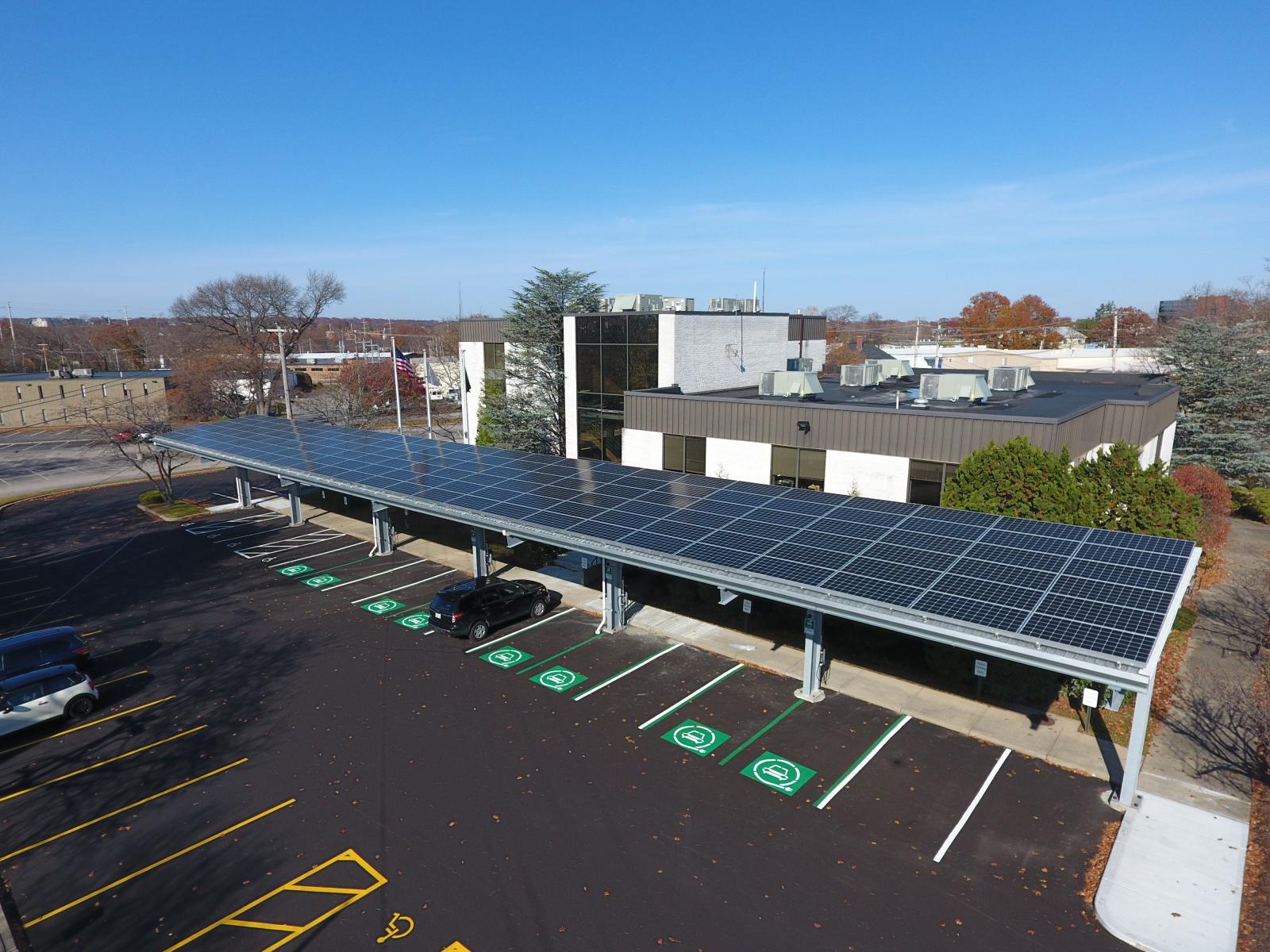
Commercial properties typically have two major sun-exposed assets: rooftops and parking areas. For many years, solar development focused primarily on rooftops because they were simpler and less expensive to engineer.
In recent years, solar carports have become a more widely considered option for commercial sites with large parking areas. This shift is driven by improvements in solar economics, stronger federal incentives for commercial systems, and increased demand for EV charging infrastructure at workplaces, retail centers, and institutions.
This guide explains what solar carports are, how they work, typical costs, engineering requirements, energy production, and when they may be a good fit compared to rooftop solar.
What Is a Solar Carport?
A solar carport is a parking structure designed to support solar panels as its roof system. Instead of mounting panels on an existing building, the system is built over parking spaces using a dedicated steel structure and foundation.
Vehicles park underneath while the system generates electricity that can be used on-site or exported to the grid depending on system design and utility interconnection agreements.
Unlike rooftop solar, carports are standalone structures. They typically require:
Engineered steel framing
Concrete foundations or piers
Underground electrical infrastructure
Utility interconnection upgrades in some cases
Because of these structural requirements, carports generally involve higher upfront costs than rooftop systems, but they can also provide additional functionality such as shaded parking and EV charging readiness.
How Solar Carports Work
From an energy perspective, solar carports operate in the same way as rooftop solar systems.
Solar panels mounted on the canopy convert sunlight into direct current (DC) electricity. Inverters convert this electricity into alternating current (AC), which is then used on-site or exported to the grid.
The main system components include:
Solar panels (modules)
Inverters (string or microinverters)
Mounting structure and steel canopy
Electrical wiring and conduit
Monitoring systems for performance tracking
Energy Production from Solar Carports
Solar carports generate electricity at similar rates to rooftop solar because they use the same photovoltaic technology.
Typical U.S. production estimates range from:
1,200 to 1,500 kWh per kW per year
Example Production Estimates
100 kW system → 120,000–150,000 kWh/year
500 kW system → 600,000–750,000 kWh/year
1 MW system → 1.2–1.5 million kWh/year
In some cases, carports may produce slightly more consistent output than rooftop systems because parking lots often allow for more optimal panel orientation and fewer shading obstructions.
Solar Carports vs Rooftop Solar
Both systems can be effective depending on site conditions.
Rooftop solar may be more suitable when:
The roof is structurally sound and relatively new
There is minimal shading
There is sufficient available roof area
Lower upfront cost is a priority
Solar carports may be more suitable when:
Parking areas are large and underutilized
Roof space is limited or already in use
The roof requires replacement in the near future
EV charging infrastructure is being planned
Covered parking adds value for tenants or customers
Combined systems
Many commercial properties use both rooftop and carport solar to maximize total site generation capacity.
EV Charging Integration
Solar carports are frequently paired with EV charging infrastructure because both systems share electrical and civil components.
Key advantages include:
Shared trenching and conduit installation
Reduced duplication of electrical infrastructure
Alignment of solar generation with daytime charging demand
Improved site readiness for future EV adoption
When planned together, solar and EV infrastructure can often be designed more efficiently than when installed separately.
Maintenance and System Lifespan
Commercial solar carports are generally designed for long-term operation.
Typical lifespan:
Structural system: 25–30+ years
Solar panels: ~25-year performance warranty
Inverters: 10–15 years (replacement expected once during system life)
Routine maintenance may include:
Periodic visual inspections
Electrical system checks
Occasional panel cleaning depending on environment
Structural inspections at scheduled intervals
Overall maintenance requirements are generally low compared to many other commercial building systems.
When Solar Carports May Be a Good Fit
Solar carports are typically most relevant for:
Commercial properties with large parking lots
Facilities with significant daytime electricity use
Sites with limited or unsuitable rooftop space
Organizations planning EV charging infrastructure
Long-term property owners seeking asset improvement strategies
Frequently Asked Questions
How long do solar carports last?
Structural systems typically last 25–30 years, with solar panels designed for long-term performance over similar timeframes.
Do solar carports qualify for incentives?
Commercial solar carports may qualify for federal incentives such as the Investment Tax Credit (ITC), as well as applicable state and utility programs depending on location.
Can solar carports support EV charging?
Yes. Many systems are designed with EV charging infrastructure in mind, often sharing electrical and trenching components to improve installation efficiency.
Are solar carports more expensive than rooftop solar?
Yes, generally on a per-watt basis, due to additional structural and civil engineering requirements. However, they may provide additional functional and site-level benefits depending on use case.
Final Note
Solar carports are one of several ways commercial properties can utilize available space for solar generation. Whether they are appropriate depends on site conditions, energy goals, infrastructure needs, and long-term planning considerations.
For many properties, they are most effective when evaluated alongside rooftop solar as part of a broader site energy strategy rather than as a standalone solution.
Let's Chat
Start your next project with Newport Renewables.
OUR SERVICES
Work with Newport Renewables
We do two things, and we do them at full scale: commercial solar across Rhode Island and ground-up custom homes built to perform. Here's where you fit.
Commercial solar for your property or business?
We design and install solar for commercial buildings, warehouses, and income properties across Rhode Island — sized to your actual load, your roof or land, and the incentives available right now. The goal isn't just panels on a roof; it's a system that pays for itself and keeps producing for decades.
→ See how commercial solar works
Building a new custom home?
We design and build custom homes with integrated zero-energy systems from the ground up. When every component — orientation, envelope, electrical capacity, HVAC, solar, storage — is planned together instead of bolted on later, you get a home that's built for long-term performance and value.
→ Learn about our zero-energy home builds
316 Columbia St • Wakefield, RI 02879 | 401.619.5906




Copyright © 2024 Newport Renewables. All Rights Reserved.
316 Columbia St • Wakefield, RI 02879 | 401.619.5906
Copyright © 2024 Newport Renewables. All Rights Reserved.
Solar Carports & Parking Canopies: The Complete Guide for Businesses
Commercial properties typically have two major sun-exposed assets: rooftops and parking areas. For many years, solar development focused primarily on rooftops because they were simpler and less expensive to engineer.
In recent years, solar carports have become a more widely considered option for commercial sites with large parking areas. This shift is driven by improvements in solar economics, stronger federal incentives for commercial systems, and increased demand for EV charging infrastructure at workplaces, retail centers, and institutions.
This guide explains what solar carports are, how they work, typical costs, engineering requirements, energy production, and when they may be a good fit compared to rooftop solar.
What Is a Solar Carport?
A solar carport is a parking structure designed to support solar panels as its roof system. Instead of mounting panels on an existing building, the system is built over parking spaces using a dedicated steel structure and foundation.
Vehicles park underneath while the system generates electricity that can be used on-site or exported to the grid depending on system design and utility interconnection agreements.
Unlike rooftop solar, carports are standalone structures. They typically require:
Engineered steel framing
Concrete foundations or piers
Underground electrical infrastructure
Utility interconnection upgrades in some cases
Because of these structural requirements, carports generally involve higher upfront costs than rooftop systems, but they can also provide additional functionality such as shaded parking and EV charging readiness.
How Solar Carports Work
From an energy perspective, solar carports operate in the same way as rooftop solar systems.
Solar panels mounted on the canopy convert sunlight into direct current (DC) electricity. Inverters convert this electricity into alternating current (AC), which is then used on-site or exported to the grid.
The main system components include:
Solar panels (modules)
Inverters (string or microinverters)
Mounting structure and steel canopy
Electrical wiring and conduit
Monitoring systems for performance tracking
Energy Production from Solar Carports
Solar carports generate electricity at similar rates to rooftop solar because they use the same photovoltaic technology.
Typical U.S. production estimates range from:
1,200 to 1,500 kWh per kW per year
Example Production Estimates
100 kW system → 120,000–150,000 kWh/year
500 kW system → 600,000–750,000 kWh/year
1 MW system → 1.2–1.5 million kWh/year
In some cases, carports may produce slightly more consistent output than rooftop systems because parking lots often allow for more optimal panel orientation and fewer shading obstructions.
Solar Carports vs Rooftop Solar
Both systems can be effective depending on site conditions.
Rooftop solar may be more suitable when:
The roof is structurally sound and relatively new
There is minimal shading
There is sufficient available roof area
Lower upfront cost is a priority
Solar carports may be more suitable when:
Parking areas are large and underutilized
Roof space is limited or already in use
The roof requires replacement in the near future
EV charging infrastructure is being planned
Covered parking adds value for tenants or customers
Combined systems
Many commercial properties use both rooftop and carport solar to maximize total site generation capacity.
EV Charging Integration
Solar carports are frequently paired with EV charging infrastructure because both systems share electrical and civil components.
Key advantages include:
Shared trenching and conduit installation
Reduced duplication of electrical infrastructure
Alignment of solar generation with daytime charging demand
Improved site readiness for future EV adoption
When planned together, solar and EV infrastructure can often be designed more efficiently than when installed separately.
Maintenance and System Lifespan
Commercial solar carports are generally designed for long-term operation.
Typical lifespan:
Structural system: 25–30+ years
Solar panels: ~25-year performance warranty
Inverters: 10–15 years (replacement expected once during system life)
Routine maintenance may include:
Periodic visual inspections
Electrical system checks
Occasional panel cleaning depending on environment
Structural inspections at scheduled intervals
Overall maintenance requirements are generally low compared to many other commercial building systems.
When Solar Carports May Be a Good Fit
Solar carports are typically most relevant for:
Commercial properties with large parking lots
Facilities with significant daytime electricity use
Sites with limited or unsuitable rooftop space
Organizations planning EV charging infrastructure
Long-term property owners seeking asset improvement strategies
Frequently Asked Questions
How long do solar carports last?
Structural systems typically last 25–30 years, with solar panels designed for long-term performance over similar timeframes.
Do solar carports qualify for incentives?
Commercial solar carports may qualify for federal incentives such as the Investment Tax Credit (ITC), as well as applicable state and utility programs depending on location.
Can solar carports support EV charging?
Yes. Many systems are designed with EV charging infrastructure in mind, often sharing electrical and trenching components to improve installation efficiency.
Are solar carports more expensive than rooftop solar?
Yes, generally on a per-watt basis, due to additional structural and civil engineering requirements. However, they may provide additional functional and site-level benefits depending on use case.
Final Note
Solar carports are one of several ways commercial properties can utilize available space for solar generation. Whether they are appropriate depends on site conditions, energy goals, infrastructure needs, and long-term planning considerations.
For many properties, they are most effective when evaluated alongside rooftop solar as part of a broader site energy strategy rather than as a standalone solution.
OUR SERVICES
Work with Newport Renewables
We do two things, and we do them at full scale: commercial solar across Rhode Island and ground-up custom homes built to perform. Here's where you fit.
Commercial solar for your property or business?
We design and install solar for commercial buildings, warehouses, and income properties across Rhode Island — sized to your actual load, your roof or land, and the incentives available right now. The goal isn't just panels on a roof; it's a system that pays for itself and keeps producing for decades.
→ See how commercial solar works
Building a new custom home?
We design and build custom homes with integrated zero-energy systems from the ground up. When every component — orientation, envelope, electrical capacity, HVAC, solar, storage — is planned together instead of bolted on later, you get a home that's built for long-term performance and value.
→ Learn about our zero-energy home builds
316 Columbia St • Wakefield, RI 02879 | 401.619.5906
Copyright © 2024 Newport Renewables. All Rights Reserved.

Solar Carports & Parking Canopies: The Complete Guide for Businesses
Commercial properties typically have two major sun-exposed assets: rooftops and parking areas. For many years, solar development focused primarily on rooftops because they were simpler and less expensive to engineer.
In recent years, solar carports have become a more widely considered option for commercial sites with large parking areas. This shift is driven by improvements in solar economics, stronger federal incentives for commercial systems, and increased demand for EV charging infrastructure at workplaces, retail centers, and institutions.
This guide explains what solar carports are, how they work, typical costs, engineering requirements, energy production, and when they may be a good fit compared to rooftop solar.
What Is a Solar Carport?
A solar carport is a parking structure designed to support solar panels as its roof system. Instead of mounting panels on an existing building, the system is built over parking spaces using a dedicated steel structure and foundation.
Vehicles park underneath while the system generates electricity that can be used on-site or exported to the grid depending on system design and utility interconnection agreements.
Unlike rooftop solar, carports are standalone structures. They typically require:
Engineered steel framing
Concrete foundations or piers
Underground electrical infrastructure
Utility interconnection upgrades in some cases
Because of these structural requirements, carports generally involve higher upfront costs than rooftop systems, but they can also provide additional functionality such as shaded parking and EV charging readiness.
How Solar Carports Work
From an energy perspective, solar carports operate in the same way as rooftop solar systems.
Solar panels mounted on the canopy convert sunlight into direct current (DC) electricity. Inverters convert this electricity into alternating current (AC), which is then used on-site or exported to the grid.
The main system components include:
Solar panels (modules)
Inverters (string or microinverters)
Mounting structure and steel canopy
Electrical wiring and conduit
Monitoring systems for performance tracking
Energy Production from Solar Carports
Solar carports generate electricity at similar rates to rooftop solar because they use the same photovoltaic technology.
Typical U.S. production estimates range from:
1,200 to 1,500 kWh per kW per year
Example Production Estimates
100 kW system → 120,000–150,000 kWh/year
500 kW system → 600,000–750,000 kWh/year
1 MW system → 1.2–1.5 million kWh/year
In some cases, carports may produce slightly more consistent output than rooftop systems because parking lots often allow for more optimal panel orientation and fewer shading obstructions.
Solar Carports vs Rooftop Solar
Both systems can be effective depending on site conditions.
Rooftop solar may be more suitable when:
The roof is structurally sound and relatively new
There is minimal shading
There is sufficient available roof area
Lower upfront cost is a priority
Solar carports may be more suitable when:
Parking areas are large and underutilized
Roof space is limited or already in use
The roof requires replacement in the near future
EV charging infrastructure is being planned
Covered parking adds value for tenants or customers
Combined systems
Many commercial properties use both rooftop and carport solar to maximize total site generation capacity.
EV Charging Integration
Solar carports are frequently paired with EV charging infrastructure because both systems share electrical and civil components.
Key advantages include:
Shared trenching and conduit installation
Reduced duplication of electrical infrastructure
Alignment of solar generation with daytime charging demand
Improved site readiness for future EV adoption
When planned together, solar and EV infrastructure can often be designed more efficiently than when installed separately.
Maintenance and System Lifespan
Commercial solar carports are generally designed for long-term operation.
Typical lifespan:
Structural system: 25–30+ years
Solar panels: ~25-year performance warranty
Inverters: 10–15 years (replacement expected once during system life)
Routine maintenance may include:
Periodic visual inspections
Electrical system checks
Occasional panel cleaning depending on environment
Structural inspections at scheduled intervals
Overall maintenance requirements are generally low compared to many other commercial building systems.
When Solar Carports May Be a Good Fit
Solar carports are typically most relevant for:
Commercial properties with large parking lots
Facilities with significant daytime electricity use
Sites with limited or unsuitable rooftop space
Organizations planning EV charging infrastructure
Long-term property owners seeking asset improvement strategies
Frequently Asked Questions
How long do solar carports last?
Structural systems typically last 25–30 years, with solar panels designed for long-term performance over similar timeframes.
Do solar carports qualify for incentives?
Commercial solar carports may qualify for federal incentives such as the Investment Tax Credit (ITC), as well as applicable state and utility programs depending on location.
Can solar carports support EV charging?
Yes. Many systems are designed with EV charging infrastructure in mind, often sharing electrical and trenching components to improve installation efficiency.
Are solar carports more expensive than rooftop solar?
Yes, generally on a per-watt basis, due to additional structural and civil engineering requirements. However, they may provide additional functional and site-level benefits depending on use case.
Final Note
Solar carports are one of several ways commercial properties can utilize available space for solar generation. Whether they are appropriate depends on site conditions, energy goals, infrastructure needs, and long-term planning considerations.
For many properties, they are most effective when evaluated alongside rooftop solar as part of a broader site energy strategy rather than as a standalone solution.
OUR SERVICES
Work with Newport Renewables
We do two things, and we do them at full scale: commercial solar across Rhode Island and ground-up custom homes built to perform. Here's where you fit.
Commercial solar for your property or business?
We design and install solar for commercial buildings, warehouses, and income properties across Rhode Island — sized to your actual load, your roof or land, and the incentives available right now. The goal isn't just panels on a roof; it's a system that pays for itself and keeps producing for decades.
→ See how commercial solar works
Building a new custom home?
We design and build custom homes with integrated zero-energy systems from the ground up. When every component — orientation, envelope, electrical capacity, HVAC, solar, storage — is planned together instead of bolted on later, you get a home that's built for long-term performance and value.
→ Learn about our zero-energy home builds
Let's Chat
Start your next project with Newport Renewables.
316 Columbia St • Wakefield, RI 02879 | 401.619.5906
Copyright © 2024 Newport Renewables. All Rights Reserved.
316 Columbia St • Wakefield, RI 02879 | 401.619.5906
Copyright © 2024 Newport Renewables. All Rights Reserved.