How Does Weather Affect Solar Panels? Snow, Clouds, Rain, and Heat.
The most common reason people hesitate on solar is weather. They live somewhere cloudy, or cold, or snowy, and they assume those conditions make solar a bad investment. It's one of the most widespread misconceptions in the industry — and one of the most easily disproven.
Germany is one of the top solar markets on the planet. It gets roughly as much sunlight as Alaska. The United Kingdom is installing solar at record pace. Seattle and Portland, the two cloudiest major cities in the United States, both rank among the top solar cities in the country. New England, which sees more overcast days than most of the continental U.S., has some of the fastest payback periods for solar anywhere.
Weather affects how much electricity solar panels produce on any given day. It almost never determines whether they work at all. Understanding the difference — and understanding exactly what each weather condition actually does — is what this article is about.
The One Thing Worth Understanding First
Solar panels run on light, not heat. This is the single most important and most misunderstood fact about how solar panels work.
Inside each panel are photovoltaic cells made from semiconductor material, usually silicon. When photons — the particles that make up light — strike those cells, they knock electrons loose. That movement of electrons is electricity. The process is called the photovoltaic effect, which is where the term "PV panel" comes from.
Notice what's not in that description: heat. Heat is not a power source for solar panels. It's actually the enemy of efficiency, as we'll cover shortly. A crisp, clear morning in January can produce more electricity than a sweltering July afternoon. This single fact reshapes how most people think about weather and solar.
Cloudy Days
Clouds reduce solar output. They don't eliminate it.
On a heavily overcast day, panels typically produce somewhere between 10% and 25% of their normal output — that's the range the National Renewable Energy Laboratory confirms for dense cloud cover. The European Commission's Joint Research Centre found the figure is often higher: even on heavily cloudy days, panels can still generate 25–40% of their potential output. The variation comes down to what kind of clouds are overhead. Thick, low-lying storm clouds cut output more aggressively than thin, high-altitude clouds that simply diffuse the light.
The reason panels still work at all under cloud cover is that they capture diffuse light — sunlight scattered in multiple directions as it passes through water droplets and atmospheric particles. Diffuse light lacks the intensity of direct sunlight, but it still carries photons. And photons still knock electrons loose.
There's also an effect that most people don't know about called the edge-of-cloud effect, sometimes called cloud lensing. When the sun sits just behind the edge of a passing cloud, the cloud's edge acts like a lens, briefly concentrating and intensifying the light hitting the panels. On partially cloudy days, this can temporarily push output above normal — a small burst of extra production as clouds pass by.
The practical implication: a solar system in Rhode Island is sized and designed for Rhode Island's actual weather patterns, cloudy days included. Installers don't assume every day is sunny. They account for local cloud cover, seasonal variation, and average annual sunlight hours when determining how many panels you need to meet your energy goals.
Rain
Rain works similarly to heavy clouds — panels keep producing, just at reduced levels. During a significant storm, output typically drops to around 10–20% of normal while the rain is actively falling.
But here's what most people overlook: rain is one of the best things that can happen to a solar installation.
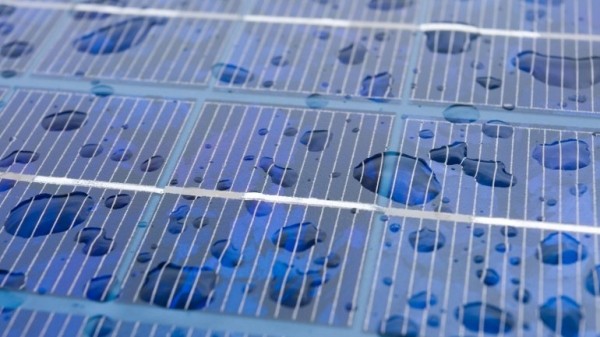
Panels accumulate dust, pollen, bird droppings, and general airborne grime over time. Each layer of buildup creates a thin barrier between the panel's glass surface and incoming sunlight, gradually reducing efficiency. Rain washes all of it off for free. After a good rainstorm, panels often perform slightly better than they did in the days before it — the rain effectively does the cleaning work that would otherwise require manual maintenance.
In dry climates or during long stretches without rain, this accumulation matters more. In New England, where rainfall is consistent year-round, it's largely a self-correcting problem.
Snow
Snow raises the question everyone in cold climates eventually asks, and the answer is more reassuring than most people expect.
A panel completely covered in thick snow will produce essentially no electricity. Light can't pass through a solid white blanket. But that blanket rarely lasts long.
Solar panels are dark, glass-surfaced, and installed at an angle. Snow melts at the contact point as soon as any sunlight reaches the panel surface — even indirect light generates a small amount of heat — and once the bottom edge starts to go, the rest slides off. It happens faster than it does on a typical roof shingle. And most residential and commercial systems are designed with tilt angles that accelerate exactly this process.
Panels are also structurally built for snow. Certified panels are rated to hold over 5,000 pascals of pressure — the equivalent of two to four feet of snow depending on its density. Snow load is not a structural concern with properly installed equipment.
There's also an upside that surprises most people: the albedo effect. Albedo is the scientific term for how reflective a surface is, and snow has very high albedo — it reflects a large percentage of incoming light rather than absorbing it. Snow on the ground around and below a solar array reflects additional light upward onto the panels, boosting output on clear winter days. A crisp winter morning after a fresh snowfall, with the panels clear and the ground covered in white, can actually be a strong production day.
The general advice from installers: let snow slide off on its own. Scraping panels risks scratching the glass, and the time savings rarely justify the risk. Ground-mounted systems where panels are easily accessible are the exception — a soft roof rake can speed things up safely.
Heat
This is the counterintuitive one. Hot weather actually reduces solar panel efficiency.
Every panel has what's called a temperature coefficient — a specification that describes how its output changes with temperature. Panels are rated under standard test conditions at exactly 25°C (77°F). Above that temperature, efficiency starts to drop. The typical temperature coefficient for a silicon panel is between −0.3% and −0.5% per degree Celsius above 25°C.
That sounds small. The effect accumulates quickly. On a hot summer day, the surface of a rooftop solar panel can reach 60°C or higher — even when the air temperature is only in the mid-80s Fahrenheit, because dark glass absorbs heat and the roof surface radiates it upward. At 60°C, a panel with a coefficient of −0.4% per degree has crossed 35 degrees above its rated temperature. That's roughly 14% less output than its rated capacity, purely from heat.
In cold conditions, the reverse is true. At 0°C, a panel may actually produce 5–7% more than its rated output. Cold temperatures reduce internal electrical resistance, which improves voltage and increases efficiency.
This is why professional installers leave a gap between the panel and the roof surface. It's not aesthetic — it's thermal management. That gap allows air to circulate underneath the panel, cooling it down and recovering some of the efficiency that heat would otherwise cost. It's also why a cold, clear, sunny day in March can outperform a hot, bright day in August.
Wind
Wind is mostly a structural consideration rather than an efficiency one, with one notable exception: moderate wind actively helps panels perform better.
Moving air cools the panel surface, recovering some of the heat-related efficiency loss described above. A breezy, sunny day is actually better for production than a still, sunny day at the same temperature.
Strong wind is where the structural engineering matters. Commercial and residential racking systems are designed for significant wind loads — proper installation accounts for local wind patterns and building codes require appropriate attachment methods. A well-installed system doesn't move in high wind; the panels and their racking are a single rigid unit anchored to the structure beneath them.
One secondary effect worth noting: wind carries dust and debris, which gradually coats panel surfaces over time. This is a slow, cumulative drag on efficiency — another reason why periodic cleaning and the natural assist from rainfall matters for long-term performance.
Hail and Severe Storms
Modern solar panels are engineered to take a beating.
The IEC 61215 standard — the international certification that virtually all commercially sold panels carry — requires panels to withstand 25mm (about one inch) diameter hailstones traveling at 51 miles per hour with no visible damage and less than 5% power loss. The U.S. Department of Energy confirms that all commercially available PV modules pass this baseline test. Panels with UL 61730 or IEC 61730 certification go further, having been tested to withstand hailstones between one and three inches in diameter traveling up to 88 miles per hour.
Direct lightning strikes to panels are rare. Inverters and modern electrical systems include surge protection that handles nearby strikes without damage to the panels themselves.
Homeowners and business owners who do experience storm damage have recourse: commercial property insurance typically covers solar arrays, and quality installers carry workmanship warranties that cover installation-related issues. The practical takeaway is that severe weather is not a reason to avoid solar — it's a reason to choose quality equipment and a reputable installer.
What This Means Across a Full Year
Any individual day's output — good or bad — is less meaningful than it might seem. Solar systems are designed around annual production targets, not daily performance.
A system in Providence and a system in Phoenix will both hit their projected annual output, because the Providence system was sized for Providence's weather: its cloudier winters, its moderate summers, its rain patterns, and its average peak sun hours. Every variable that matters gets factored into the system design before a single panel goes on the roof.
Net metering reinforces this. On a clear, high-production day, a commercial or residential system often generates more electricity than the building is using. That surplus flows back to the grid in exchange for credits. On a cloudy or low-production day, those credits offset whatever the building draws from the grid. The two balance out over the course of a month and a year.
Weather creates variation day to day. Properly designed solar systems are built to smooth that variation into consistent, predictable annual performance — and they have a 25-plus-year track record of doing exactly that.
The Short Answer
Every weather condition covered in this article — clouds, rain, snow, heat, wind, hail — affects how much electricity solar panels produce in the moment. None of them, including harsh winters, stop a well-designed system from meeting its annual goals.
The only condition that brings output to zero is complete darkness: a thick snow cover blocking all light, or nighttime. Everything else is a matter of degree, already accounted for in how your system is sized and designed.
Where you live matters less than most people assume. What matters more is the quality of the equipment, the competence of the installer, and whether the system was designed for your actual local conditions — not for some imagined ideal.
Sources
https://www.sepco-solarlighting.com/blog/can-solar-panels-still-generate-power-in-bad-weather
https://enact.solar/do-solar-panels-work-on-cloudy-or-rainy-days/
https://www.solarreviews.com/blog/do-solar-panels-work-on-cloudy-days-or-at-night
https://www.ecoflow.com/us/blog/what-temperature-do-solar-panels-lose-effectiveness
https://www.energysage.com/solar/solar-panel-temperature-overheating/
https://www.energy.gov/femp/hail-damage-mitigation-solar-photovoltaic-systems
Let's Chat
Start your next project with Newport Renewables.
OUR SERVICES
Work with Newport Renewables
We do two things, and we do them at full scale: commercial solar across Rhode Island and ground-up custom homes built to perform. Here's where you fit.
Commercial solar for your property or business?
We design and install solar for commercial buildings, warehouses, and income properties across Rhode Island — sized to your actual load, your roof or land, and the incentives available right now. The goal isn't just panels on a roof; it's a system that pays for itself and keeps producing for decades.
→ See how commercial solar works
Building a new custom home?
We design and build custom homes with integrated zero-energy systems from the ground up. When every component — orientation, envelope, electrical capacity, HVAC, solar, storage — is planned together instead of bolted on later, you get a home that's built for long-term performance and value.
→ Learn about our zero-energy home builds
316 Columbia St • Wakefield, RI 02879 | 401.619.5906




Copyright © 2024 Newport Renewables. All Rights Reserved.
316 Columbia St • Wakefield, RI 02879 | 401.619.5906
Copyright © 2024 Newport Renewables. All Rights Reserved.
How Does Weather Affect Solar Panels? Snow, Clouds, Rain, and Heat.
The most common reason people hesitate on solar is weather. They live somewhere cloudy, or cold, or snowy, and they assume those conditions make solar a bad investment. It's one of the most widespread misconceptions in the industry — and one of the most easily disproven.
Germany is one of the top solar markets on the planet. It gets roughly as much sunlight as Alaska. The United Kingdom is installing solar at record pace. Seattle and Portland, the two cloudiest major cities in the United States, both rank among the top solar cities in the country. New England, which sees more overcast days than most of the continental U.S., has some of the fastest payback periods for solar anywhere.
Weather affects how much electricity solar panels produce on any given day. It almost never determines whether they work at all. Understanding the difference — and understanding exactly what each weather condition actually does — is what this article is about.
The One Thing Worth Understanding First
Solar panels run on light, not heat. This is the single most important and most misunderstood fact about how solar panels work.
Inside each panel are photovoltaic cells made from semiconductor material, usually silicon. When photons — the particles that make up light — strike those cells, they knock electrons loose. That movement of electrons is electricity. The process is called the photovoltaic effect, which is where the term "PV panel" comes from.
Notice what's not in that description: heat. Heat is not a power source for solar panels. It's actually the enemy of efficiency, as we'll cover shortly. A crisp, clear morning in January can produce more electricity than a sweltering July afternoon. This single fact reshapes how most people think about weather and solar.
Cloudy Days
Clouds reduce solar output. They don't eliminate it.
On a heavily overcast day, panels typically produce somewhere between 10% and 25% of their normal output — that's the range the National Renewable Energy Laboratory confirms for dense cloud cover. The European Commission's Joint Research Centre found the figure is often higher: even on heavily cloudy days, panels can still generate 25–40% of their potential output. The variation comes down to what kind of clouds are overhead. Thick, low-lying storm clouds cut output more aggressively than thin, high-altitude clouds that simply diffuse the light.
The reason panels still work at all under cloud cover is that they capture diffuse light — sunlight scattered in multiple directions as it passes through water droplets and atmospheric particles. Diffuse light lacks the intensity of direct sunlight, but it still carries photons. And photons still knock electrons loose.
There's also an effect that most people don't know about called the edge-of-cloud effect, sometimes called cloud lensing. When the sun sits just behind the edge of a passing cloud, the cloud's edge acts like a lens, briefly concentrating and intensifying the light hitting the panels. On partially cloudy days, this can temporarily push output above normal — a small burst of extra production as clouds pass by.
The practical implication: a solar system in Rhode Island is sized and designed for Rhode Island's actual weather patterns, cloudy days included. Installers don't assume every day is sunny. They account for local cloud cover, seasonal variation, and average annual sunlight hours when determining how many panels you need to meet your energy goals.
Rain
Rain works similarly to heavy clouds — panels keep producing, just at reduced levels. During a significant storm, output typically drops to around 10–20% of normal while the rain is actively falling.
But here's what most people overlook: rain is one of the best things that can happen to a solar installation.
Panels accumulate dust, pollen, bird droppings, and general airborne grime over time. Each layer of buildup creates a thin barrier between the panel's glass surface and incoming sunlight, gradually reducing efficiency. Rain washes all of it off for free. After a good rainstorm, panels often perform slightly better than they did in the days before it — the rain effectively does the cleaning work that would otherwise require manual maintenance.
In dry climates or during long stretches without rain, this accumulation matters more. In New England, where rainfall is consistent year-round, it's largely a self-correcting problem.
Snow
Snow raises the question everyone in cold climates eventually asks, and the answer is more reassuring than most people expect.
A panel completely covered in thick snow will produce essentially no electricity. Light can't pass through a solid white blanket. But that blanket rarely lasts long.
Solar panels are dark, glass-surfaced, and installed at an angle. Snow melts at the contact point as soon as any sunlight reaches the panel surface — even indirect light generates a small amount of heat — and once the bottom edge starts to go, the rest slides off. It happens faster than it does on a typical roof shingle. And most residential and commercial systems are designed with tilt angles that accelerate exactly this process.
Panels are also structurally built for snow. Certified panels are rated to hold over 5,000 pascals of pressure — the equivalent of two to four feet of snow depending on its density. Snow load is not a structural concern with properly installed equipment.
There's also an upside that surprises most people: the albedo effect. Albedo is the scientific term for how reflective a surface is, and snow has very high albedo — it reflects a large percentage of incoming light rather than absorbing it. Snow on the ground around and below a solar array reflects additional light upward onto the panels, boosting output on clear winter days. A crisp winter morning after a fresh snowfall, with the panels clear and the ground covered in white, can actually be a strong production day.
The general advice from installers: let snow slide off on its own. Scraping panels risks scratching the glass, and the time savings rarely justify the risk. Ground-mounted systems where panels are easily accessible are the exception — a soft roof rake can speed things up safely.
Heat
This is the counterintuitive one. Hot weather actually reduces solar panel efficiency.
Every panel has what's called a temperature coefficient — a specification that describes how its output changes with temperature. Panels are rated under standard test conditions at exactly 25°C (77°F). Above that temperature, efficiency starts to drop. The typical temperature coefficient for a silicon panel is between −0.3% and −0.5% per degree Celsius above 25°C.
That sounds small. The effect accumulates quickly. On a hot summer day, the surface of a rooftop solar panel can reach 60°C or higher — even when the air temperature is only in the mid-80s Fahrenheit, because dark glass absorbs heat and the roof surface radiates it upward. At 60°C, a panel with a coefficient of −0.4% per degree has crossed 35 degrees above its rated temperature. That's roughly 14% less output than its rated capacity, purely from heat.
In cold conditions, the reverse is true. At 0°C, a panel may actually produce 5–7% more than its rated output. Cold temperatures reduce internal electrical resistance, which improves voltage and increases efficiency.
This is why professional installers leave a gap between the panel and the roof surface. It's not aesthetic — it's thermal management. That gap allows air to circulate underneath the panel, cooling it down and recovering some of the efficiency that heat would otherwise cost. It's also why a cold, clear, sunny day in March can outperform a hot, bright day in August.
Wind
Wind is mostly a structural consideration rather than an efficiency one, with one notable exception: moderate wind actively helps panels perform better.
Moving air cools the panel surface, recovering some of the heat-related efficiency loss described above. A breezy, sunny day is actually better for production than a still, sunny day at the same temperature.
Strong wind is where the structural engineering matters. Commercial and residential racking systems are designed for significant wind loads — proper installation accounts for local wind patterns and building codes require appropriate attachment methods. A well-installed system doesn't move in high wind; the panels and their racking are a single rigid unit anchored to the structure beneath them.
One secondary effect worth noting: wind carries dust and debris, which gradually coats panel surfaces over time. This is a slow, cumulative drag on efficiency — another reason why periodic cleaning and the natural assist from rainfall matters for long-term performance.
Hail and Severe Storms
Modern solar panels are engineered to take a beating.
The IEC 61215 standard — the international certification that virtually all commercially sold panels carry — requires panels to withstand 25mm (about one inch) diameter hailstones traveling at 51 miles per hour with no visible damage and less than 5% power loss. The U.S. Department of Energy confirms that all commercially available PV modules pass this baseline test. Panels with UL 61730 or IEC 61730 certification go further, having been tested to withstand hailstones between one and three inches in diameter traveling up to 88 miles per hour.
Direct lightning strikes to panels are rare. Inverters and modern electrical systems include surge protection that handles nearby strikes without damage to the panels themselves.
Homeowners and business owners who do experience storm damage have recourse: commercial property insurance typically covers solar arrays, and quality installers carry workmanship warranties that cover installation-related issues. The practical takeaway is that severe weather is not a reason to avoid solar — it's a reason to choose quality equipment and a reputable installer.
What This Means Across a Full Year
Any individual day's output — good or bad — is less meaningful than it might seem. Solar systems are designed around annual production targets, not daily performance.
A system in Providence and a system in Phoenix will both hit their projected annual output, because the Providence system was sized for Providence's weather: its cloudier winters, its moderate summers, its rain patterns, and its average peak sun hours. Every variable that matters gets factored into the system design before a single panel goes on the roof.
Net metering reinforces this. On a clear, high-production day, a commercial or residential system often generates more electricity than the building is using. That surplus flows back to the grid in exchange for credits. On a cloudy or low-production day, those credits offset whatever the building draws from the grid. The two balance out over the course of a month and a year.
Weather creates variation day to day. Properly designed solar systems are built to smooth that variation into consistent, predictable annual performance — and they have a 25-plus-year track record of doing exactly that.
The Short Answer
Every weather condition covered in this article — clouds, rain, snow, heat, wind, hail — affects how much electricity solar panels produce in the moment. None of them, including harsh winters, stop a well-designed system from meeting its annual goals.
The only condition that brings output to zero is complete darkness: a thick snow cover blocking all light, or nighttime. Everything else is a matter of degree, already accounted for in how your system is sized and designed.
Where you live matters less than most people assume. What matters more is the quality of the equipment, the competence of the installer, and whether the system was designed for your actual local conditions — not for some imagined ideal.
Sources
https://www.sepco-solarlighting.com/blog/can-solar-panels-still-generate-power-in-bad-weather
https://enact.solar/do-solar-panels-work-on-cloudy-or-rainy-days/
https://www.solarreviews.com/blog/do-solar-panels-work-on-cloudy-days-or-at-night
https://www.ecoflow.com/us/blog/what-temperature-do-solar-panels-lose-effectiveness
https://www.energysage.com/solar/solar-panel-temperature-overheating/
https://www.energy.gov/femp/hail-damage-mitigation-solar-photovoltaic-systems
OUR SERVICES
Work with Newport Renewables
We do two things, and we do them at full scale: commercial solar across Rhode Island and ground-up custom homes built to perform. Here's where you fit.
Commercial solar for your property or business?
We design and install solar for commercial buildings, warehouses, and income properties across Rhode Island — sized to your actual load, your roof or land, and the incentives available right now. The goal isn't just panels on a roof; it's a system that pays for itself and keeps producing for decades.
→ See how commercial solar works
Building a new custom home?
We design and build custom homes with integrated zero-energy systems from the ground up. When every component — orientation, envelope, electrical capacity, HVAC, solar, storage — is planned together instead of bolted on later, you get a home that's built for long-term performance and value.
→ Learn about our zero-energy home builds
316 Columbia St • Wakefield, RI 02879 | 401.619.5906
Copyright © 2024 Newport Renewables. All Rights Reserved.

How Does Weather Affect Solar Panels? Snow, Clouds, Rain, and Heat.
The most common reason people hesitate on solar is weather. They live somewhere cloudy, or cold, or snowy, and they assume those conditions make solar a bad investment. It's one of the most widespread misconceptions in the industry — and one of the most easily disproven.
Germany is one of the top solar markets on the planet. It gets roughly as much sunlight as Alaska. The United Kingdom is installing solar at record pace. Seattle and Portland, the two cloudiest major cities in the United States, both rank among the top solar cities in the country. New England, which sees more overcast days than most of the continental U.S., has some of the fastest payback periods for solar anywhere.
Weather affects how much electricity solar panels produce on any given day. It almost never determines whether they work at all. Understanding the difference — and understanding exactly what each weather condition actually does — is what this article is about.
The One Thing Worth Understanding First
Solar panels run on light, not heat. This is the single most important and most misunderstood fact about how solar panels work.
Inside each panel are photovoltaic cells made from semiconductor material, usually silicon. When photons — the particles that make up light — strike those cells, they knock electrons loose. That movement of electrons is electricity. The process is called the photovoltaic effect, which is where the term "PV panel" comes from.
Notice what's not in that description: heat. Heat is not a power source for solar panels. It's actually the enemy of efficiency, as we'll cover shortly. A crisp, clear morning in January can produce more electricity than a sweltering July afternoon. This single fact reshapes how most people think about weather and solar.
Cloudy Days
Clouds reduce solar output. They don't eliminate it.
On a heavily overcast day, panels typically produce somewhere between 10% and 25% of their normal output — that's the range the National Renewable Energy Laboratory confirms for dense cloud cover. The European Commission's Joint Research Centre found the figure is often higher: even on heavily cloudy days, panels can still generate 25–40% of their potential output. The variation comes down to what kind of clouds are overhead. Thick, low-lying storm clouds cut output more aggressively than thin, high-altitude clouds that simply diffuse the light.
The reason panels still work at all under cloud cover is that they capture diffuse light — sunlight scattered in multiple directions as it passes through water droplets and atmospheric particles. Diffuse light lacks the intensity of direct sunlight, but it still carries photons. And photons still knock electrons loose.
There's also an effect that most people don't know about called the edge-of-cloud effect, sometimes called cloud lensing. When the sun sits just behind the edge of a passing cloud, the cloud's edge acts like a lens, briefly concentrating and intensifying the light hitting the panels. On partially cloudy days, this can temporarily push output above normal — a small burst of extra production as clouds pass by.
The practical implication: a solar system in Rhode Island is sized and designed for Rhode Island's actual weather patterns, cloudy days included. Installers don't assume every day is sunny. They account for local cloud cover, seasonal variation, and average annual sunlight hours when determining how many panels you need to meet your energy goals.
Rain
Rain works similarly to heavy clouds — panels keep producing, just at reduced levels. During a significant storm, output typically drops to around 10–20% of normal while the rain is actively falling.
But here's what most people overlook: rain is one of the best things that can happen to a solar installation.
Panels accumulate dust, pollen, bird droppings, and general airborne grime over time. Each layer of buildup creates a thin barrier between the panel's glass surface and incoming sunlight, gradually reducing efficiency. Rain washes all of it off for free. After a good rainstorm, panels often perform slightly better than they did in the days before it — the rain effectively does the cleaning work that would otherwise require manual maintenance.
In dry climates or during long stretches without rain, this accumulation matters more. In New England, where rainfall is consistent year-round, it's largely a self-correcting problem.
Snow
Snow raises the question everyone in cold climates eventually asks, and the answer is more reassuring than most people expect.
A panel completely covered in thick snow will produce essentially no electricity. Light can't pass through a solid white blanket. But that blanket rarely lasts long.
Solar panels are dark, glass-surfaced, and installed at an angle. Snow melts at the contact point as soon as any sunlight reaches the panel surface — even indirect light generates a small amount of heat — and once the bottom edge starts to go, the rest slides off. It happens faster than it does on a typical roof shingle. And most residential and commercial systems are designed with tilt angles that accelerate exactly this process.
Panels are also structurally built for snow. Certified panels are rated to hold over 5,000 pascals of pressure — the equivalent of two to four feet of snow depending on its density. Snow load is not a structural concern with properly installed equipment.
There's also an upside that surprises most people: the albedo effect. Albedo is the scientific term for how reflective a surface is, and snow has very high albedo — it reflects a large percentage of incoming light rather than absorbing it. Snow on the ground around and below a solar array reflects additional light upward onto the panels, boosting output on clear winter days. A crisp winter morning after a fresh snowfall, with the panels clear and the ground covered in white, can actually be a strong production day.
The general advice from installers: let snow slide off on its own. Scraping panels risks scratching the glass, and the time savings rarely justify the risk. Ground-mounted systems where panels are easily accessible are the exception — a soft roof rake can speed things up safely.
Heat
This is the counterintuitive one. Hot weather actually reduces solar panel efficiency.
Every panel has what's called a temperature coefficient — a specification that describes how its output changes with temperature. Panels are rated under standard test conditions at exactly 25°C (77°F). Above that temperature, efficiency starts to drop. The typical temperature coefficient for a silicon panel is between −0.3% and −0.5% per degree Celsius above 25°C.
That sounds small. The effect accumulates quickly. On a hot summer day, the surface of a rooftop solar panel can reach 60°C or higher — even when the air temperature is only in the mid-80s Fahrenheit, because dark glass absorbs heat and the roof surface radiates it upward. At 60°C, a panel with a coefficient of −0.4% per degree has crossed 35 degrees above its rated temperature. That's roughly 14% less output than its rated capacity, purely from heat.
In cold conditions, the reverse is true. At 0°C, a panel may actually produce 5–7% more than its rated output. Cold temperatures reduce internal electrical resistance, which improves voltage and increases efficiency.
This is why professional installers leave a gap between the panel and the roof surface. It's not aesthetic — it's thermal management. That gap allows air to circulate underneath the panel, cooling it down and recovering some of the efficiency that heat would otherwise cost. It's also why a cold, clear, sunny day in March can outperform a hot, bright day in August.
Wind
Wind is mostly a structural consideration rather than an efficiency one, with one notable exception: moderate wind actively helps panels perform better.
Moving air cools the panel surface, recovering some of the heat-related efficiency loss described above. A breezy, sunny day is actually better for production than a still, sunny day at the same temperature.
Strong wind is where the structural engineering matters. Commercial and residential racking systems are designed for significant wind loads — proper installation accounts for local wind patterns and building codes require appropriate attachment methods. A well-installed system doesn't move in high wind; the panels and their racking are a single rigid unit anchored to the structure beneath them.
One secondary effect worth noting: wind carries dust and debris, which gradually coats panel surfaces over time. This is a slow, cumulative drag on efficiency — another reason why periodic cleaning and the natural assist from rainfall matters for long-term performance.
Hail and Severe Storms
Modern solar panels are engineered to take a beating.
The IEC 61215 standard — the international certification that virtually all commercially sold panels carry — requires panels to withstand 25mm (about one inch) diameter hailstones traveling at 51 miles per hour with no visible damage and less than 5% power loss. The U.S. Department of Energy confirms that all commercially available PV modules pass this baseline test. Panels with UL 61730 or IEC 61730 certification go further, having been tested to withstand hailstones between one and three inches in diameter traveling up to 88 miles per hour.
Direct lightning strikes to panels are rare. Inverters and modern electrical systems include surge protection that handles nearby strikes without damage to the panels themselves.
Homeowners and business owners who do experience storm damage have recourse: commercial property insurance typically covers solar arrays, and quality installers carry workmanship warranties that cover installation-related issues. The practical takeaway is that severe weather is not a reason to avoid solar — it's a reason to choose quality equipment and a reputable installer.
What This Means Across a Full Year
Any individual day's output — good or bad — is less meaningful than it might seem. Solar systems are designed around annual production targets, not daily performance.
A system in Providence and a system in Phoenix will both hit their projected annual output, because the Providence system was sized for Providence's weather: its cloudier winters, its moderate summers, its rain patterns, and its average peak sun hours. Every variable that matters gets factored into the system design before a single panel goes on the roof.
Net metering reinforces this. On a clear, high-production day, a commercial or residential system often generates more electricity than the building is using. That surplus flows back to the grid in exchange for credits. On a cloudy or low-production day, those credits offset whatever the building draws from the grid. The two balance out over the course of a month and a year.
Weather creates variation day to day. Properly designed solar systems are built to smooth that variation into consistent, predictable annual performance — and they have a 25-plus-year track record of doing exactly that.
The Short Answer
Every weather condition covered in this article — clouds, rain, snow, heat, wind, hail — affects how much electricity solar panels produce in the moment. None of them, including harsh winters, stop a well-designed system from meeting its annual goals.
The only condition that brings output to zero is complete darkness: a thick snow cover blocking all light, or nighttime. Everything else is a matter of degree, already accounted for in how your system is sized and designed.
Where you live matters less than most people assume. What matters more is the quality of the equipment, the competence of the installer, and whether the system was designed for your actual local conditions — not for some imagined ideal.
Sources
https://www.sepco-solarlighting.com/blog/can-solar-panels-still-generate-power-in-bad-weather
https://enact.solar/do-solar-panels-work-on-cloudy-or-rainy-days/
https://www.solarreviews.com/blog/do-solar-panels-work-on-cloudy-days-or-at-night
https://www.ecoflow.com/us/blog/what-temperature-do-solar-panels-lose-effectiveness
https://www.energysage.com/solar/solar-panel-temperature-overheating/
https://www.energy.gov/femp/hail-damage-mitigation-solar-photovoltaic-systems
OUR SERVICES
Work with Newport Renewables
We do two things, and we do them at full scale: commercial solar across Rhode Island and ground-up custom homes built to perform. Here's where you fit.
Commercial solar for your property or business?
We design and install solar for commercial buildings, warehouses, and income properties across Rhode Island — sized to your actual load, your roof or land, and the incentives available right now. The goal isn't just panels on a roof; it's a system that pays for itself and keeps producing for decades.
→ See how commercial solar works
Building a new custom home?
We design and build custom homes with integrated zero-energy systems from the ground up. When every component — orientation, envelope, electrical capacity, HVAC, solar, storage — is planned together instead of bolted on later, you get a home that's built for long-term performance and value.
→ Learn about our zero-energy home builds
Let's Chat
Start your next project with Newport Renewables.
316 Columbia St • Wakefield, RI 02879 | 401.619.5906
Copyright © 2024 Newport Renewables. All Rights Reserved.
316 Columbia St • Wakefield, RI 02879 | 401.619.5906
Copyright © 2024 Newport Renewables. All Rights Reserved.