Commercial Solar Tax Incentive Guide 2026: The 30% ITC, Bonus Adders & Depreciation Explained
Commercial electricity rates have risen significantly over the past several years nationally, and in high-cost regions like New England, the Mid-Atlantic, and California, businesses are paying well above the national average for power. Against that backdrop, the federal government offers a tax credit that directly offsets 30% of the cost of installing a commercial solar system. On a $500,000 installation, that's $150,000 back against your federal tax liability before a single kilowatt-hour is generated.
That credit is the starting point. On top of it sit bonus adders that can materially increase the effective federal credit rate depending on where your facility is located and what equipment is used. Underneath it sits accelerated depreciation treatment that can recover additional project cost through reduced taxable income. Layered over all of it are state-level programs that vary by location — performance payments, grants, tax exemptions, and utility incentives — that combine with the federal stack to bring the effective net cost of a commercial solar project well below what the sticker price suggests.
This guide walks through how each layer works, how they interact with each other, and what commercial property owners should understand when evaluating solar project economics.
What Is the Commercial Solar Investment Tax Credit?
The federal Investment Tax Credit — the ITC — is a dollar-for-dollar reduction in federal tax liability equal to a percentage of qualifying project costs. For commercial solar projects, the governing statute is Section 48E of the Internal Revenue Code, which applies to projects beginning construction after December 31, 2024.
The credit rate under Section 48E is 30% for projects that meet prevailing wage and apprenticeship requirements, meaning workers on the project are paid federally established wage rates and a portion of labor hours are performed by registered apprentices.
Many established commercial installers structure projects to satisfy prevailing wage and apprenticeship requirements from the outset, though compliance should always be verified during project planning and documentation.
What counts as a qualifying cost? Solar panels, inverters, racking hardware, wiring, installation labor, permitting fees, and battery storage systems of 3 kWh or larger generally qualify. The credit is calculated against the total eligible project cost — not just equipment.
The credit is claimed on IRS Form 3468 and flows through to Form 3800, the General Business Credit. For partnerships and S-corporations, the credit passes through to owners via Schedule K-1.
How the 30% Base Credit Works — With Real Numbers
The math on the base credit is straightforward. Take the total qualifying project cost and multiply by 30%. The result is a direct reduction in what you owe the federal government in the year the system is placed in service.
A $500,000 commercial rooftop system generates a $150,000 federal tax credit. A $1 million system generates $300,000. The credit scales directly with project size — there is no cap.
To claim it, the system generally must be:
Used in a trade or business or for-profit activity
Owned by the entity claiming the credit
Located in the United States
Placed in service during the tax year being claimed
Who can claim it: C-corporations, S-corporations, LLCs, partnerships, and sole proprietors with commercial property are generally eligible provided they have sufficient federal tax liability to absorb the credit.
The ITC is non-refundable. It reduces federal tax liability but does not generate a refund if liability is smaller than the credit amount. If the credit exceeds liability in a given year, unused credit may generally be carried forward for up to 20 years or carried back up to three years subject to applicable tax rules.
One structural note: the credit belongs to the system owner. If a solar system is leased rather than purchased outright, the leasing company or system owner typically claims the ITC. Ownership structure matters from the outset.
The Bonus Adders That Can Increase the Effective Credit Rate
The 30% base credit is often only the starting point. Section 48E includes several bonus credit adders that can materially increase the effective federal credit rate depending on project location, labor compliance, and equipment sourcing.
Certain projects may qualify for combined bonus credits materially above the 30% base rate, though eligibility, stacking rules, and program availability are highly project-specific.
Domestic Content Bonus (+10 Percentage Points)
Projects using qualifying US-manufactured steel, iron, and manufactured products may qualify for an additional 10 percentage points of credit value.
The threshold generally requires that all steel and iron used in the project is produced in the United States and that a specified percentage of manufactured product costs are attributable to US-manufactured components.
Not all equipment qualifies. Many solar modules and components are manufactured overseas and may not satisfy domestic content thresholds. Working with an installer who understands domestic content compliance and documentation requirements is important because IRS substantiation requirements apply when claiming the adder.
Energy Community Bonus (+10 Percentage Points)
Projects located in designated energy communities may qualify for an additional 10 percentage points of credit value.
The IRS defines several categories of qualifying energy communities, including certain brownfield sites, areas with significant fossil fuel employment history, and communities affected by coal mine or coal plant closures.
Qualifying census tracts exist across the country, including portions of the Northeast, Appalachia, the Rust Belt, and parts of the Gulf Coast. The Department of Energy maintains mapping tools businesses can use to evaluate whether a project location qualifies.
Low-Income Community Bonus
Certain projects serving low-income communities or qualifying populations may be eligible for additional bonus credits through separate federal allocation programs.
Eligibility for low-income community bonus credits is subject to annual allocation limits, application requirements, and evolving federal guidance. Because these programs are capacity-capped and project-specific, businesses should confirm eligibility assumptions before modeling them into project economics.
MACRS Depreciation — The Second Layer of Savings
The ITC receives most of the attention in commercial solar discussions. Depreciation is where another meaningful portion of project cost can potentially be recovered, and it is often underestimated during early project evaluation.
The IRS generally classifies commercial solar equipment as 5-year property under the Modified Accelerated Cost Recovery System — MACRS. This allows businesses to depreciate qualifying solar equipment over five years rather than over the full useful life of the system.
Compressing deductions into the early years of operation can materially improve project cash flow during the payback period.
The Basis Reduction Rule
Before calculating depreciation, the depreciable basis must generally be adjusted for the ITC.
The IRS requires businesses to reduce the depreciable basis by one-half of the tax credit claimed. If the ITC rate is 30%, the basis reduction equals 15% of total project cost, leaving 85% of the original project cost eligible for depreciation.
On a $1,000,000 system claiming the 30% ITC, the credit equals $300,000. The depreciable basis becomes $850,000 after applying the required basis reduction.
If bonus adders increase the effective credit rate, the basis reduction generally scales accordingly.
Federal bonus depreciation rules have changed significantly in recent years, and businesses should verify the current treatment at the time a project is placed in service.
Combined ITC + MACRS Recovery
When the ITC and MACRS are stacked, the combined federal benefit can materially reduce effective project cost. The exact economics depend on the depreciation rules in effect during the year the system is placed in service, the business's tax situation, and whether additional bonus depreciation treatment applies.
Over a full depreciation schedule, combined federal tax benefits can substantially improve project economics before state incentives, utility programs, or electricity savings are factored in.
Direct Pay — For Nonprofits, Schools, Municipalities, and Houses of Worship
Tax-exempt entities such as nonprofits, schools, municipalities, and tribal governments historically could not fully benefit from solar tax credits because they lacked federal income tax liability.
Direct Pay, introduced under the Inflation Reduction Act, changed that structure.
Direct Pay converts certain clean energy tax credits into direct payments from the IRS to qualifying tax-exempt entities. Rather than applying the credit against tax liability, qualifying organizations may receive a payment tied to the value of the credit.
Timing for Direct Pay reimbursements can vary depending on IRS processing and filing timelines.
Certain smaller projects may qualify for simplified compliance treatment under prevailing wage and apprenticeship rules, though Direct Pay eligibility itself depends on entity type and applicable IRS guidance rather than project size alone.
Depreciation benefits are generally not available to tax-exempt entities because depreciation offsets taxable income. This is one reason third-party ownership structures such as PPAs can sometimes make financial sense for nonprofits, schools, and municipalities.
How State Incentives Stack on Top
The federal incentives described above are available nationally. State incentives vary substantially and are often what separate a good solar project from an exceptional one financially.
Rhode Island
Rhode Island's Renewable Energy Growth (REG) program provides long-term performance-based payments tied to system production.
Ceiling rates under the REG program vary by project class, contract term, and annual program block, and should be verified against current Rhode Island Office of Energy Resources guidance at the time of project development.
Rhode Island also offers:
Sales tax exemptions on qualifying solar equipment
Property tax exemptions for qualifying installations
Renewable Energy Fund grant opportunities for certain projects
Combined with federal tax incentives and depreciation, Rhode Island commercial solar projects can achieve substantially reduced effective project costs depending on financing structure, incentive availability, and system performance assumptions.
Massachusetts
Massachusetts' SMART program provides production-based incentives that stack on top of federal incentives. The state also offers solar-related sales tax and property tax exemptions.
New Jersey
New Jersey's Successor Solar Incentive program provides long-term production incentives for qualifying commercial systems.
New York
NY-Sun offers commercial solar incentives that vary by utility territory, project type, and system size.
Because state programs change regularly, businesses should confirm current rates, availability, and eligibility before finalizing project economics.
How the Full Stack Looks on a Real Project
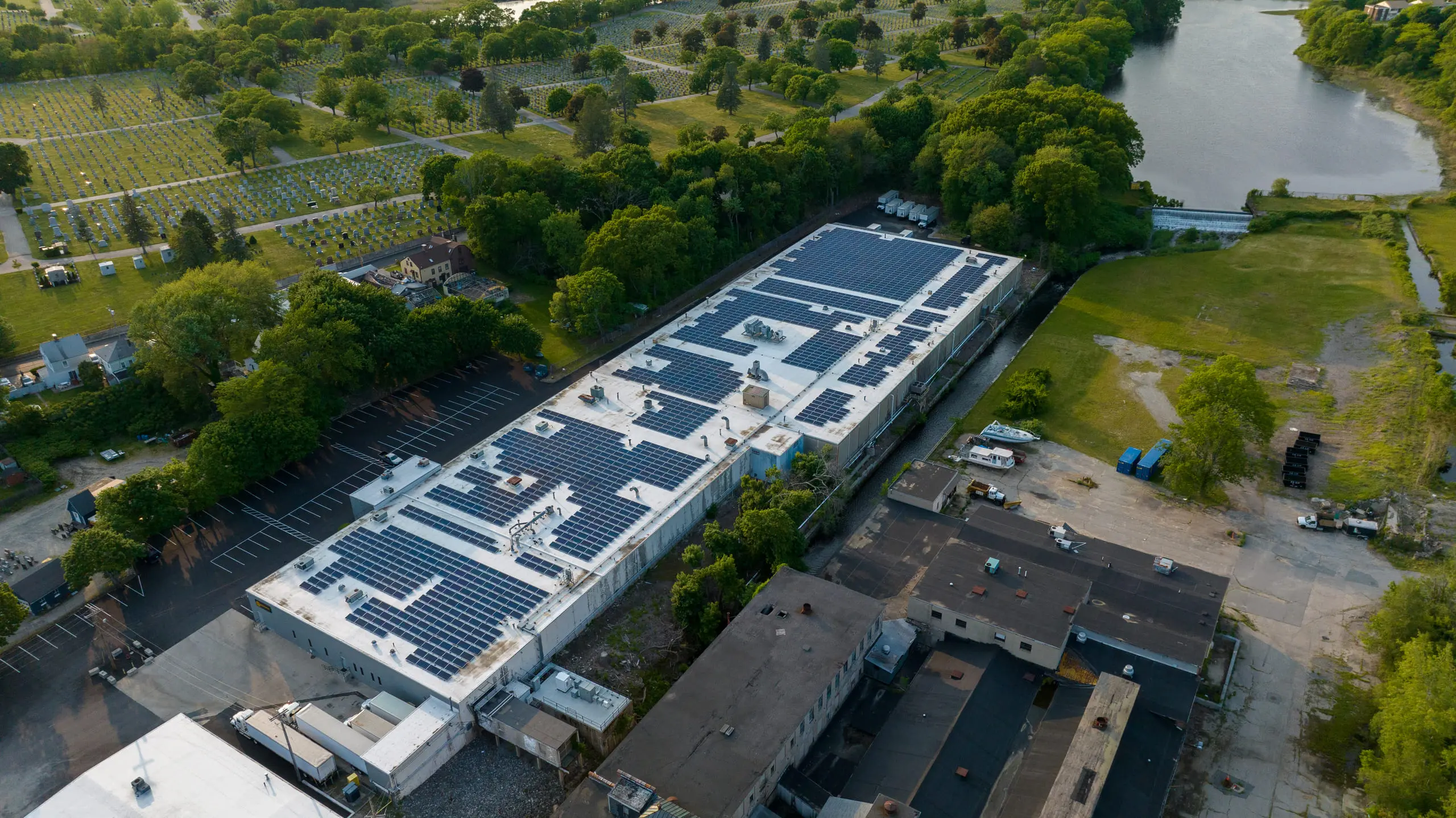
In 2024, Newport Renewables completed a 520 kW rooftop solar installation on a distribution warehouse in Providence, Rhode Island. The gross project cost was $1.33 million, but a stack of incentives significantly reshaped the economics. A 30% federal Investment Tax Credit reduced the cost, and additional value came from bonus depreciation, which allowed a 60% year-one write-off of qualifying equipment. On top of that, Rhode Island’s REGrowth Program provided performance-based payments over 10 years, further lowering the effective cost.
After accounting for these layers, the effective net cost dropped to approximately $766,000. Year-one electricity savings combined with REGrowth payments totaled about $142,000, producing a simple payback period of 5.4 years. Over a 25-year horizon, the project is projected to generate $2.98 million in net cash flow with an internal rate of return of 19.3%. While the federal incentives are broadly available to commercial property owners nationwide, the REGrowth payments are specific to Rhode Island. The example illustrates how multiple incentive layers, each valuable on its own, can combine to dramatically improve project economics.
Frequently Asked Questions
Is there a tax credit for commercial solar in 2026?
The federal commercial solar Investment Tax Credit remains available under current federal law for qualifying projects, though businesses should verify current eligibility timelines, phaseout schedules, and applicable Treasury guidance at the time a project begins construction.
What's the difference between the commercial and residential solar tax credit?
Commercial and residential solar incentives operate under different sections of the tax code and may follow different timelines, eligibility requirements, and ownership structures. Businesses and homeowners should verify current IRS guidance at the time of installation.
Can my LLC claim the solar tax credit?
LLCs, S-corporations, C-corporations, partnerships, and sole proprietors with qualifying commercial property may generally claim the ITC provided they own the system and satisfy applicable requirements.
What happens if my tax liability is less than the credit amount?
Unused credits may generally be carried forward subject to applicable IRS carry-forward rules.
Can I claim both the ITC and depreciation on the same system?
Yes, though the depreciable basis generally must be reduced by one-half of the ITC amount before calculating depreciation.
Can a nonprofit benefit from commercial solar tax incentives?
Yes. Certain tax-exempt entities may qualify for Direct Pay treatment under current federal rules.
Do solar batteries qualify for the ITC?
Battery storage systems meeting applicable IRS requirements may qualify when installed as part of a qualifying project.
How long do I need to keep the system to avoid recapture?
The primary recapture window is generally five years from the placed-in-service date.
Does the ITC apply in every state?
Yes. The federal ITC is a national federal incentive program available to qualifying commercial projects throughout the United States, though state-level incentives vary significantly by location.
Disclaimer
This article is provided for informational purposes only and does not constitute legal, tax, or accounting advice. Federal and state solar incentive programs evolve over time, and businesses should consult qualified tax, legal, and solar professionals regarding project-specific eligibility, documentation, and compliance requirements.
Sources
https://solarinfopath.com/irs-section-48-energy-credit-compliance/
https://greenridgesolar.com/macrs-depreciation-solar-energy-businesses-tax-savings/
https://www.paradisesolarenergy.com/blog/how-commercial-solar-panel-depreciation-works/
https://www.energysage.com/business-solutions/macrs-overview/
https://8msolar.com/what-is-bonus-depreciation-commercial-solar/
https://isaksensolar.com/renewable-energy-fund-ref-in-rhode-island/
https://nuwattenergy.com/en/rhode-island/solar-incentives-2026
Let's Chat
Start your next project with Newport Renewables.
OUR SERVICES
Work with Newport Renewables
We do two things, and we do them at full scale: commercial solar across Rhode Island and ground-up custom homes built to perform. Here's where you fit.
Commercial solar for your property or business?
We design and install solar for commercial buildings, warehouses, and income properties across Rhode Island — sized to your actual load, your roof or land, and the incentives available right now. The goal isn't just panels on a roof; it's a system that pays for itself and keeps producing for decades.
→ See how commercial solar works
Building a new custom home?
We design and build custom homes with integrated zero-energy systems from the ground up. When every component — orientation, envelope, electrical capacity, HVAC, solar, storage — is planned together instead of bolted on later, you get a home that's built for long-term performance and value.
→ Learn about our zero-energy home builds
316 Columbia St • Wakefield, RI 02879 | 401.619.5906




Copyright © 2024 Newport Renewables. All Rights Reserved.
316 Columbia St • Wakefield, RI 02879 | 401.619.5906
Copyright © 2024 Newport Renewables. All Rights Reserved.
Commercial Solar Tax Incentive Guide 2026: The 30% ITC, Bonus Adders & Depreciation Explained
Commercial electricity rates have risen significantly over the past several years nationally, and in high-cost regions like New England, the Mid-Atlantic, and California, businesses are paying well above the national average for power. Against that backdrop, the federal government offers a tax credit that directly offsets 30% of the cost of installing a commercial solar system. On a $500,000 installation, that's $150,000 back against your federal tax liability before a single kilowatt-hour is generated.
That credit is the starting point. On top of it sit bonus adders that can materially increase the effective federal credit rate depending on where your facility is located and what equipment is used. Underneath it sits accelerated depreciation treatment that can recover additional project cost through reduced taxable income. Layered over all of it are state-level programs that vary by location — performance payments, grants, tax exemptions, and utility incentives — that combine with the federal stack to bring the effective net cost of a commercial solar project well below what the sticker price suggests.
This guide walks through how each layer works, how they interact with each other, and what commercial property owners should understand when evaluating solar project economics.
What Is the Commercial Solar Investment Tax Credit?
The federal Investment Tax Credit — the ITC — is a dollar-for-dollar reduction in federal tax liability equal to a percentage of qualifying project costs. For commercial solar projects, the governing statute is Section 48E of the Internal Revenue Code, which applies to projects beginning construction after December 31, 2024.
The credit rate under Section 48E is 30% for projects that meet prevailing wage and apprenticeship requirements, meaning workers on the project are paid federally established wage rates and a portion of labor hours are performed by registered apprentices.
Many established commercial installers structure projects to satisfy prevailing wage and apprenticeship requirements from the outset, though compliance should always be verified during project planning and documentation.
What counts as a qualifying cost? Solar panels, inverters, racking hardware, wiring, installation labor, permitting fees, and battery storage systems of 3 kWh or larger generally qualify. The credit is calculated against the total eligible project cost — not just equipment.
The credit is claimed on IRS Form 3468 and flows through to Form 3800, the General Business Credit. For partnerships and S-corporations, the credit passes through to owners via Schedule K-1.
How the 30% Base Credit Works — With Real Numbers
The math on the base credit is straightforward. Take the total qualifying project cost and multiply by 30%. The result is a direct reduction in what you owe the federal government in the year the system is placed in service.
A $500,000 commercial rooftop system generates a $150,000 federal tax credit. A $1 million system generates $300,000. The credit scales directly with project size — there is no cap.
To claim it, the system generally must be:
Used in a trade or business or for-profit activity
Owned by the entity claiming the credit
Located in the United States
Placed in service during the tax year being claimed
Who can claim it: C-corporations, S-corporations, LLCs, partnerships, and sole proprietors with commercial property are generally eligible provided they have sufficient federal tax liability to absorb the credit.
The ITC is non-refundable. It reduces federal tax liability but does not generate a refund if liability is smaller than the credit amount. If the credit exceeds liability in a given year, unused credit may generally be carried forward for up to 20 years or carried back up to three years subject to applicable tax rules.
One structural note: the credit belongs to the system owner. If a solar system is leased rather than purchased outright, the leasing company or system owner typically claims the ITC. Ownership structure matters from the outset.
The Bonus Adders That Can Increase the Effective Credit Rate
The 30% base credit is often only the starting point. Section 48E includes several bonus credit adders that can materially increase the effective federal credit rate depending on project location, labor compliance, and equipment sourcing.
Certain projects may qualify for combined bonus credits materially above the 30% base rate, though eligibility, stacking rules, and program availability are highly project-specific.
Domestic Content Bonus (+10 Percentage Points)
Projects using qualifying US-manufactured steel, iron, and manufactured products may qualify for an additional 10 percentage points of credit value.
The threshold generally requires that all steel and iron used in the project is produced in the United States and that a specified percentage of manufactured product costs are attributable to US-manufactured components.
Not all equipment qualifies. Many solar modules and components are manufactured overseas and may not satisfy domestic content thresholds. Working with an installer who understands domestic content compliance and documentation requirements is important because IRS substantiation requirements apply when claiming the adder.
Energy Community Bonus (+10 Percentage Points)
Projects located in designated energy communities may qualify for an additional 10 percentage points of credit value.
The IRS defines several categories of qualifying energy communities, including certain brownfield sites, areas with significant fossil fuel employment history, and communities affected by coal mine or coal plant closures.
Qualifying census tracts exist across the country, including portions of the Northeast, Appalachia, the Rust Belt, and parts of the Gulf Coast. The Department of Energy maintains mapping tools businesses can use to evaluate whether a project location qualifies.
Low-Income Community Bonus
Certain projects serving low-income communities or qualifying populations may be eligible for additional bonus credits through separate federal allocation programs.
Eligibility for low-income community bonus credits is subject to annual allocation limits, application requirements, and evolving federal guidance. Because these programs are capacity-capped and project-specific, businesses should confirm eligibility assumptions before modeling them into project economics.
MACRS Depreciation — The Second Layer of Savings
The ITC receives most of the attention in commercial solar discussions. Depreciation is where another meaningful portion of project cost can potentially be recovered, and it is often underestimated during early project evaluation.
The IRS generally classifies commercial solar equipment as 5-year property under the Modified Accelerated Cost Recovery System — MACRS. This allows businesses to depreciate qualifying solar equipment over five years rather than over the full useful life of the system.
Compressing deductions into the early years of operation can materially improve project cash flow during the payback period.
The Basis Reduction Rule
Before calculating depreciation, the depreciable basis must generally be adjusted for the ITC.
The IRS requires businesses to reduce the depreciable basis by one-half of the tax credit claimed. If the ITC rate is 30%, the basis reduction equals 15% of total project cost, leaving 85% of the original project cost eligible for depreciation.
On a $1,000,000 system claiming the 30% ITC, the credit equals $300,000. The depreciable basis becomes $850,000 after applying the required basis reduction.
If bonus adders increase the effective credit rate, the basis reduction generally scales accordingly.
Federal bonus depreciation rules have changed significantly in recent years, and businesses should verify the current treatment at the time a project is placed in service.
Combined ITC + MACRS Recovery
When the ITC and MACRS are stacked, the combined federal benefit can materially reduce effective project cost. The exact economics depend on the depreciation rules in effect during the year the system is placed in service, the business's tax situation, and whether additional bonus depreciation treatment applies.
Over a full depreciation schedule, combined federal tax benefits can substantially improve project economics before state incentives, utility programs, or electricity savings are factored in.
Direct Pay — For Nonprofits, Schools, Municipalities, and Houses of Worship
Tax-exempt entities such as nonprofits, schools, municipalities, and tribal governments historically could not fully benefit from solar tax credits because they lacked federal income tax liability.
Direct Pay, introduced under the Inflation Reduction Act, changed that structure.
Direct Pay converts certain clean energy tax credits into direct payments from the IRS to qualifying tax-exempt entities. Rather than applying the credit against tax liability, qualifying organizations may receive a payment tied to the value of the credit.
Timing for Direct Pay reimbursements can vary depending on IRS processing and filing timelines.
Certain smaller projects may qualify for simplified compliance treatment under prevailing wage and apprenticeship rules, though Direct Pay eligibility itself depends on entity type and applicable IRS guidance rather than project size alone.
Depreciation benefits are generally not available to tax-exempt entities because depreciation offsets taxable income. This is one reason third-party ownership structures such as PPAs can sometimes make financial sense for nonprofits, schools, and municipalities.
How State Incentives Stack on Top
The federal incentives described above are available nationally. State incentives vary substantially and are often what separate a good solar project from an exceptional one financially.
Rhode Island
Rhode Island's Renewable Energy Growth (REG) program provides long-term performance-based payments tied to system production.
Ceiling rates under the REG program vary by project class, contract term, and annual program block, and should be verified against current Rhode Island Office of Energy Resources guidance at the time of project development.
Rhode Island also offers:
Sales tax exemptions on qualifying solar equipment
Property tax exemptions for qualifying installations
Renewable Energy Fund grant opportunities for certain projects
Combined with federal tax incentives and depreciation, Rhode Island commercial solar projects can achieve substantially reduced effective project costs depending on financing structure, incentive availability, and system performance assumptions.
Massachusetts
Massachusetts' SMART program provides production-based incentives that stack on top of federal incentives. The state also offers solar-related sales tax and property tax exemptions.
New Jersey
New Jersey's Successor Solar Incentive program provides long-term production incentives for qualifying commercial systems.
New York
NY-Sun offers commercial solar incentives that vary by utility territory, project type, and system size.
Because state programs change regularly, businesses should confirm current rates, availability, and eligibility before finalizing project economics.
How the Full Stack Looks on a Real Project
In 2024, Newport Renewables completed a 520 kW rooftop solar installation on a distribution warehouse in Providence, Rhode Island. The gross project cost was $1.33 million, but a stack of incentives significantly reshaped the economics. A 30% federal Investment Tax Credit reduced the cost, and additional value came from bonus depreciation, which allowed a 60% year-one write-off of qualifying equipment. On top of that, Rhode Island’s REGrowth Program provided performance-based payments over 10 years, further lowering the effective cost.
After accounting for these layers, the effective net cost dropped to approximately $766,000. Year-one electricity savings combined with REGrowth payments totaled about $142,000, producing a simple payback period of 5.4 years. Over a 25-year horizon, the project is projected to generate $2.98 million in net cash flow with an internal rate of return of 19.3%. While the federal incentives are broadly available to commercial property owners nationwide, the REGrowth payments are specific to Rhode Island. The example illustrates how multiple incentive layers, each valuable on its own, can combine to dramatically improve project economics.
Frequently Asked Questions
Is there a tax credit for commercial solar in 2026?
The federal commercial solar Investment Tax Credit remains available under current federal law for qualifying projects, though businesses should verify current eligibility timelines, phaseout schedules, and applicable Treasury guidance at the time a project begins construction.
What's the difference between the commercial and residential solar tax credit?
Commercial and residential solar incentives operate under different sections of the tax code and may follow different timelines, eligibility requirements, and ownership structures. Businesses and homeowners should verify current IRS guidance at the time of installation.
Can my LLC claim the solar tax credit?
LLCs, S-corporations, C-corporations, partnerships, and sole proprietors with qualifying commercial property may generally claim the ITC provided they own the system and satisfy applicable requirements.
What happens if my tax liability is less than the credit amount?
Unused credits may generally be carried forward subject to applicable IRS carry-forward rules.
Can I claim both the ITC and depreciation on the same system?
Yes, though the depreciable basis generally must be reduced by one-half of the ITC amount before calculating depreciation.
Can a nonprofit benefit from commercial solar tax incentives?
Yes. Certain tax-exempt entities may qualify for Direct Pay treatment under current federal rules.
Do solar batteries qualify for the ITC?
Battery storage systems meeting applicable IRS requirements may qualify when installed as part of a qualifying project.
How long do I need to keep the system to avoid recapture?
The primary recapture window is generally five years from the placed-in-service date.
Does the ITC apply in every state?
Yes. The federal ITC is a national federal incentive program available to qualifying commercial projects throughout the United States, though state-level incentives vary significantly by location.
Disclaimer
This article is provided for informational purposes only and does not constitute legal, tax, or accounting advice. Federal and state solar incentive programs evolve over time, and businesses should consult qualified tax, legal, and solar professionals regarding project-specific eligibility, documentation, and compliance requirements.
Sources
https://solarinfopath.com/irs-section-48-energy-credit-compliance/
https://greenridgesolar.com/macrs-depreciation-solar-energy-businesses-tax-savings/
https://www.paradisesolarenergy.com/blog/how-commercial-solar-panel-depreciation-works/
https://www.energysage.com/business-solutions/macrs-overview/
https://8msolar.com/what-is-bonus-depreciation-commercial-solar/
https://isaksensolar.com/renewable-energy-fund-ref-in-rhode-island/
https://nuwattenergy.com/en/rhode-island/solar-incentives-2026
OUR SERVICES
Work with Newport Renewables
We do two things, and we do them at full scale: commercial solar across Rhode Island and ground-up custom homes built to perform. Here's where you fit.
Commercial solar for your property or business?
We design and install solar for commercial buildings, warehouses, and income properties across Rhode Island — sized to your actual load, your roof or land, and the incentives available right now. The goal isn't just panels on a roof; it's a system that pays for itself and keeps producing for decades.
→ See how commercial solar works
Building a new custom home?
We design and build custom homes with integrated zero-energy systems from the ground up. When every component — orientation, envelope, electrical capacity, HVAC, solar, storage — is planned together instead of bolted on later, you get a home that's built for long-term performance and value.
→ Learn about our zero-energy home builds
316 Columbia St • Wakefield, RI 02879 | 401.619.5906
Copyright © 2024 Newport Renewables. All Rights Reserved.

Commercial Solar Tax Incentive Guide 2026: The 30% ITC, Bonus Adders & Depreciation Explained
Commercial electricity rates have risen significantly over the past several years nationally, and in high-cost regions like New England, the Mid-Atlantic, and California, businesses are paying well above the national average for power. Against that backdrop, the federal government offers a tax credit that directly offsets 30% of the cost of installing a commercial solar system. On a $500,000 installation, that's $150,000 back against your federal tax liability before a single kilowatt-hour is generated.
That credit is the starting point. On top of it sit bonus adders that can materially increase the effective federal credit rate depending on where your facility is located and what equipment is used. Underneath it sits accelerated depreciation treatment that can recover additional project cost through reduced taxable income. Layered over all of it are state-level programs that vary by location — performance payments, grants, tax exemptions, and utility incentives — that combine with the federal stack to bring the effective net cost of a commercial solar project well below what the sticker price suggests.
This guide walks through how each layer works, how they interact with each other, and what commercial property owners should understand when evaluating solar project economics.
What Is the Commercial Solar Investment Tax Credit?
The federal Investment Tax Credit — the ITC — is a dollar-for-dollar reduction in federal tax liability equal to a percentage of qualifying project costs. For commercial solar projects, the governing statute is Section 48E of the Internal Revenue Code, which applies to projects beginning construction after December 31, 2024.
The credit rate under Section 48E is 30% for projects that meet prevailing wage and apprenticeship requirements, meaning workers on the project are paid federally established wage rates and a portion of labor hours are performed by registered apprentices.
Many established commercial installers structure projects to satisfy prevailing wage and apprenticeship requirements from the outset, though compliance should always be verified during project planning and documentation.
What counts as a qualifying cost? Solar panels, inverters, racking hardware, wiring, installation labor, permitting fees, and battery storage systems of 3 kWh or larger generally qualify. The credit is calculated against the total eligible project cost — not just equipment.
The credit is claimed on IRS Form 3468 and flows through to Form 3800, the General Business Credit. For partnerships and S-corporations, the credit passes through to owners via Schedule K-1.
How the 30% Base Credit Works — With Real Numbers
The math on the base credit is straightforward. Take the total qualifying project cost and multiply by 30%. The result is a direct reduction in what you owe the federal government in the year the system is placed in service.
A $500,000 commercial rooftop system generates a $150,000 federal tax credit. A $1 million system generates $300,000. The credit scales directly with project size — there is no cap.
To claim it, the system generally must be:
Used in a trade or business or for-profit activity
Owned by the entity claiming the credit
Located in the United States
Placed in service during the tax year being claimed
Who can claim it: C-corporations, S-corporations, LLCs, partnerships, and sole proprietors with commercial property are generally eligible provided they have sufficient federal tax liability to absorb the credit.
The ITC is non-refundable. It reduces federal tax liability but does not generate a refund if liability is smaller than the credit amount. If the credit exceeds liability in a given year, unused credit may generally be carried forward for up to 20 years or carried back up to three years subject to applicable tax rules.
One structural note: the credit belongs to the system owner. If a solar system is leased rather than purchased outright, the leasing company or system owner typically claims the ITC. Ownership structure matters from the outset.
The Bonus Adders That Can Increase the Effective Credit Rate
The 30% base credit is often only the starting point. Section 48E includes several bonus credit adders that can materially increase the effective federal credit rate depending on project location, labor compliance, and equipment sourcing.
Certain projects may qualify for combined bonus credits materially above the 30% base rate, though eligibility, stacking rules, and program availability are highly project-specific.
Domestic Content Bonus (+10 Percentage Points)
Projects using qualifying US-manufactured steel, iron, and manufactured products may qualify for an additional 10 percentage points of credit value.
The threshold generally requires that all steel and iron used in the project is produced in the United States and that a specified percentage of manufactured product costs are attributable to US-manufactured components.
Not all equipment qualifies. Many solar modules and components are manufactured overseas and may not satisfy domestic content thresholds. Working with an installer who understands domestic content compliance and documentation requirements is important because IRS substantiation requirements apply when claiming the adder.
Energy Community Bonus (+10 Percentage Points)
Projects located in designated energy communities may qualify for an additional 10 percentage points of credit value.
The IRS defines several categories of qualifying energy communities, including certain brownfield sites, areas with significant fossil fuel employment history, and communities affected by coal mine or coal plant closures.
Qualifying census tracts exist across the country, including portions of the Northeast, Appalachia, the Rust Belt, and parts of the Gulf Coast. The Department of Energy maintains mapping tools businesses can use to evaluate whether a project location qualifies.
Low-Income Community Bonus
Certain projects serving low-income communities or qualifying populations may be eligible for additional bonus credits through separate federal allocation programs.
Eligibility for low-income community bonus credits is subject to annual allocation limits, application requirements, and evolving federal guidance. Because these programs are capacity-capped and project-specific, businesses should confirm eligibility assumptions before modeling them into project economics.
MACRS Depreciation — The Second Layer of Savings
The ITC receives most of the attention in commercial solar discussions. Depreciation is where another meaningful portion of project cost can potentially be recovered, and it is often underestimated during early project evaluation.
The IRS generally classifies commercial solar equipment as 5-year property under the Modified Accelerated Cost Recovery System — MACRS. This allows businesses to depreciate qualifying solar equipment over five years rather than over the full useful life of the system.
Compressing deductions into the early years of operation can materially improve project cash flow during the payback period.
The Basis Reduction Rule
Before calculating depreciation, the depreciable basis must generally be adjusted for the ITC.
The IRS requires businesses to reduce the depreciable basis by one-half of the tax credit claimed. If the ITC rate is 30%, the basis reduction equals 15% of total project cost, leaving 85% of the original project cost eligible for depreciation.
On a $1,000,000 system claiming the 30% ITC, the credit equals $300,000. The depreciable basis becomes $850,000 after applying the required basis reduction.
If bonus adders increase the effective credit rate, the basis reduction generally scales accordingly.
Federal bonus depreciation rules have changed significantly in recent years, and businesses should verify the current treatment at the time a project is placed in service.
Combined ITC + MACRS Recovery
When the ITC and MACRS are stacked, the combined federal benefit can materially reduce effective project cost. The exact economics depend on the depreciation rules in effect during the year the system is placed in service, the business's tax situation, and whether additional bonus depreciation treatment applies.
Over a full depreciation schedule, combined federal tax benefits can substantially improve project economics before state incentives, utility programs, or electricity savings are factored in.
Direct Pay — For Nonprofits, Schools, Municipalities, and Houses of Worship
Tax-exempt entities such as nonprofits, schools, municipalities, and tribal governments historically could not fully benefit from solar tax credits because they lacked federal income tax liability.
Direct Pay, introduced under the Inflation Reduction Act, changed that structure.
Direct Pay converts certain clean energy tax credits into direct payments from the IRS to qualifying tax-exempt entities. Rather than applying the credit against tax liability, qualifying organizations may receive a payment tied to the value of the credit.
Timing for Direct Pay reimbursements can vary depending on IRS processing and filing timelines.
Certain smaller projects may qualify for simplified compliance treatment under prevailing wage and apprenticeship rules, though Direct Pay eligibility itself depends on entity type and applicable IRS guidance rather than project size alone.
Depreciation benefits are generally not available to tax-exempt entities because depreciation offsets taxable income. This is one reason third-party ownership structures such as PPAs can sometimes make financial sense for nonprofits, schools, and municipalities.
How State Incentives Stack on Top
The federal incentives described above are available nationally. State incentives vary substantially and are often what separate a good solar project from an exceptional one financially.
Rhode Island
Rhode Island's Renewable Energy Growth (REG) program provides long-term performance-based payments tied to system production.
Ceiling rates under the REG program vary by project class, contract term, and annual program block, and should be verified against current Rhode Island Office of Energy Resources guidance at the time of project development.
Rhode Island also offers:
Sales tax exemptions on qualifying solar equipment
Property tax exemptions for qualifying installations
Renewable Energy Fund grant opportunities for certain projects
Combined with federal tax incentives and depreciation, Rhode Island commercial solar projects can achieve substantially reduced effective project costs depending on financing structure, incentive availability, and system performance assumptions.
Massachusetts
Massachusetts' SMART program provides production-based incentives that stack on top of federal incentives. The state also offers solar-related sales tax and property tax exemptions.
New Jersey
New Jersey's Successor Solar Incentive program provides long-term production incentives for qualifying commercial systems.
New York
NY-Sun offers commercial solar incentives that vary by utility territory, project type, and system size.
Because state programs change regularly, businesses should confirm current rates, availability, and eligibility before finalizing project economics.
How the Full Stack Looks on a Real Project
In 2024, Newport Renewables completed a 520 kW rooftop solar installation on a distribution warehouse in Providence, Rhode Island. The gross project cost was $1.33 million, but a stack of incentives significantly reshaped the economics. A 30% federal Investment Tax Credit reduced the cost, and additional value came from bonus depreciation, which allowed a 60% year-one write-off of qualifying equipment. On top of that, Rhode Island’s REGrowth Program provided performance-based payments over 10 years, further lowering the effective cost.
After accounting for these layers, the effective net cost dropped to approximately $766,000. Year-one electricity savings combined with REGrowth payments totaled about $142,000, producing a simple payback period of 5.4 years. Over a 25-year horizon, the project is projected to generate $2.98 million in net cash flow with an internal rate of return of 19.3%. While the federal incentives are broadly available to commercial property owners nationwide, the REGrowth payments are specific to Rhode Island. The example illustrates how multiple incentive layers, each valuable on its own, can combine to dramatically improve project economics.
Frequently Asked Questions
Is there a tax credit for commercial solar in 2026?
The federal commercial solar Investment Tax Credit remains available under current federal law for qualifying projects, though businesses should verify current eligibility timelines, phaseout schedules, and applicable Treasury guidance at the time a project begins construction.
What's the difference between the commercial and residential solar tax credit?
Commercial and residential solar incentives operate under different sections of the tax code and may follow different timelines, eligibility requirements, and ownership structures. Businesses and homeowners should verify current IRS guidance at the time of installation.
Can my LLC claim the solar tax credit?
LLCs, S-corporations, C-corporations, partnerships, and sole proprietors with qualifying commercial property may generally claim the ITC provided they own the system and satisfy applicable requirements.
What happens if my tax liability is less than the credit amount?
Unused credits may generally be carried forward subject to applicable IRS carry-forward rules.
Can I claim both the ITC and depreciation on the same system?
Yes, though the depreciable basis generally must be reduced by one-half of the ITC amount before calculating depreciation.
Can a nonprofit benefit from commercial solar tax incentives?
Yes. Certain tax-exempt entities may qualify for Direct Pay treatment under current federal rules.
Do solar batteries qualify for the ITC?
Battery storage systems meeting applicable IRS requirements may qualify when installed as part of a qualifying project.
How long do I need to keep the system to avoid recapture?
The primary recapture window is generally five years from the placed-in-service date.
Does the ITC apply in every state?
Yes. The federal ITC is a national federal incentive program available to qualifying commercial projects throughout the United States, though state-level incentives vary significantly by location.
Disclaimer
This article is provided for informational purposes only and does not constitute legal, tax, or accounting advice. Federal and state solar incentive programs evolve over time, and businesses should consult qualified tax, legal, and solar professionals regarding project-specific eligibility, documentation, and compliance requirements.
Sources
https://solarinfopath.com/irs-section-48-energy-credit-compliance/
https://greenridgesolar.com/macrs-depreciation-solar-energy-businesses-tax-savings/
https://www.paradisesolarenergy.com/blog/how-commercial-solar-panel-depreciation-works/
https://www.energysage.com/business-solutions/macrs-overview/
https://8msolar.com/what-is-bonus-depreciation-commercial-solar/
https://isaksensolar.com/renewable-energy-fund-ref-in-rhode-island/
https://nuwattenergy.com/en/rhode-island/solar-incentives-2026
OUR SERVICES
Work with Newport Renewables
We do two things, and we do them at full scale: commercial solar across Rhode Island and ground-up custom homes built to perform. Here's where you fit.
Commercial solar for your property or business?
We design and install solar for commercial buildings, warehouses, and income properties across Rhode Island — sized to your actual load, your roof or land, and the incentives available right now. The goal isn't just panels on a roof; it's a system that pays for itself and keeps producing for decades.
→ See how commercial solar works
Building a new custom home?
We design and build custom homes with integrated zero-energy systems from the ground up. When every component — orientation, envelope, electrical capacity, HVAC, solar, storage — is planned together instead of bolted on later, you get a home that's built for long-term performance and value.
→ Learn about our zero-energy home builds
Let's Chat
Start your next project with Newport Renewables.
316 Columbia St • Wakefield, RI 02879 | 401.619.5906
Copyright © 2024 Newport Renewables. All Rights Reserved.
316 Columbia St • Wakefield, RI 02879 | 401.619.5906
Copyright © 2024 Newport Renewables. All Rights Reserved.